
Research Arsenal Spotlight 50: William Walker 17th Illinois Infantry
William Walker was born in 1839 to William Hammer Walker and Ann (Harris) Walker of Mason City, Illinois. All of the letters in this collection were written to his brother, James, who worked as a physician.
William Walker enlisted in as a musician in the 17th Illinois Infantry on May 25, 1861. He served in company K, and his cousin, James Philander Walker, was its captain. The letters in this collection were written to William Walker’s brother, James A. Walker.
Departure for Missouri
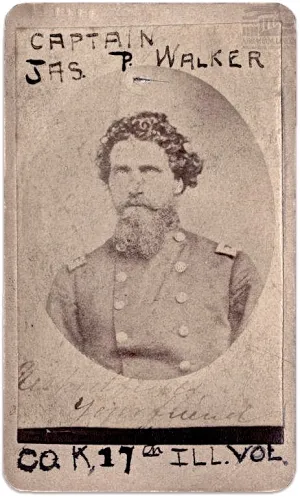
William Walker’s letters begin in Peoria, Illinois on May 16, 1861. At that time the regiment was still forming and he was getting acquainted with the life of a soldier. He was also interested in the upcoming election of officers and thought that his cousin, James Philander (J.P.) Walker might be elected major.
“There is lively times here now. There is ten companies here on the ground now — a full regiment. Companies are drilling all over the ground — some in uniform and some not. We are of the not kind. We will elect our regimental officers soon — perhaps today. There is a fair show for Capt. Ross of Fulton Co. for Colonel and some talk of J. P. [Walker] being our Major. I’ll tell you Jim, it’s no fun to be a soldier. There is a strict guard kept now of 100 men and if we bat our eye once, they tell us to halt — and if we repeat it, they call the officer of the guard — and if we do it again, they charge bayonet. Everybody is well, I believe. No very late news.”
On July 21, 1861, William Walker wrote about a train ride through Missouri, which the soldiers spent with their arms ready for any guerillas or bushwhackers that might attempt to attack the train.
“In the morning at 4 o’clock, we struck our tents and moved up in town and got on the cars and such a train I never saw in my life before. Two engines was hitched on and a third went on before to see that all was right and then with a shriek and a jerk and the Gallant 17th was thundering along through the Rebel country of Missouri. It was a ride full of interest. Our train was nearly 400 yards long and the soldiers all [ar]ranged along at an outward face with loaded guns grasped in our hands, peering in the dark woods as we passed looking for the bands of guerrillas that we heard was watching the road. But we was not molested although we saw one company of men in the woods but they fled in terror. It is said our regiment is the first Union band that has escaped being fired on as they passed this way. I guess there is truth in it for the sides of the cars had lots of fresh bullet holes in them.”
In Fredericktown, Missouri, William Walker and the 17th Illinois Infantry encountered the army of General John C. Frémont, which they were very glad to see as William described in a letter dated August 28, 1861.
“I ate breakfast and laid down in the tent and was soon buried in sleep but was soon aroused up by some of the boys. I went out to the land where nearly all the 17th was gathered and soon beheld the cause of all the noise my ears was nearly deafened with. It was part of Fremont’s army coming up. Oh Jim, it made us feel as only soldiers can feel. Here we had been for a week 30 miles from any Union troops and the sneaking citizens a hinting to us every day that the 17th [Illinois] Regiment would soon be no more — that [Gideon J.] Pillow & [William J.] Hardee would soon cut us to pieces. I tell you, Jim, when we heard the rolling of the drums and saw the head of one column coming through the woods from the direction of Pilot Knob with the old Star Spanged Banner proudly floating in the breeze, then we knew the camels were coming. First came Old Hecker’s Regiment [24th Illinois] — the terror of all evil doers, then the savage 17th [15th] Illinois and Buell’s Battery close behind. They passed on to their camping ground a little the other side of Frederick, then came the Iowa 2nd with M. M. Crocker (now Colonel) at their head mounted on a cream-colored horse. He presents a fine military appearance. The next was the Iowa 7th, then the 7th Illinois, Col. Curtis commanding. I seen an old Mason City Dickinson in their martial band beating a drum like blazes. Lastly came a company of cavalry 100 strong and the baggage wagons stretching out 2 or 3 miles.
They were about 6,000 strong. Their columns were nearly two hours passing our camp. They are now pitching their tents close by us. They will stay here a day or two and tomorrow we will go on as the advance guard. I do not know our destination.”
The 17th Illinois Infantry at the Battle of Fort Donelson
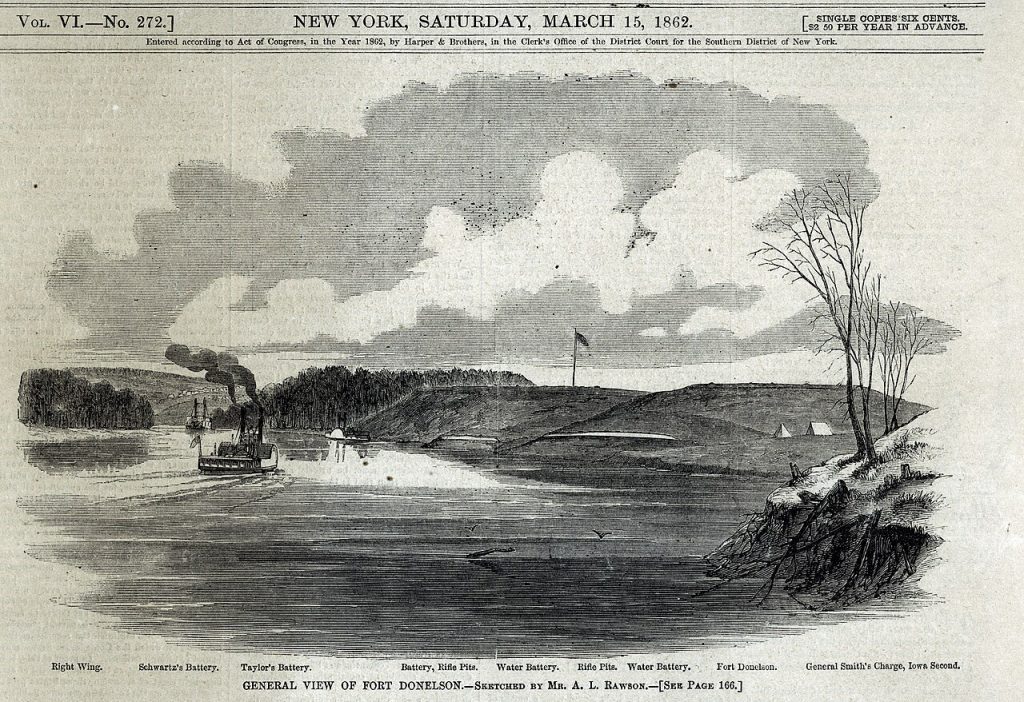
The Battle of Fort Donelson was fought from February 11-16, 1862. The Union victory brought General Ulysses S. Grant to national prominence as was the key to further Union advances in Tennessee. On February 20, 1862, William Walker wrote home to his brother about the battle and the role of the 17th Illinois Infantry in the fighting.
“I feel so full of enthusiasm that I must give vent to some of it by writing to you. I cannot give you much of an idea of the big battle in which we were engaged but it was terrible indeed. The enemy had once one hundred cannon playing at us for four days. I thought I had heard nearly all kinds of music but I never heard such music as was played over our heads around Fort Donelson.
Jim, you must not be startled when I tell you my idea of the loss. I speak of both sides. I wrote to Captain and told him I thought the loss on both sides would come up to three thousand. Since then I have been over the field and have heard lots of officers’ opinions in regard to it and I believe that on both sides in killed and wounded will exceed seven thousand. The loss on both sides are about the same. Perhaps the Federal loss was the heaviest. Just think of it. Last Wednesday we attacked the Fort, and this is Wednesday again and there are still poor soldiers laying on the battlefield unburied.
You may want to know how I like fighting. I will only say that I will follow the 17th [Illinois Infantry] to the gates of death but I am in hopes we may never get in such a place as we was last Thursday. Look a here, James, last Thursday 10 minutes after 2 o’clock P.M. until nearly 3 o’clock, we were within 100 yards of the enemy’s entrenchments with two field batteries playing on us all the time besides about 2,000 infantry. They rained a perfect storm of iron hail amongst all the time. Our regiment and the 49th Illinois stood the whole brunt without flinching till we was ordered to fall back under the hill. Almost every tree and bush was cut off and some of our boys was hurt by the falling timber. A bomb shell burst within two feet of [Andrew J.] Bruner and me and flew all over us and tore one man’s gun that was next to us all to pieces. How our company escaped so well, I don’t know without it was owing to our laying so close to the ground.”
William Walker also described some the celebration after the fort was capture as well as some of the souvenirs he took from the fort.
“This is a lovely place now. Our camp stretches for miles up and down the river. It was worth a lifetime to see the State of Illinois marching into Fort Donelson. Our bands came in playing Dixie and then covered it up with Yankee Doodle. The Rebels all had blankets made of fine Brussel’s carpet. They was fixed as well as I ever seen soldiers anywhere. If I had have had any way to have got them home, I could have got a great many things that I would have liked to have had. As it was, I only got a fine English rifled musket (shoots 900 yards) and a big knife of the Mississippi Butcher notoriety and a secesh blanket (having thrown mine away in the fight) and a canteen and some other little things home as mementoes.”
William Walker Serves as Cook
In the spring of 1862, William Walker came down with chronic diarrhea. He received a discharge for disability on April 24, 1862 and returned home. However, this was not the end of his service to the union cause. After some time recovering, he took a job as a civilian cook for the officers at the headquarters of the 85th Illinois Infantry. Like the 17th Illinois, the 85th Illinois Infantry had many soldiers from William Walker’s home town of Mason City. His cousin, James Philander Walker, was also the lieutenant colonel of the regiment.
On July 26, 1863, William Walker wrote from Nashville, Tennessee and described the difficult conditions in the south, especially regarding having adequate food.
“I went to Murfreesboro and just before starting back an old citizen came to me and asked me for a little salt that was left lying on the table where we had eaten our dinner. I told him he could have it as our people was not so badly spoilt as to be saving of salt. He said it cost them one dollar a pound. I told him it cost us two cents in America. Can Copperheads ask which side the war affects. I went in to prisons at Murfreesboro and I speak truth when I say that I saw no one that expressed a wish to fight us longer. The time draws near. The end approaches. The giant skeleton of starvation is stalking through the South with fearful strides. They know it. We see it on every hand. I pity the women and children. Nearly the last ear of corn is off the crib. The pig sty is empty. The men all gone (thousands will never come back), and the support of the Rebellion, the hope upon which all their affections were centered.”
After the war, William Walker married Margaret “Maggie” Montross in 1869. The couple later moved to Los Galos, California where William Walker worked as printer. He died on November 29, 1907.
We’d like to thank William Griffing of Spared & Shared for his work in transcribing and sharing these letters.
If you want to read more of William Walker’s letters, or access thousands of other Civil War letters and documents, sign up for a Research Arsenal membership.
Check out more about our recent featured collections, like Francis West of the 31st Wisconsin Infantry and Joseph Vaill of the 8th Connecticut Infantry.
