
Research Arsenal Spotlight 51: Henry Chandler Smith 1st New York Mounted Rifles
Henry Chandler Smith was born in 1838 to Chandler Smith and Electra Marie (Wilcox) Smith of Canaan, New York. His father, Chandler, died in 1861. Henry Chandler Smith enlisted in Company I of the 1st New York Mounted Rifles (also sometimes designated the 7th New York Cavalry) on August 18, 1862.
The 1st New York Mounted Rifles was first formed as a squadron with companies A and B in July, 1861. Companies C and D were mustered in during October, 1861, with further companies following. The final companies, which became I, K, L, and M, were mustered in during August and September of 1862, making over a year of difference between when the first companies mustered in and when the regiment reached full strength. This time difference proved to be very significant later on as will be shown in Henry Chandler Smith’s letters.
The 1st New York Mounted Rifles in Virginia
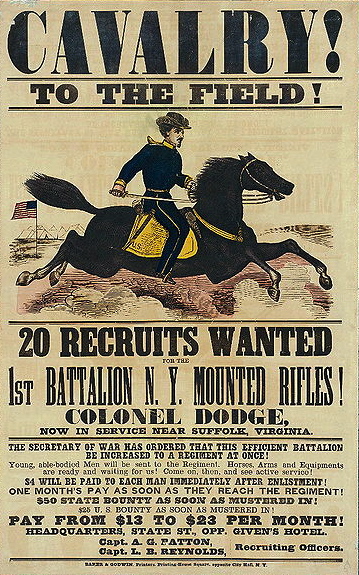
Henry Chandler Smith’s letters in our collection begin in 1863. Most are written to his sweetheart, Kate Gertrude Cooke, and to his sisters Isadore and Mary Branch “Branchie.” While in Suffolk, Virginia one June 26, 1863, he wrote about recovering from a recent illness and his belief that the 1st New York Mounted Rifles would soon be moving to Norfolk, Virginia.
“I am feeling first rate now and hope I shall not have any more sickness right away. Mother wanted to know if I bled at the lungs as I did before. Tell her that I did not but in other respects the attack was the same and was well again as soon as when at home though I often thought of Mother and wished she could be here for an hour or so.
We came from South Mills last Tuesday and have been very busy ever since. Suffolk is being evacuated and almost everything is already moved. We have got our things packed and are in readiness to move at any time. Most likely we shall be stationed at Norfolk but you may direct as usual till I send you word. Only be sure to direct in care of Capt. Fairgraves. I have received 2 letters and one paper this week that belonged to a man in Co. C just because his Captain’s name was not on it. It would have made you laugh to have seen the spelling in those letters.”
By the fall of 1863, the 1st New York Mounted Rifles had moved to Williamsburg, Virginia where they faced guerilla attacks, as Henry Chandler Smith detailed in a letter written October 25, 1863.
“There was a scouting party went out last Friday and in the night when they came back within sight of where I was on post a party of guerrillas fired on them and then ran for the woods. The same night three colored soldiers came in who were taken prisoners at the Battle of Winchester.”
On December 31, 1863, Henry Chandler Smith wrote about some rather devastating news for the men of his company and many of the others that had formed at the same time. When the men had enlisted, most believed that they would be serving a shorter term of a year and ten months to match when the older companies would muster out. However, the chaplain brought news that they had instead been enlisted for much longer.
“Our chaplain got back last Saturday and brought rather bad news to us from the War Department. There are not three men in the whole regiment but what were enlisted by Col. Dodge for the term of one year and ten months, and he pledged us his solemn word of honor as a soldier and gentleman that we should be mustered out with the old men but now he turns around and says that he remembers nothing about it so we shall have to stay eighteen months longer. The men were so outraged at being humbugged in this way that Col. Patton (who is now Lieut. Col.) went immediately to Gen. Butler’s Headquarters and under the circumstances got permission to reenlist us for three years or during the war and our time to commence from the first of January 1864. By reenlisting, we stand nearly as good a chance to get home as soon as though we remain as we are for no one can hardly think the war will last for two years longer. The bounties that we get now are the U.S., State, and N.Y. City bounties, amounting in all to nine hundred and fifty dollars. We get a furlough of not less than thirty-five days immediately after being mustered and if I join with the rest, shall be at home without fail in about twenty-five days. I have been humbugged so that I want to make everything sure before I go any further. Our chaplain says that anyone would be foolish in the extreme under the present circumstances who didn’t enlist.”
Henry Chandler Smith in 1864
In 1864 much of Henry Chandler Smith’s correspondence was with Kate Cooke and concerned their blossoming romance. On April 6, 1864, Henry Chandler Smith wrote about a recent dream he had about Kate.
“I don’t know but I ought to tell you what a pleasant dream I had not long ago when I imagined myself at home and while there I “escorted” you to a party and of course enjoyed it in the extreme. Kissed you (I dare not say how many times) and all of ladies present too, and then waked only to hear the disgusting reveille when all my fun was at an end.
Dearest Catharine, I am anxiously looking forward to a time when such imaginations will be realities yet I cannot nor must not be impatient but wait until our Heavenly Father wills it to be so. I know that my absence has made all of my friends a thousand times dearer to me than they were before and I am sure I never loved you before as I have since I have been in the army. I shall commence reading the bible with you next Sunday and hope it will be a great assistance to me as well as a pleasure. I have prayed for you very much lately and trust that we shall meet in the ‘Better Land’ if not on earth.”
Henry Chandler Smith was a religious man and he and Kate often read the same bible verses as a way to be close with each other even while separated many miles. In a letter dated April 18, 1864, Henry Chandler Smith wrote about how religion gave him strength.
“When I was reading the eighth chapter of Romans yesterday, I was very much affected by the precious promises that are found there. I think after all that there is nothing can make us half as happy as religion.”
On May 23, 1864, Henry Chandler Smith wrote from the Headquarters of the 10th Army Corps at Turkey Bend, Virginia where he was stationed quite close to Confederate troops.
“A telegraphic dispatch to General Butler says that General Meade & Lee are engaged again so I expect that we will soon make another move when there will doubtless be a desperate engagement too awful for any woman to witness and I pray that you, dearest, may never be obliged to be very near such times. The enemy’s forts are not over a quarter or half mile from ours and our pickets are not over six rods apart. I can now hear the whistle of the Richmond-Petersburg train so they must have the road repaired again. We have a large number of rifle cannon mounted so that we could throw shells beyond the Petersburg Railroad if we chose. I think that our artillerists could plant one of their guns near our house and after firing three shots, could burst every shell directly on the roof of your house. A week ago Saturday during the fight near the Halfway Hotel, the rebel sharpshooters occupied a large house and were doing fearful execution on our officers & men so a piece of artillery was ordered up and the first shot burst directly in the house and it was instantly in flames.”
Continued Duty in Virginia and North Carolina
On June 8, 1864, Henry Chandler Smith was at City Point, Virginia which was overall calmer than the previous places he had been, with only the occasional exchange of artillery fire.
“I have very pleasant & easy times here at Col. Plaisted’s when “all is quiet” and by the way, we have not been disturbed only once since Sunday afternoon. About the time when you & Jane were enjoying that pleasant walk, we had an artillery duel (if I may call it by that name). Yesterday the rebs chucked over a few solid shot and since then it has been entirely quiet.”
Just a few days later, Henry Chandler Smith wrote about ongoing preparations to attempt to capture the city of Petersburg, Virginia.
“General Grant arrived here yesterday and his army has been crossing the James on pontoons ever since. I suppose he means to get in the rear of Petersburg. Today we have heard heavy firing in that direction though it has been very [heavy] for several days.”
On July 24, 1864 Henry Chandler Smith wrote from somewhere near Point of Rocks, Virginia about a fatigue party that came under fire.
“There was very heavy firing at Petersburg last night lasting about two hours. I got up and could see a large part of the tragedy. I heard today that it was caused by a fatigue party of ours being sent out to throw up some earthworks.”
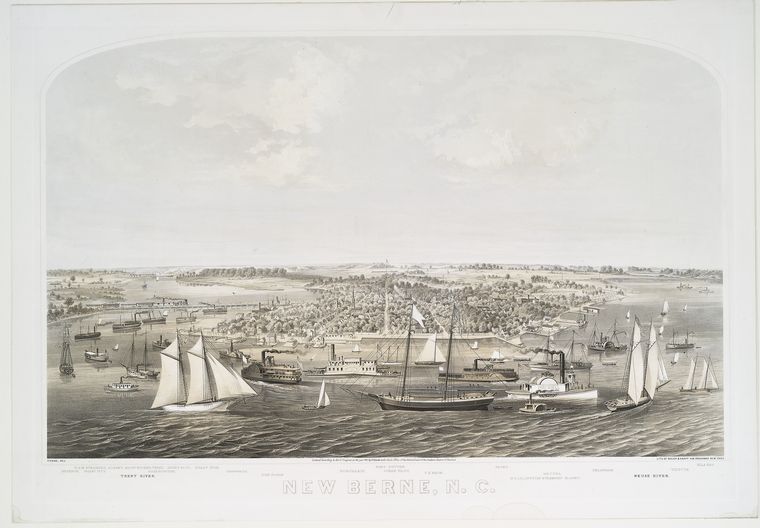
By November 13, 1864, Henry Chandler Smith was at New Bern, North Carolina and had fallen rather seriously ill. He wrote to his mother with an unusual amount of detail of his affliction.
“When I recovered from my last turn of chills, I was a going to write pretty often but no sooner that I recovered from the chills than a diarrhea took hold of me & has kept me down so weak that I have kept putting off writing in order to feel better. I am now nearly or quite as well as ever. The severest turn I have ever had for forty-eight hours I run to the sink as many times & the pain I underwent was almost beyond description. From Sunday night until the next Saturday I never took my clothes off. I could do nothing but run, run, run. It was the worst type of diarrhea, nothing passing my bowels but blood & slime. My bowels were so sore occasioned by the pain that it was with difficulty I could move. I had the good luck to be attended by Dr. Holcomb. He tried almost everything but with no effect. At last on yesterday he ordered an opium injection in fifteen minutes, I felt easier & in half an hours time I was entirely free from pain & did not have to go out again until this morning. I took another this morning & have felt first rate all day. It is seven in the evening.”
The final letter by Henry Chandler Smith in our collection was written on December 25, 1864 from Oak Grove Church, Virginia.
“We had a very good Christmas sermon this afternoon but it is astonishing how few of the great army take any interest in religion. I don’t suppose that on an average there is really over one religious man to seventy that are irreligious. Perhaps you will think this strange when so many good Christians (apparently) have joined the army. But as far as I have been able to observe, this is about the ratio to the whole army. Such is the degrading influence of war. I hope & pray, and more, I believe that it will end before next July. I would like to be in the service till it is ended and then I want my discharge forthwith.”
Henry Chandler Smith mustered out on June 12, 1865. On September 13, 1865 he married Catherine “Kate” Cooke. He died in 1882.
We’d like to give a special thanks to William Griffing of Spared & Shared for his work in transcribing and sharing these letters.
To read more of Henry Chandler Smith’s letters and access thousands of other Civil War letters and documents, sign up for a Research Arsenal membership.
If you enjoyed this article, check out some of our other featured collections like William Walker of the 17th Illinois Infantry and Francis West of the 31st Wisconsin Infantry.
