
Research Arsenal Spotlight 63: Josiah Osgood 24th Massachusetts Infantry
Josiah Osgood was born in 1842 to Hamilton Osgood and Adaline (Stevens) Osgood of Chelsea, Massachusetts. He enlisted as a corporal in Company C of the 24th Massachusetts Infantry in October, 1861. He later became the color guard of his company.
From Boston to Maryland
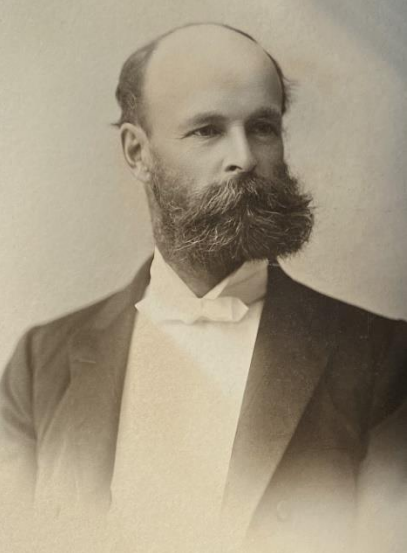
After his initial enlistment, Josiah Osgood spent some time waiting for the regiment to go south and join the war effort. His earliest letters are from Boston, Massachusetts. In one written on November 26, 1861 to his mother, he described his mess and company, both of which he had positive feelings toward. He also explained how the men passed the time while waiting to eventually be sent south.
“In our mess there is less profanity I think than in any other company in the regiment. The men like our captain very much. We may lose him if he takes the position of adjutant of the regiment. Marshall Kane, having a parole was prevented from leaving the fort (most on parole have only the liberty of the island). He probably intended the sentry on the wharf at which the boat stops recognized him and told the officer of the day. Said officer sung out and stopped the boat just as she was leaving the wharf. He has since been kept quite close. Last night, I understand, he was taken with the cholera. My opinion is that the man was little to be trusted, is confined.
Last night in our mess we made fifteen pans of molasses candy—anything to amuse ourselves with an evening. The Nantucket which is to bring a company here just passed. The captain of the boat sung out that they would be here at eleven o’clock this a.m.”
On December 26, 1861, Josiah Osgood wrote home about how the regiment spent Christmas. By this time they had been sent south to Annapolis, Maryland but had not yet participated in any fighting.
“Our Christmas Day we had what the sailors called duff—a very nice pudding. Also oysters (which here are very fine) for dinner. Several of Gen. Burnsides staff were with the colonel at dinner. Our adjutant has been attached to Gen. Burnside’s staff. Tell Mr. Monroe that our colonel is troubled by disorder in his throat.
Today a number of companies practiced in firing at a basket. Our regiment is winning a good name for its fine appearance when on review, and in drilling in the manual of arms. In the latter, the regiment has won great praise. Our band also has attained great attention. They nightly delight us by their beautiful music. If the men are ill-natured, music at once smooths over every rough feeling. Our privilege in hearing such a band as [Patrick] Gilmore’s is you can be assured felt to be very great.
Tomorrow our company practice at target shooting. I see the manual of arms is making their own cigars from the leaves taken from a neighboring plantation.”
Josiah Osgood and the Battle of New Bern
The Battle of New Bern took place on March 14, 1862 and resulted in Union forces taking control of the city for the remainder of the war. On March 23, 1862, Josiah Osgood wrote a letter describing his role in the battle and detailed a fellow color guard getting shot in the shoulder.
“On Thursday (13th) a.m. a landing was made some fifteen miles from New Bern. The 24th Regiment was in part of the first to land. The Colonel came first, then the colors with guard. I understand that General Burnside was the first to land having in his hand the colors of the 25th. It is of small importance at all event.
Our march—or rather half wade—was very tiresome. Clay predominated in the composition of the mud making a sticky, putty-like mud sometimes to the depth of ten and twelve inches. On our first day’s march, we passed through a rebel entrenchment of some length, not fortified. Here a halt was made at about one o’clock at noon. Our resting place, after a few more miles march, was a piece of swampy woods, which we afterwards found to be about one mile from a rebel entrenchment, well fortified and garrisoned, report says by ten thousand rebels. In our damp bed we slept soundly till morning, the rain merrily dripping on our rubber blankets.
An early march was made. The 24th was halted, then filed to the right into a field where we formed in line of battle. We then advanced a short distance into some woods before us. Just then a cannon shot came whiffing down the road we had just left, burying itself by the side of it. Soon firing was commenced by the 27th Massachusetts on our left. We now advanced to the edge of he woods in front of a clearing made by the rebels’ felling trees before their fortification. A bullet whipped between two of the color guard, burying itself with a strange “thud” in a fellow’s shoulder on my right. At the order, “Down!” the regiment dropped on their stomachs and firing commenced.
As you have probably heard ere this, the 24th did its duty. The men were, most of them, very cool, aiming for the artillery horses and gunners. The firing of the rebels was mostly done in volleys unlike the scattering and more destructive fire our own regiments. Ours was the victory after a charge over the muddy sides of the fortification. As we scrambled over the embankment, I could not help thinking of one of our old cats as she once tried almost in vain to go up a pile of coal. The 24th was subjected to a fire from other points—from the rebel battery in front, from one on our left (rebel), [and] also from our gunboats as our position was not known by the commanders of the boats until the 24th’s colors were planted on the rebel battery.
After a short rest, our march was resumed. We came to the banks of the river Trent late in the afternoon. Our men were very tired. The gunboat Delaware landed upon the New Bern side of the river as the fine bridge to the city was burnt by the rebels. The importance of our victory is great. Communication between Goldsboro and Beaufort is now cut off. Quite an enormous amount of ordnance stores, artillery, &c. are ours.”
The 24th Massachusetts Infantry remained camped at New Bern for several months, regularly going out on picket and sometimes engaging in small skirmishes against Confederate forces.
The 24th Massachusetts Infantry and the Battle of Tranter’s Creek
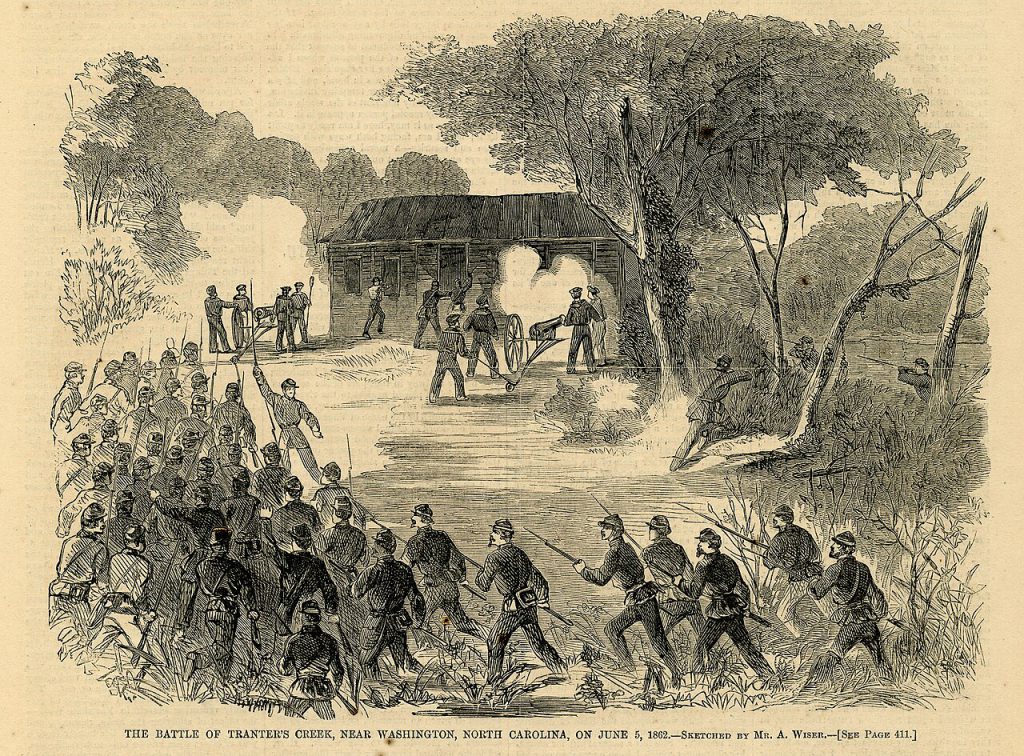
On June 6, 1862, Josiah Osgood wrote a quick letter detailing the Battle of Tranter’s Creek which had been fought one day previous as part of General Burnside’s North Carolina Expedition. He was so rushed that he included his signature midway through the letter before returning to add a few more sentences.
“We left at about eight. Companies C & D were left as guard for the city. After a very warm march through a beautiful country, our advance came up with the enemy some nine miles from Washington. Our artillery were rushed to the front, the gallant sailors unlimbered their guns directly in front of our concealed enemy and blazed away. Before the gun could be sponged, two sailors of the first gun dropped. The mail goes at once.
Some twelve wounded and killed is the result. Seven are dead. Our place was a most difficult one for a fight.
I am well, — Si
Some twelve of our enemy are thought to have been killed. One fellow’s head laid by the road side as we rushed on. The bridge over the creek where we fought was destroyed so we are unable to follow them in time for their capture. Of course we were completely successful. Lu [Lieutenant] Javele’s [Jarves] of Co. A, also the captain of same company are wounded. I again thank God for my preservation.
Tranter’s Mills Creek was the scene of our battle. Marched twenty miles that day.”
On June 8, 1862, Josiah Osgood wrote a more detailed account of the battle. He also included information he learned afterward, such as the death of Colonel George B. Singletary of the 44th North Carolina in the battle.
“Our advance company came up with the traitors only one fourth of a mile from her house. They were fired upon. A halt was made. The artillery ordered forward. The lieutenant of the cavalry came riding from the front and sung out, “We have scared up the game, boys!” The brave sailors gave a cheer, rushed forward, and unlimbered the gun directly in front of the enemy who were posted behind a mill or several of them and in trees beyond the stream.
Before the gun could be sponged, two fine fellows dropped. We then rushed forward down a small hill in the road and halted before the mills within one hundred yards of the enemy. The guns before us now blazed away, showering shell and canister among the trees in which the sharpshooters were placed and scattering death among the rebel ranks. Meanwhile we were ordered to lie down with the exception of Co. F as but one company could operate at a time and the bullets were whistling a little too thick and close for sport. One company was now ordered to the left of the road to fire over the river, each side of which was covered by a thick growth of timber. Not a man of the enemy could be seen by us except as they moved from some cover to get sight of us.
We fought forty minutes by Mr. Blake’s time. The traitors then gave a yell. Afore that, not a shot was fired from their side. We now went forward, found the first bridge destroyed, put up a temporary one and rushed on. About thirty yards from the first was another bridge; at the same distance another. The delay caused by the building of a bridge made us too late for a farther pursuit without the aid of cavalry and artillery, neither of which could be crossed over the slight board bridge. One rebel head lay near us. Also a dead whole rebel. The loss of the enemy has not been ascertained but must have been heavy as the appearance of the ground where they had been indicated. The earth around them was very bloody We hear by negroes who have come in since that the force of the traitors was from ten to fifteen hundred men but this seems too large. We have seven men killed including one sailor. Some eight are wounded.
We marched back to Washington [N. C.] after the wounded and killed were placed on carts. We got back at nine, pretty well drenched and tired. This movement was probably made to stop the picket shooting which has been so constant here. Their Colonel [George B. Singletary, 44th North Carolina] was killed we learn by a letter which came through our pickets to his brother in New York. He saw a man aiming at him and snatched a double gun from one of his men saying, ‘A man is aiming at me.’ At that moment, he fell dead—a shot having pierced his forehead.”
In November, 1862 Josiah Osgood was discharged from the 24th Massachusetts Infantry to accept a commission as an officer. He then served as captain of Company K in the 47th Massachusetts Infantry. After the war he moved to Michigan. He died in 1927.
We’d like to give a special thanks to William Griffing of Spared & Shared for his work in transcribing and sharing these letters.
To read more of Josiah Osgood’s letters and access thousands of other Civil War letters and documents, sign up for a Research Arsenal membership.
If you enjoyed this article, check out some of our other featured collections like Otis Whitney of the 27th Iowa Infantry and Constantine Hege of the 48th North Carolina Infantry.
