
Research Arsenal Spotlight 78: Mahlon Thatcher 40th Massachusetts Infantry
Mahlon Thatcher was born in 1821 to John and Charlotte Thatcher of Hunterdon County, New Jersey. He later moved to Boston and worked as a salesman. In 1850 he married Julia Wallace and the couple had three children together before Mahlon enlisted in the Union army on June 26, 1862.
Mahlon Thatcher joins the 40th Massachusetts Infantry
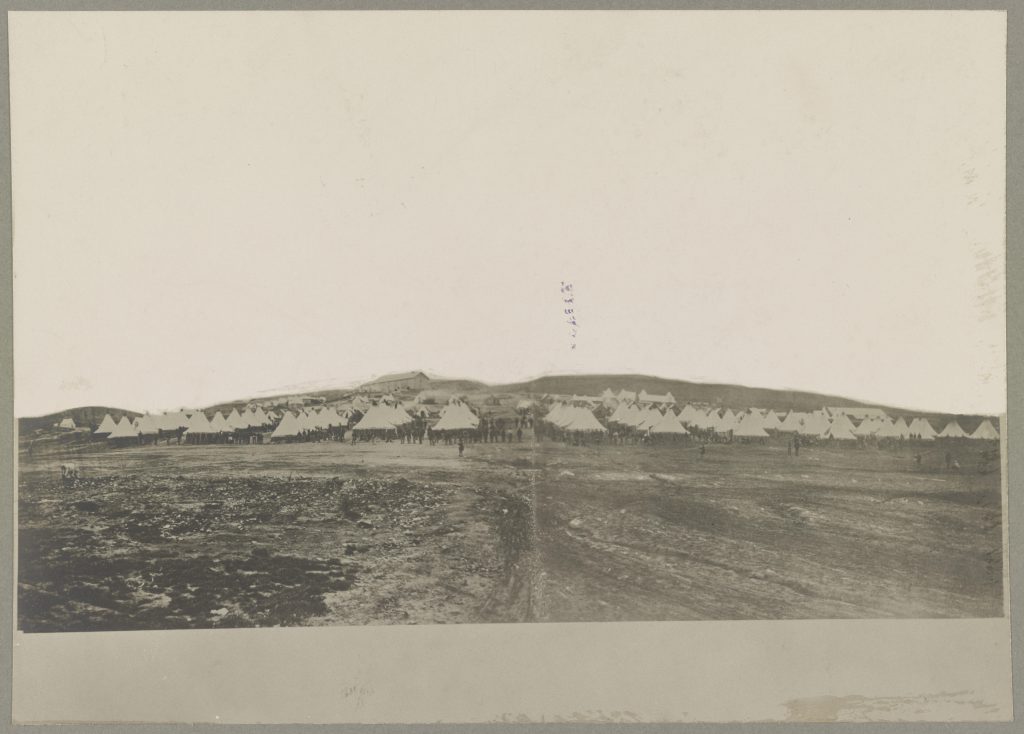
Though Mahlon Thatcher enlisted in late June, 1862, his path to the 40th Massachusetts Infantry was a complicated one. He first enlisted in the 32nd Massachusetts Infantry, was then transferred to the 35th Massachusetts, and then when the captain of his company in the 35th Massachusetts failed to get a commission, he was transferred again to Company B of the 40th Massachusetts Infantry. Fearing that the many transfers might lead to trouble with receiving his pay if something happened to him, Mahlon detailed the sequence in a letter to his wife written around September, 1862.
“Dear Julia, I wrote this to you so if it should be my sad fate to fall in the coming battles, you might know how much was coming to you from the government. I suppose you know that I enlisted and was mustered into the service of the United States on the twenty-sixth day of June, One thousand eight hundred and sixty-two by Captain John M. M. Goodhue, then the mustering-in officer of Boston. I enlisted for the Thirty-second regiment under Lieutenant Nat Wales who was afterwards promoted to Adjutant of the Thirty-fifth Regiment. So if there should be any trouble of getting my money, you can show them this letter. I was transferred to the Thirty-fifth Regiment by the order of Colonel H. Day, the military commandant of Massachusetts and the captain that I was transferred to did not get his commission. I was transferred to the Fortieth under Captain D[aniel] H. Johnson’s Company B.”
In November, 1862, the 40th Massachusetts Infantry was stationed at Miner’s Hill, Virginia, though there were many rumors that they would soon be sent elsewhere. In a letter written November 14, 1862, Mahlon Thatcher revealed his frustration at the politicians in the country and the persistent unfounded rumors.
“But I suppose that by this [time] you have heard that this regiment is going to Texas, but I do not believe it. If you but knew how much we believe or care for the stories that is flying round the camp, you would not be surprised at anything. And as for the movements of the army, we do not care one snap for, for I think that if they that is the men at the head of the government was to go to pandemonium—the council chamber of hell for dictators—they could not get any more damnable spirits of contention between the politicians and the speculators. The country is getting ruined as fast as it is possible for it to do, but I hope the time may come when the country may get right side up and this accursed war may be brought to a close. But Heaven only knows when that may be. Staying out here and moving one day one way and then another day back again has a great effect on the rebels we all think, but that seems to be all that we have all to do now-a-days; that and picketing, drilling, and guarding the camp seems to be the amount total of the good we are doing out here.”
As expected, the 40th Massachusetts Infantry did not go to Texas and remained in Virginia into the summer of 1863. On June 20, 1863 Mahlon Thatcher wrote about the difficult conditions in facing bushwhackers along the road to Richmond.
“As I wrote that we expected to march at any moment, in about an hour after mailing the letter to you the order came to get ready for a march with three days rations and by six o’clock in the afternoon we started. We marched for three hours and then halted for the night. In the morning we started on for a few hundred yards then commenced to throw out pickets and sentries on the road until the whole regiment was doing picket duties on the direct road to Richmond and forces lined the whole road for almost twenty miles in length doing picket duty and watching for bushwhackers and guerrillas and we take some almost every night, not without some cost to ourselves for there is seldom a day passes but some of our men is shot at their post and it is the worst of duties for you cannot see the enemy for they skulk in the bushes and lay still until they get a chance to fire on us in the place that our company is. The road runs right through the woods and it is very dark in the night. We have to guard the road so as to keep it open so our transportation can be kept up when our forces moves on as they say that there is a large force coming through this place for Richmond.”
Mahlan Thatcher in South Carolina
The 40th Massachusetts Infantry was sent to Folly Island, South Carolina in August, 1863. Around that time Mahlon Thatcher became seriously ill with bowel inflammation and was sent to the hospital. Others in the regiment were also sick, and the morale of the regiment was low. On September 20, 1863, he wrote:
“Dear Family, to see the camp of our regiment now, you would think instead of our being the same regiment that was at Miners Hill last winter all full of fun, that we was some body of men now to mourn over the fate of the country as after supper in the evening there is no singing or any fun at all. The men feels that they are all worn out—at least so it seems to me. I must stop now for this time as I am very tired and I must lie down.”
Later in the letter he added more about the condition of the regiment.
“Last evening at about eight o’clock there was another soldier died in our hospital. They are dropping off very fast and if they do not remove this division from this island, I think there may be many more soon go the same road from which no traveler ever returns. The whole truth of the fact is that this division was all worn out before it come to this place. It made all those that was able to do duty sick themselves and now the camps of the whole division looks more like a hospital than the defenders of their country. But so it is and we have to submit and I hope for my part that I will always try to bear the burthen without murmuring at the dispensation of Heaven or finding fault with the Rulers of our Country. May they always rule with wisdom and the fear of the Almighty God in their hearts.”
In early 1864, the 40th Massachusetts Infantry moved down to Jacksonville, Florida, and fought at the Battle of Olustee. Mahlon Thatcher detailed the fighting in a letter home and revealed that he was promoted to corporal for his good conduct during the fighting.
“My health is first rate and spirits is good although we have been in four fights since we arrived in the State of Florida. Three of them we was victorious and the last was a drawing battle—or in other words, we got the worst of the fight as we had to have all of our dead unburied.
The fight commenced at about two o’clock in the afternoon and lasted until dark, Then we fell back though in good order. Our side lost 1500 in killed and wounded and missing. Our loss was very severe for we had not over four thousand men with us and some of them was black soldiers. But the enemy had fifteen thousand men and we held them [in] check some five hours. O, I hope never to see so hard a fight for us. Out of a fight that I was in of four men, two was shot and the sergeant’s horse was shot under him right at my side so I may say that within five feet of my place in the ranks, two men and three horses was shot down. And through the divine mercy of Providence, I escaped unhurt and it was not for any safer place or any skedaddling, for I have just been promoted for my good conduct on the field of battle.”
Return to Virginia
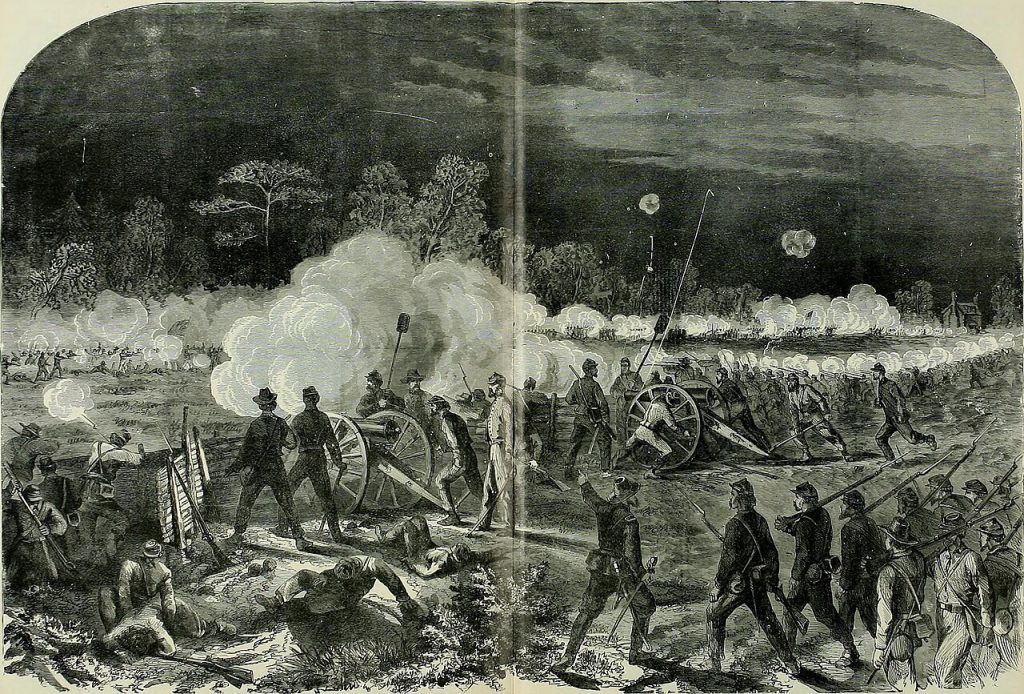
In spring 1864, the 40th Massachusetts returned to Virginia. On May 7, 1864, Mahlon Thatcher wrote from outside of Petersburg.
“We have been to West Point since I wrote my last to you but now we are here way up the James River on the Petersburg side and almost twenty miles from Richmond with quite a force and I do not know the moment the order may come to go into battle as the enemy is close to us and some think that they have left Petersburg but I don’t believe it as that place is said to be very strongly fortified and I think that they will make a stand there and we will have to whip them out of the place before they will leave. But they must give way this time as we are bound to drive all before us this time and Richmond must come down. If Jeff Davis gets out of this, he will have to run for it, I think. The heavy guns is making a great noise in our front as I am writing and the rattle of small arms is very plain and that a great battle may be very soon.”
On May 18, 1864, Mahlon Thatcher wrote another letter, this time after surviving a serious battle.
“Thank the Almighty God and the blessed and his Holy Mother, I am still able to write to you and I have not been hurt in the least but how I was brought safe, God only knows for the shot rained very thick and we have for eight days & nights the dreadful fire has been kept up and our little regiment has done its duty manfully all the time. God bless her. Yesterday was the worst of any time and our loss was very severe but still we meet them as only brave men can and for some time our small regiment held the whole center of the line at defiance and we was praised by both of the corps and department generals in command and they say when this regiment has to fall back, it will be when they are ordered or that they are all dead.
Dear family, I cannot write much as I am very much worn out by exposure and fatigue.”
Sadly, Mahlon Thatcher’s good fortune didn’t last. On June 5, 1864 he wrote from White House Landing and revealed that he had been seriously wounded at the Battle of Cold Harbor.
“Through the blessing of the Almighty God and his blessed Mother, I still am amongst the living but I am very severely wounded. The ball hit me in my breast and passed through my body and out my back making a hole right through me but I am a good deal better than anyone could suppose me to be. I was wounded at Gaines Hill [Mill] or Coal [Cold] Harbor—I do not know which it is called—on Wednesday night about 7 o’clock. I do not know where I will be sent to but I hope it may be to Boston sometime soon.
Dear family, you may think that I am dangerously wounded but I hope that the danger is over now and I may get well again as soon as possible. You must keep up good courage and all will be for the best. Our men fell very fast as we charged right in the face of the rebel rifle pits and the fire was dreadful. I fell on the second charge that we made, facing the enemy as I always said I would if I was hit at all. I can’t write no more now.”
Mahlon Thatcher was later moved to Knights Hospital in New Haven, Connecticut, where he penned a letter on June 29, 1864.
“I now address a few lines to you to let you know how I am getting along. My wound is about the same as when I last wrote but the diarrhea is not any better. I am troubled bad with it but I am in hopes that in a few days it will be better so that I can get a furlough and go home. But it will be some few days before I shall be strong enough to travel. I do not sit up now but hope to be so as to sit up in a few days. You had better not come to see me—not by any means. I will write again in a few days.”
Mahlon Thatcher died of his wounds at Knight Hospital on July 14, 1864. His wife, Julia lived until 1894 and never remarried.
We’d like to give a special thanks to William Griffing of Spared & Shared for his work in transcribing and sharing these letters.
To read more of Mahlon Thatcher’s letters as well as access thousands of other Civil War letters and documents, sign up for a Research Arsenal membership.
If you enjoyed this article, check out some of our other featured collections like William Augur of the 7th Connecticut Infantry and Martin Culver of the 16th Connecticut Infantry.
