
Research Arsenal Spotlight 70: Henry Murray 8th New York Light Artillery
Henry Murray was born in 1836 to John Murray and Jennet (Scott) Murray of Bovina, New York. Before the war he worked as a tinsmith. He enlisted in the 8th New York Light Artillery as a corporal on September 26, 1861.
The 8th New York Light Artillery at Newport News, Virginia
Henry Murray’s letters in our collection begin in March 1862, despite him having enlisted several months earlier. All of them were written to an unspecified brother or brothers, one of whom may have been John Murray who served in company E of the 144th New York Infantry.
After several months organizing in New York, the 8th New York Light Artillery left for Washington, D.C. On March 31, 1862, Henry Murray wrote about their march to Alexandria, Virginia and sleeping underneath their own artillery pieces.
“We are now in the land of Dixie within sight of the city of Alexandria and about a mile from it. We are encamped by the side of the railroad which leads to Manassas. We got orders to march last Friday about two o’clock and by four o’clock we were under march for Alexandria with Casey’s whole division. We crossed the Long Bridge a little after dark and kept marching until two o’clock in the morning when we encamped for the night. Taking the canvas which we have to cover our guns for beds, we laid down on the ground and slept until morning when I assure you, the camp presented rather an amusing appearance. Some were lying under the guns — others out in the open air with nothing but their blankets over them. Officers and men were all on a level then, and all glad to take mother earth for a bed and the canopy of heaven for a covering.”
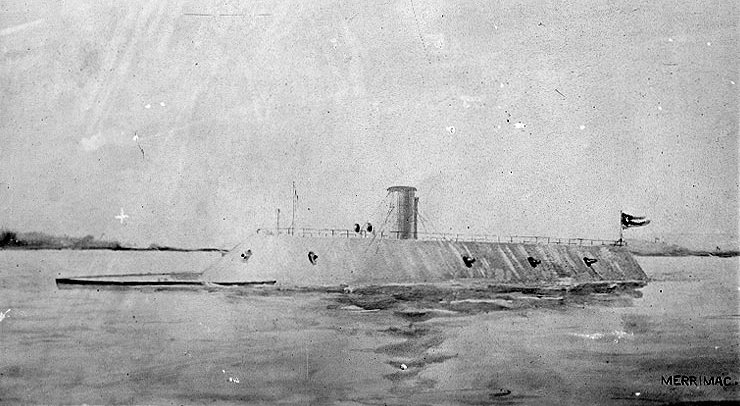
A few weeks later, on April 12, 1862, Henry Murray wrote from Newport News, Virginia and revealed that the fort was dealing with some harassment from the CSS Virginia (rebuilt from the famed USS Merrimack), though the ironclad ship was currently keeping her distance.
“All is quiet around here this morning. The Merrimack [CSS Virginia] has not made her appearance again. No doubt she has made up her mind that she is safest to stay where she is as the large guns from the Fort gave her some pretty heavy guns before she got out of their range. We could see the shells as they struck the water around the old Merrimack. There was two English and one French vessels lying nearby at the time of the engagement. They were no doubt taking notes of the proceedings. They are heavy gunboats carrying some forty guns each. They have been lying near here for some time. We passed by them when we came down here.”
On April 15, 1862, Henry Murray wrote another letter from Newport News which described a fellow soldier being injured by his horse.
“There is not much news here at present. One of our boys got badly kicked yesterday by a horse. He was cleaning his horse when the horse turned round and kicked him on the head, knocking him senseless. He was taken to his quarters and the doctor called but he still remains insensible and was taken to the hospital at Newport News today. His recovery is thought doubtful. His name is [George D.] Eighmy. I think he was from Roxbury.”
George D. Eighmy (or Eighmie) was discharged for disability on July 16, 1862.
Henry Murray and the Battle of Yorktown
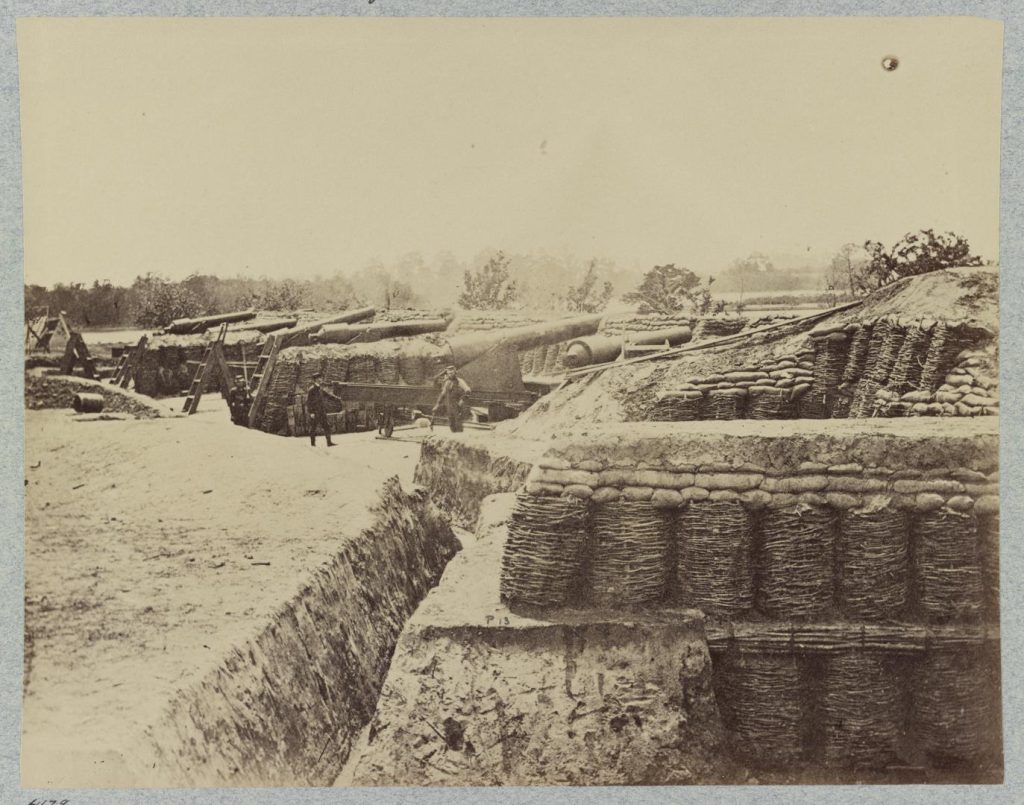
The Siege of Yorktown began on April 5, 1862. On April 26, 1862, Henry Murray wrote a letter describing preparations for a coming battle and the capture of a few Confederate spies.
“We were ordered out the other day to go and shell rebel fortifications that they were building about two miles from here. We started and got about a mile when we got news that the rebels had left so we had to return to camp without having a chance to get a shot at them.
There has been four rebel prisoners captured here yesterday. They were supposed to be spies. They were examined and their clothes searched and some papers found, sewed in their overcoats. What the papers were, I have not heard, but they are now confined in a log cabin a short way from our camp. They are rather suspicious-looking characters and I think if they are a specimen of the rebels, they are a degraded-looking race of men. They were dressed in uniform the same as our troops. In their knapsacks were found some clothes which were stained with blood (which they could not give a very strict account of). They are to be sent to McClellan’s headquarters for further examination.
Everything around here has the appearance of a rapid preparation for the coming battle which will soon take place at Yorktown. There is roads being made and fortifications being thrown up in almost every direction from here, and there is troops coming in around here by the thousands. Sickles’ Brigade is now stationed some five miles from here.”
Henry Murray sent his brother another letter on May 6, 1862, one day after the successful capture of Yorktown, and described a gruesome incident of a soldier being killed by a mine left behind by retreating Confederate forces.
“Before this can reach you the glorious news that Yorktown has been evacuated will have reached you. We are in pursuit of them. We left camp on Sunday morning about eight o’clock as the news came into camp that the rebels were evacuating. There was a heavy cannonading kept up all Saturday night but it stopped on Sunday morning before we left camp. we marched about two miles when we came to a small fort that had been left but a short time before by the rebels, but the old Stars & Stripes were waving over it when we arrived in sight of it, having been planted there by Gen. Casey. We did not stop at this fort but kept on about a mile farther where there was quite a strong and large fort. Near the fort were found several shells which were buried in the road with a cap placed on them in such a manner than when stepped on, they would explode. The infantry were in advance of us and — while near the fort — a shell was stepped on by one of them whereupon it exploded, killing him instantly — blowing him to atoms and wounding five others. They were in the 52nd Pennsylvania. There was several of those infernal machines found in and near the fort but were dug out before any more accidents happened.”
Further in the same letter, Murray described the state of the battlefield.
“We are now encamped by the forts and the battleground is but a short distance from here. I went through it after we got here, but for me to attempt to describe the sights that I saw — it is impossible. The dead were lying in heaps, men and horses were lying in all directions, guns were scattered around and other things beyond description. Our men were burying the dead but the rebel dead were lying unburied. There is hundreds of them scattered around the field and in the woods. What the loss of the rebels were I have not heard, but judging from what I saw, I should think it heavy as they did not leave the field until after night and no doubt buried many of their dead. What the loss on our side is, I cannot say. You will have an account of it, no doubt, before this reaches you.”
Onward Toward Richmond
After the successful Battle of Yorktown, Union forces pursued the rebel army through Williamsburg. On May 11, 1862, Henry Murray was riding high off of the recent victory and hoped it would soon be followed by the capture of Richmond, Virginia.
“In my last letter which I wrote to you last Tuesday, I told you that we were then encamped on the battleground [at Williamsburg] of last Monday. We remained there until Friday morning when we again started on the march and this time it is, “On to Richmond” in reality. It is no longer the feeble dry of a few aspiring politicians and newspaper editors, but it is now the order of the Commander in Chief of the great Army of the Potomac and, with him at its head, we are now moving slowly but surely to the city of Richmond — and, in a few days, we will be in possession of that great Capitol of the Southern Confederacy which so long has been the boasted stronghold of the rebels, but which must soon fall before the onward march of this great army. And then, when the old Stars and Stripes are again floating in triumph over that rebellious city, we may consider this rebellion as nearly at any end for with Yorktown and Richmond in the hands of the government, it will be impossible for them to make a stand anywhere in Virginia.
It is said that the rebels are going to make a stand some twelve miles from Richmond and that they are now throwing up fortifications and making every preparation for a desperate battle. But very likely it will turn out like Yorktown — when our forces are ready to make an attack, they will evacuate for I think from the appearance of their forts in front of Yorktown that if they could not make a stand in such forts, it will be impossible for them to build stronger forts before this army reaches there.
We passed through Williamsburg on our way here. It is a small village and everything in it gave evidence of a hasty retreat. In the streets were to be seen wagons, forges, and ammunition chests having stuck in the mud and were set on fire or cut to pieces to prevent them falling into our hands. Horses and mules were lying on the road dead as we came along this side of Williamsburg, and as we came along, we met several who had deserted from them and they say that rebel soldiers are getting disheartened and are almost in a state of mutiny.”
Henry Murray’s high spirits continued in another letter written outside of Richmond on May 19, 1862.
“We are within eighteen miles of Richmond. The rebels were here where we are now encamped last Saturday but retreated as our troops advanced. They are nary nine miles from here and it is said they are going to make a stand at that place which no doubt is true. And in all probability before this reaches you, there will have been a decisive battle fought and the City of Richmond will be in our hands. It is reported here that the rebels have a large force at that place but yet I doubt not but the result will be a glorious victory for the Union forces.”
Despite Henry Murray’s optimism, it proved to take almost three more years before the Civil War finally ended. Henry Murray served for the duration of the war, receiving a promotion to sergeant on August 15, 1862, and reenlisting as a veteran in 1864. He mustered out with the rest of the battery on June 30, 1865. He died in 1905.
We’d like to give a special thanks to William Griffing of Spared & Shared for his work in transcribing and sharing these letters.
To read more of Henry Murray’s letters and access thousands of other Civil War letters and documents, sign up for a Research Arsenal membership.
If you enjoyed this article, check out some of our other featured collections like John Madison of the 96th Pennsylvania Infantry and Robert Browne of the 100th Pennsylvania Infantry.
