
Research Arsenal Spotlight 83: Isaac Mead 17th Connecticut Infantry
Isaac Mead was born in 1834 to Jonas and Abigail Mead of Greenwich, Connecticut. He married his second cousin, Esther Mead, in 1855. In August, 1862, he enlisted as a private in Company I of the 17th Connecticut Infantry.
Isaac Mead Spends Time in Camp
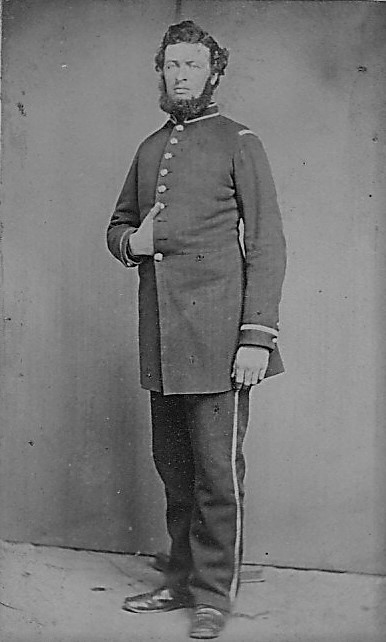
After being mustered in, the 17th Connecticut Infantry began its service as part of the defenses of Baltimore, Maryland. On September 27, 1862, Isaac Mead wrote to his wife about how he was earning a bit of extra money while there.
“I have been sewing for some time back. I made two towels for Henry Held and marked his name on them. He gave me 12 cts. One of the drummers had me put stripes on his blouse and pants. He gave me 25 cts. George Peck, the orderly sergeant, had me make two towels and two bandages (flannel). He has not paid me anything yet. I paid 9 cts. for tape for strings. I put two pockets in each. They are made double the edges catstitched down. It took me a good while to make them and they are very nice, I think. If he does not offer pay, I shall not think any better of him than I do now. He is very peevish. I don’t think the men like him much. If there could be another nomination of officers, I am sure there would be a great change in them. I am afraid if we were called to battle, we should not get much credit.”
On October 1, 1862, Isaac Mead wrote that he was learning the fife and considering becoming a musician in the regiment’s band rather than continuing service as a private.
“I am learning to fife. Some of the companies have no fifer & if I can be exchanged for one of the privates of one of the companies to be a fifer, it will be better for me than being on guard &c. The fife will cost me $1.00 which will take the last lot of stamps you sent. I have to spend some money but am not so extravagant as some. Some have spent nearly $50.00 since being here for provision &c. Father told me when he was in Bridgeport that I might have his fife if I wanted to learn but the fifers expect soon to use a different kind than his.”
The 17th Connecticut Infantry on the March
On November 20, 1862, Isaac Mead wrote a letter recounting the 17th Connecticut Infantry’s difficult march to Chantilly, Virginia.
“We started last Tuesday for this place about 7 o’clock. Our Colonel hurried us into line. We had to wait awhile for some other regiment to start first. It was reported that we were on a retreat. I don’t know how that is, but our Col. told the sick ones that those who stayed behind would fall into the hands of the rebs. That was hard. Some hardly able to stand, they must walk and carry a load. That is too much for many well men. Some who were sick could ride in ambulance wagon but they were few compared to the whole number who ought to ride. I know some would say how can a man travel so if he is unable. He does it by feeling that he must & using great exertion. I know of one who had been in the hospital a day or two. He acted as though he could hardly stand, but he had to walk and carry his knapsack. I saw him after marching a few miles, his mouth was open and he panting as though he was almost gone. Not long after he was missing. He had dropped by the way. At night he came in, I believe.
I said it was reported we were on a retreat. When we commenced out march it looked very much so as we started very fast for men who had a load to carry. This seemed to tire me out fast, but I felt that I must stick & hang as long as possible. I kept up until 12½ o’clock, when we halted for an hour. We ate some crackers and cold meat. Some of us started to find water. We found some frost grapes which although about the size of dried currants and as sour, yet made a good relish with dry crackers. Before we had quite finished our dinner, toot–toot goes the bugle to fall in. Some said we had come 10 miles. We felt as though we had. But there was no time to think about it. Even thinking seems tiresome.
How still it is. Hardly a word spoken. Hardly a sound but the splosh of the men’s feet in the mud for it had commenced to rain. This made the walking still harder. Well, we kept digging along as well as we could, one after another falling out by the way, for the slippery walking—especially up and down steep hills—wore out the men fast. Towards night we came to some log huts which I suppose were used by the rebels as winter quarters. These we occupied. We got wood and built a fire in our house. There were six of us in it. At one end was a fireplace. The chimney which was outside was made of sticks put up cob house fashion & the cracks plastered with mud and the fireplace lined with stone.”
A few weeks later, Isaac Mead wrote home with some exciting news: he had unexpectedly been promoted from private to 5th sergeant.
“Regiment inspection is rather tedious. We had to stand in the cold quite awhile. At the close of the inspection, we were marched into our street. Capt. [Wilcoxon] told the company that he would make the appointments to fill the vacancies in the officers. Orderly Peck has been promoted to be Sergeant Major. Dennie Vagan, our 3rd Sergeant, takes his place. The other two sergeants — that is the 4th & 5th — step up a step & become the 3rd & 4th. Henry Held was 2nd Sergeant & is the same now. Private Isaac L. Mead is put in 5th Sergeant & William J. Platt of Round Hill (blacksmith) is Corporal in place of Frank Elliott who is taken for a teamster. I expected until last Sunday that one of the corporals would be our 5th Sergeant, but Sergeant Major [George C.] Peck told me then that I was the one selected. It is quite a jump to go from private to sergeant. I thought perhaps I might be a corporal was one reason I did not think best to join the band.”
Isaac Mead did face some ill feelings from the corporals that were passed over when he was promoted to sergeant, but he hoped that the hurt and jealously wouldn’t last for long as he did his best as a sergeant.
“Wednesday noon. I am on guard at one of the Gen’ls. Headquarters. I am sergeant of the guard — rather soon for a green officer to be put on duty. I asked the Capt. to excuse me until I knew my duties but he told me I would do well enough. We had regimental drill this morning. Our Lieut.-Col. [Charles Walter] told the regiment to fix up nice for a review tomorrow. When we came in from drill this morning, Capt. [Wilcoxon] cautioned the men about being noisy & spoke about some manifestations of dislike to one of his appointments. He said he had appointed a faithful soldier. He said a little more intimating that he was satisfied with his choice. Last night some of the boys were calling, “Sergeant Mead” &c. Some did it for fun. I took it all in good part. Some of the corporals are dissatisfied because a private is put over them but I guess things will be right soon.”
Transfer to the Invalid Corps
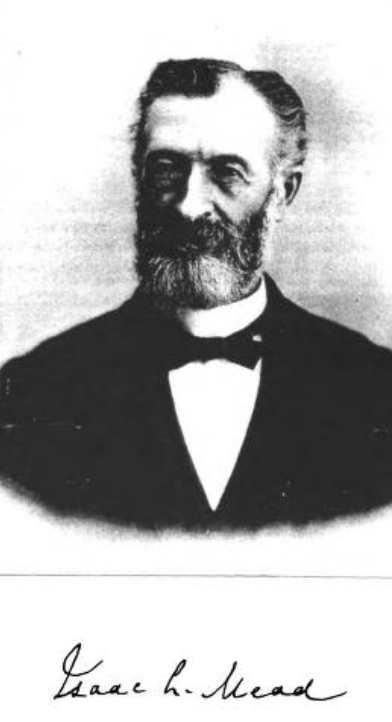
On June 9, 1863, Isaac Mead wrote from a hospital in Washington. He had been sent there after falling ill and shared the grim news that another man in his room had died.
“Another man died last night in this room making the third since I have been here. I continue to gain very slowly.”
By November, 1863, he had moved to Camp Convalescent at Alexandria, Virginia, and hoped to be transferred to the Invalid Corps (soon to be renamed the Veteran Reserve Corps) but his doctors continued to withhold judgement.
“Yesterday morning the men in this barrack were examined before the division doctor. Today those who were recommended to the Invalid Corps were examined by the board. The doctor told me to come to him this morning. He ordered a dose of tincture of iron, I should think it was. He did not tell me what I might expect. I suppose I must stay another month before we are examined again.”
In the same letter he revealed that he did not think his health would recover if he was sent south back to his regiment.
“As I think my health will not stand the Southern climate in the summertime, I do not wish to look very well until I am put in the Invalid Corps. This may seem hard talk, but the doctor goes as much by looks as anything. I very much fear I shall not be put in the Invalid Corps but I have felt more trust in Providence today than in some time before.”
Isaac Mead’s transfer to the Veteran Reserve Corps did not occur until August, 1864 when he was transferred to Company C of the 6th Infantry Regiment VRC. His earlier efforts at learning the fife led him into having a position in the regimental band.
On April 27, 1865, Isaac Mead wrote from Johnson’s Island, Ohio, and told his wife about a recent performance of the band in honor of President Lincoln’s funeral procession. Despite the solemn occasion, the event turned out to be unexpectedly humorous.
“There was to be a brigade dress parade and Col. [Frederic S.] Palmer told Mr. Vinton that the band must come out in blue jackets. Mr. V. told him that the jackets had not been fitted. No matter — they must wear them. So we rigged up. My jacket came up to my ears and was too big other ways. George Merriman and Jack Reed looked as bad if not worse than I. We were suited as long as we had to wear them and if anything, made them look a little worse than necessary (not much though). We were about as comical-looking soldiers as are often seen.
We marched to the parade ground of the 128th Ohio Regiment and as soon as the other band (128th) saw us they commenced laughing. A good many citizens were looking on and no doubt enjoyed a good laugh. What made us look worse was the other band were as nice as though they had just come out of a band box. We played a funeral march down the line and the other band played a march back. The drum corps went ahead, our band next, and the other band behind. Some say that we played well. Mr. V. said he didn’t care how we looked but we must play as good as we could, and so we did.”
Isaac Mead was discharged on July 5, 1865. He returned home to his wife and three children and later took over his father’s undertaking business. He died in 1913.
We’d like to give a special thanks to William Griffing of Spared & Shared for his work in transcribing and sharing these letters.
To read more of Isaac Mead’s letters and access thousands of other Civil War letters and documents, sign up for a Research Arsenal membership.
If you enjoyed this article, check out some of our other featured collections like Thomas Conley of the 33rd Ohio Infantry and Seth Bishop of the 4th Vermont Infantry.
