
Research Arsenal Spotlight 48: Joseph Vaill 8th Connecticut Infantry
Joseph Vaill was born in 1837 to Reverend Herman Landon Vaill and Flora (Gold) Vaill of Litchfield, Connecticut. Joseph’s brother, Theodore, severed in the 2nd Connecticut Heavy Artillery and wrote the regimental history of it after the war. A group of 26 letters written by Theodore are also part of the Research Arsenal Collection.
Joseph Vaill served in the 8th Connecticut Infantry and later as clerk in the quartermaster’s office of the 1st Brigade, 3rd Division of the 25th Corps.
The 8th Connecticut Infantry at Roanoke
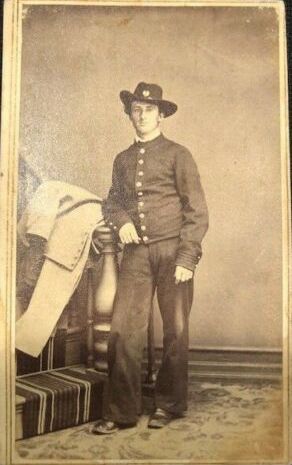
Joseph’s letters in the Research Arsenal collection begin with him on board the steam ship “Admiral” which was captained by his cousin, Edward “Ned” Vaill. In a letter written on December 14, 1861, Joseph mentions writing from the stateroom of the “Admiral” which was currently transporting men from the 24th Massachusetts Infantry. It was not clear from the letter how Joseph Vaill ended up on the ship with his cousin, but he was evidently returning to his regiment.
On February 9, 1862, Joseph Vaill wrote to his father from Roanoke Island and gave a lengthy account of the recent battle there. Joseph began by recounting the bombardment of the Confederate fortifications on the island while he was on board the ship “Sentinel” with the rest of the 8th Connecticut Infantry.
“On Wednesday morning the 5th, we weighed anchor and brought up the rear of the fleet. We were on the Propeller “Sentinel” carrying 4 guns and being in the 3rd Brigade, were ordered to the rear as guard. The weather was fine but rather cool and it was thought that we would reach our destination by 4 P. M. and have warm work before sundown. But our boys were in good spirits and every man was ready to do his duty. At about 4 or 5 P. M. we dropped anchor in the rear of the fleet and about 10 miles from the island. The weather came on thick at evening with rain. The Sentinel and Chasseur were put back about a mile to guard the fleet in the rear and several small gunboats sent ahead to sound and reconnoiter.
The next morning we did not move but the small boats were in advance to lookout the ground. Friday morning the 7th orders were to move on and so we did—the gunboats in the advance. At about 10 A. M., we saw smoke several miles up the channel which we took to be from the enemy on shore. For an hour or so, firing commenced in earnest from our gunboats and was answered quite rapidly from a fort on shore and by rebel gunboats above the fort. The rebels had previously obstructed the channels by driving in spiles so that our gunboats could not go by the fort without passing directly under the fort. During the whole afternoon the firing was continual by our vessels and answered less rapidly as the day wore on. A dense cloud of black smoke told us that the fort was on fire.”
The Sentinel was held back from the main fight, but late on the night of February 7, the 8th Connecticut Infantry was put ashore on the island. As this was the first time most of the regiment had seen any fighting, the men were a bit jumpy.
“At 11 P. M. we lay down upon a sandy cornfield about 100 rods from shore. There must have been 10,000 men on the field before 12 midnight. We lay down on our rubber blankets two together so had one rubber blanket over us which we very much needed for it soon began to rain and kept it up nearly all night. We got wet some but made the best of it for we were in an enemy’s country, and the enemy near us. It was raining some when we got up in the morning and before we had a chance to think of breakfast and before all of the men were out from under their blankets, we were startled by several shots from our pickets who were not more than 80 rods from us and the order was, “Fall in!” We had the order hundreds of times before but under very different circumstances. The rush for guns may be ‘imagined but not described.’ We were soon in line just as the firing from the pickets ceased. We were ordered to stack arms. You may consider that there was some little excitement for it was the first time the most of us were ever invited to face death on the battlefield.
At 7:30 the 1st Brigade left the field for a march to the interior to attack the battery discovered the night before. At 8:30 we heard rapid firing of musketry and an occasional field piece or gun from the battery. Regiment after regiment were ordered out from time to time and the firing was kept up with little cessation till 11 A. M. when Hawkins Zouaves (9th N. Y. V.) charged upon the battery and carried it at the point of the bayonet with a loss of only one killed and five wounded. Other regiments had stood and fired at the battery and had lost quite severely—among them one or two Massachusetts regiments. Several regiments were ordered to make an advance on the battery which lay across a terrible swamp but after making the attempt, fell back till the 10th Connecticut were ordered on and went through with a heavy loss—Col. Russell being among the killed.
The enemy were put on the run, our troops close upon them. I believe all the regiments with the expedition were ordered on except the 8th which was held in reserve under arms all day in order to cover the retreat of our troops in case they were driven back. We were in readiness to march to the battlefield at any hour. The regiments that went out into the fight and chase yesterday have not returned as yet but we learned this morning that they had taken between 2 and 3 thousand prisoners—among them Gov. Wise of Virginia, and O[badiah] Jennings Wise who it is reported was shot this morning while attempting to escape. Of course we cannot tell how much to believe as there are all sorts of reports. But it is very plain we have done a great work although our loss is quite heavy—probably nearly 50 killed and wounded. Our boys are all very well but are not able to write on account of the scarcity of paper. Our knapsacks being left onboard the boats. But their friends need not be alarmed about them for they are all well.”
Contrary the rumor about Governor Henry Wise being taken prisoner, he was in fact ill during the Battle of Roanoke and was not captured. His son, Obediah Jennings Wise of the 46th Virginia Infantry, was killed in the battle.
Joseph Vaill at Knight General Hospital
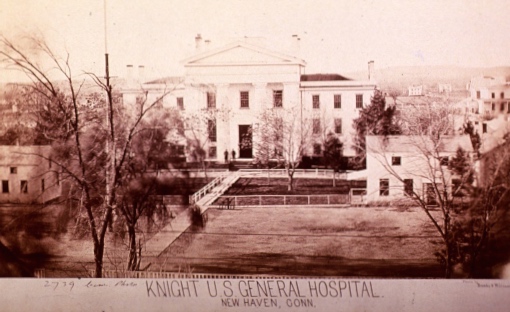
There is a gap of letters in our collection covering most of 1862 and 1863. The letters resume in 1864 with Joseph Vaill in the hospital. In the intervening time he had been promoted to Quartermaster Sergeant on May 28, 1862 and promoted to 1st Sergeant on February 20, 1864. In May of 1864, he transferred to the Veterans Reserve Corps.
On September 5, 1864, Joseph Vaill wrote home from Knight General Hospital in New Haven, Connecticut. In it he discussed his plans to become a clerk for Captain George Mason, Assistant Quartermaster.
“As to my plans, I can only say that they are not fully developed as yet, but there is a prospect of my going to be chief clerk for Captain George W. Mason, A. Q. M., as he has made me the offer, if he is situated as he expects to be, and as he probably will be. Major [Pliny Adams] Jewett expects me to remain here but I shall enlighten him tomorrow, and when he finds that I have an offer from Capt. Mason, he will see at once that he will have to dispense with my services as he is only allowed to pay $24 per month with rations & quarter for his help — though I suspect from what Dr. [Levi D.] Wilcoxson told Bill Hull that the Major would increase my pay from the Hospital fund, but he would not think he could to more than $10 per month, I presume, making my pay $34 & board. But that would not do, for I can get $84.00 including rations if with Capt. Mason, and I could board myself for $20 per month, leaving a balance of $60 & +.”
On September 20, 1864, Joseph Vaill was discharged from the service. He remained at the hospital and temporarily took up a position in the quartermaster’s department at the hospital which he detailed in letter written November 29, 1864.
“He [Major. Pliny Adams Jewett] said he would like to have me take charge of the Quartermasters Department and he said he would try Capt. Bullock, the Quartermaster at New Haven, who is responsible for the issue of clothing &c. and perhaps he could get some extra pay for me. I told him I would take all he could get for me, but don’t suppose there is any great probability of my getting anything extra.
Since I took charge of this Department, I have been very busy, but shall not have very much to do after I get caught up. I have a cozy little office all to myself with my bed in it, a little coal stove, and everything comfortable. I have an orderly to make my fire at 6, make my bed, and sweep out while I am at breakfast, and to look after the wants of the office generally.”
Joseph Vaill in the Quartermaster’s Department
Though it took some time, Captain Mason made good of his offer of making Joseph Vaill a clerk under him. On January 4, 1865, Joseph wrote about taking a position in the Assistant Quartermaster’s Office of the 3rd Division of the 25th Corps. His journey there included a surprise stop at the camp of the 2nd Connecticut Heavy Artillery, where his brother, Theodore, was currently the adjutant.
“Col. Hodge went with me to the Pro Marshall’s Office to get me a pass to the “front” by railroad and he (Col. H.) went to the 6th Corps Headquarters and I to the 2d Connecticut. I found Charley Hinsdale just about dark in front of the staff quarters and he secreted me until the adjutant started for supper when he said, “Here, Adjutant, do you know this fellow?” whereupon I received the grandest hugging and kissing I ever did from the same sex of myself. I was at once shown to the supper table and introduced to Col. Hubbard, Major Skinner, and Jones, who with Theodore compose the “mess.” I stayed over night and at noon the next day (Tuesday, Jan. 5th) went to the 6th Corps Headquarters to see Willis Gold who is chief clerk at Maj. Mellen’s, Pro. Mar. of the Corps.”
Joseph Vaill also looked forward to the increased pay he would receive as a quartermaster’s clerk.
“As Brigade Quartermaster clerk I find the established rate of pay is $75 per month and one ration per day. For Division clerk, $100 and 1 ration. And Chief Quartermaster Clerk, $125 per month and 1 ration. So that my pay now will be 75 & 1 ration. And when Capt. Mason get a Division, I shall have 100.”
Joseph Vaill continued to serve as a clerk through the end of the war and remained in North Carolina through at least 1866 which is when the letters in our collection stop. After the war he married Cornelia Elizabeth Smith. Joseph Vaill died in 1915.
We’d like to give a special thanks to William Griffing of Spared & Shared for transcribing and sharing these letters.
To read more of Joseph Vaill’s letters as well as thousands of other Civil War letters and documents, sign up for a Research Arsenal membership.
If you enjoyed this article, check out some of our other featured collections like William Heldman of the 17th Missouri Infantry and Halsey Bartlett of the 6th Connecticut Infantry.
