
Research Arsenal Spotlight 65: Henry Beckwith USS New Ironsides
Henry Beckwith was born in 1839 to David Beckwith and Eliza (Rathbone) Beckwith of Chesterfield, Connecticut. He enlisted in the US Navy on June 27, 1862 and served as the Third Assistant Engineer on the USS New Ironsides.
Henry Beckwith Third Assistant Engineer
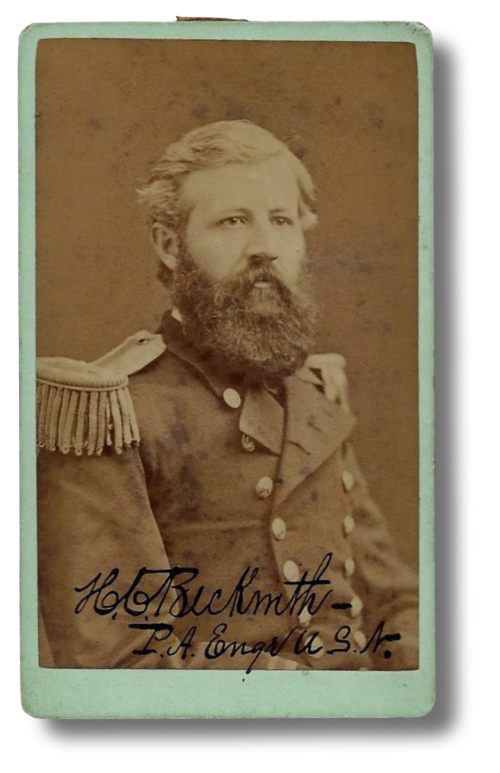
The first letter in our collection was written by Henry Beckwith on October 13, 1862 while the USS New Ironsides was near Hampton Roads, Virginia. The USS New Ironsides was a broadside ironclad ship constructed in 1862. In the letter Beckwith described some of his duties as the Third Assistant Engineer of the ship as well as the large amount of coal required to keep it running.
“We have the same duties to do on a Sunday that we have any other day which are not usually very tedious when laying under banked fires as we are at present. But sometimes at sea we see little different times. I mean by banked fires that they are piled up with coal & lays in smothering state but can be raked & in a few minutes will become a good fire. When running, we burn 25 tons of coal per day. Under banked fire, [only] 4 tons. Our engines are sixteen hundred (1600) horse power—that is, they will draw as much as 1600 horses like “Old Tom” on level ground, up or down hill.”
The nature of his duty also meant that Henry Beckwith spent a great deal of time on the ship below decks.
“We arrived here the 27th ultimo & strange to say I haven’t set foot on land since. No, I haven’t since the 23rd ultimo. Sometimes for twenty-four hours I don’t see daylight. I have been writing all the time since we arrived here & by candlelight at that. We are obliged to do almost everything by the said light such as writing, studying, eating &c. &c. In fact, our quarters are just about as dark as our cellar without a light.”
Henry Beckwith closed the letter with an announcement that he had to prepare for battle, though he himself was a noncombatant.
“Oh! I must stop writing very soon to go to quarters—that is, to arrange ourselves in the proper position for battle. I, you know, am classed with the non-combatants. Am in the same general class as doctors from the fact that I am not obliged & not expected to do any fighting. When I spoke of quarters on the opposite page, I meant our room in which we stay the most of the time which is about 12 feet by 9. I would [pay] $10 per month if I could have one all to myself with good windows in it but such luxuries are unknown to us on board ship. In fact, no officer in the ship except the captain can read either a book or paper on the Quarter Deck—one at first very naturally says that is very hard—over and above exact; but this is a man-of-war and that is a fair sample of the rules of the U.S. Navy.”
The USS New Ironsides in South Carolina
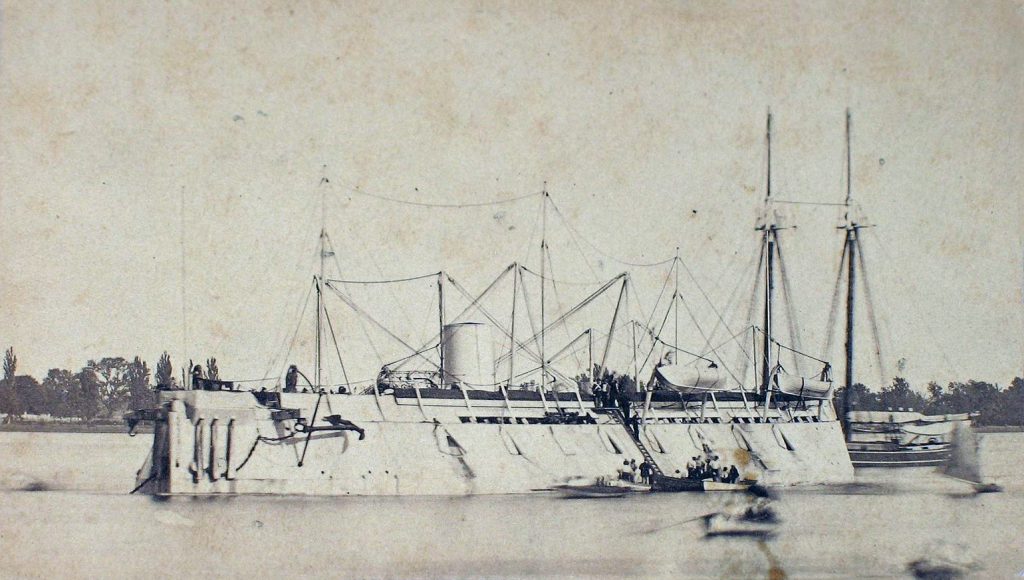
On February 2, 1863, Henry Beckwith wrote from outside Charleston, South Carolina.
“We arrived off this place and are now laying here on the blockade. I am as well as usual which is exceedingly well. You may know by this that I am in a great hurry which is owing to the fact that the mail leaves ship in about ten minutes. I expect that we shall lay here for a long time.”
On February 21, 1863, the New Ironsides was still outside Charleston and Henry Beckwith wrote to his mother and told her that he had adjusted well to having a life at sea.
“I have seen the time when if I had some pleasant employment on shore I had as soon be there as anywhere, but at present, give me the life of a sailor. I at first was afraid of the deep blue sea but since it has been so parental to me, I pass without a murmur its former chidings to my race by. I wish that you could look in upon me sometimes when vessel rolls so much that I could not lay in my berth without holding on at the sides which is often the case—or when we cannot keep anything on the table. You would think that I had a very hard time. I doubt not but that you would advise me to come home. Ah! such things did annoy me, but not now.”
On April 11, 1863, Henry Beckwith gave a short account of the First Battle of Charleston Harbor which occurred several days early on April 7, 1863.
“We made an attack on Charleston the 7th instant & neither whipped or was whipped & no one on board of this ship was either killed or wounded.
I should have written before but I considered it a very trivial affair. Consequently you will please pardon me for the neglect. I will not give you an account of the fight for I consider it an insignificant thing. We were struck only 49 times during the whole & I am of the opinion that none of their shot were more than ten inch.”
The USS New Ironsides continued to do duty around Charleston Harbor. On October 8, 1863, Henry Beckwith wrote from off Morris Island, South Carolina, and revealed that he had not been off the ship in over eight months.
“Charleston has not been occupied by the Union forces and consequently I am not on my way home. Everything is progressing well here & the general health of the fleet is excellent—mine unsurpassed. Very probable I have letters from you on the way for I have not received any for several weeks. I went on shore a few days since—the first time since the 1st of February which was about eight months.”
Henry Beckwith and the USS Yantic
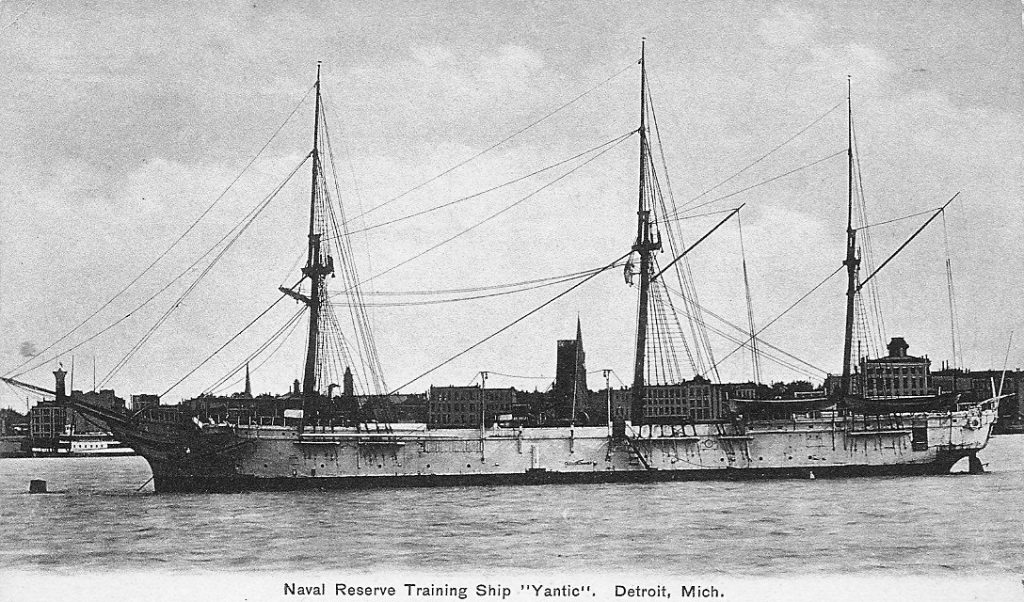
Henry Beckwith and the USS New Ironsides remained in South Carolina throughout the first half of 1864. On August 19, 1864, Henry Beckwith wrote home from Fort Delaware and revealed he had transferred to another, much smaller, ship, the USS Yantic.
“I have been detached from the New Ironsides & attached to this ship. I am very much pleased with the change. The New Ironsides was a very large & effective vessel. This is a wooden gunboat & of the smallest class—is a very fast & pleasant ship. I was suited when I was ordered to the Ironsides & am now pleased with my situation. The Chief Engineer of the Philadelphia Navy Yard applied for me to come to the Yard with him in which case I would have been ashore all the time but I did not want to come & was not slow to express myself against it & I was finally ordered on board this vessel.
We started from Philadelphia on this vessel on the 13th inst. on a trial trip. We have been cruising up to the present time along the Jersey coast, the southern shore of Long Island, Block and Nantucket Islands. We are now on our way to Philadelphia where we will arrive tomorrow where we expect to remain 10 days or a fortnight & then we expect to make our final departure on a cruise.”
On September 9, 1864, Henry Beckworth revealed that the USS Yantic was now on duty protecting against possible Confederate piracy around Massachusetts. He also gave an update on what his old ship, the USS Ironsides, was doing.
“We are on our way to “Woods Hole” which is on the coast of Massachusetts near Nantucket. We are going there for the purpose of protecting the shipping at that place against attacks of rebel pirates. We have no idea how long we are to remain there.
I received a letter from you a week or two since for which I am greatly obliged. The New Ironsides is still North but expects to leave in a few days for her station “off Charleston.” She was expecting to go to Mobile but under the circumstances of Farragut’s success she will not be needed.”
Henry Beckwith continued to serve on the USS Yantic through the end of the war and until June 5, 1866 when he transferred to the US Naval Academy. After a one year assignment at the academy he served on board the USS Saco and USS Franklin. He retired from active service in 1873 and died of consumption on July 12, 1885.
We’d like to give a special thanks to William Griffing of Spared & Shared for his work in transcribing and sharing these letters.
To read more of Henry Beckwith’s letters and access thousands of other Civil War letters and documents, sign up for a Research Arsenal membership.
If you enjoyed this article, check out some of our other featured collections like Thomas Griffith of the 116th New York Infantry and Josiah Osgood of the 24th Massachusetts Infantry.
