
Research Arsenal Spotlight 68: Robert Browne 100th Pennsylvania Infantry
Robert Browne was born in 1821 in Steubenville, Ohio, but grew up in Pittsburg, Pennsylvania. He attended the Theological Seminary at Alleghany, Pennsylvania and was ordained as a minister at the age of 23. On August 28, 1861 he entered the service of the 100th Pennsylvania Infantry as a chaplain. He married Mary Eichbaum and addressed his letters to her. For part of his service his son, William Eichbaum Browne, accompanied him. William was born in 1847 and would have been around 14 years old at the start of Robert Browne’s letters.
Voyage on the Steamer “Ocean Queen”
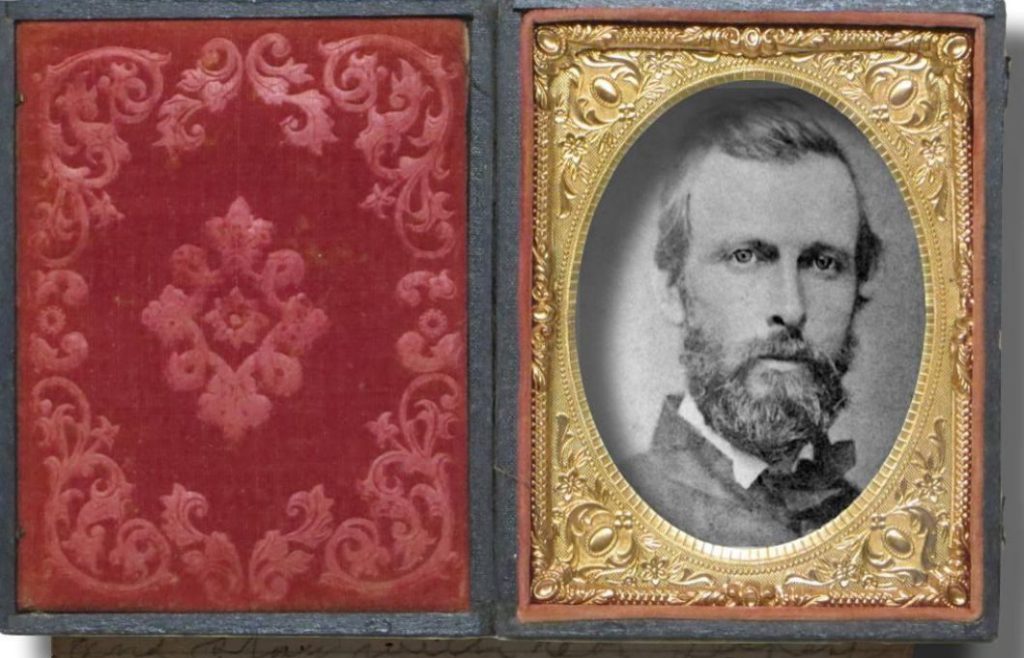
Robert Browne’s letters begin on October 20, 1861 while waiting to travel with the 100th Pennsylvania Infantry on the steamer “Ocean Queen.” The regiment was on its way to Fortress Monroe, though Robert Browne did not know when exactly they would embark.
“The curry & bustle of such and embarkation as ours even up till the Sabbath noon, you cannot conceive. Happily we can hope we have seen the most trying part of it. When we come to sail, if the weather is fair everyday afterwards, will be orderly & comparatively comfortable. Imagine 16 or 1800 men aboard of our immense vessel which immense as it is, is crowded. The ordinary distance between decks is divided into 3 or 4 tiers of sleeping platforms made of pine lumber. There are also of course many staterooms. But all are crowded. You may ask when we will sail. I do not know. The order may come at any time. Then, we rendezvous at Fortress Monroe whence you will hear from me again.”
On October 24, Robert Browne sent another letter from the “Ocean Queen.” By this time the ship had reached Fortress Monroe, but was waiting offshore rather than letting the 100th Pennsylvania disembark, leading Robert Browne to speculate that their final destination might be New Orleans.
“You see we are still at anchor here. The reason, I presume, is that the steamers are coaling. We presume from this a long voyage is intended. We will probably touch the tropics, double Florida, navigate the Gulf, and visit New Orleans. But we don’t know. At all events, one sees these little schooners drawn up along side these immense steamers hugging them close. I was up on deck this morning—a bright, cool morning—& noticed that nearly every steamer had a little schooner buckled to it.”
In fact, the regiment only went as far as South Carolina where it participated in the capture of Fort Wagner and Fort Beauregard and was then assigned to the occupation of Beaufort. The 100th Pennsylvania Infantry and other regiments in the area continued to get in small skirmishes with Confederate forces as detailed in a letter written by Robert Brown on December 6, 1861.
“The order to break camp came to us about bed time last night and by daybreak our camp was a busy scene. Some of the boys who cannot get fighting out of their heads on such occasions could not sleep but must be up in the night working with their guns—some of which went off but did no harm.
Last night there was a skirmish at Beaufort (as I have been told since coming down to the beach) resulting in the enemy leaving some earthworks in our possession which they had been putting up since the former visit of our gunboats. As our troops are in possession, we expect no trouble. But we will be now farther from the Post Office & the postal arrangements, & again your dear mother & all the rest of you will be liable to anxiety on our account.”
The 100th Pennsylvania Infantry and the Battle of Chantilly
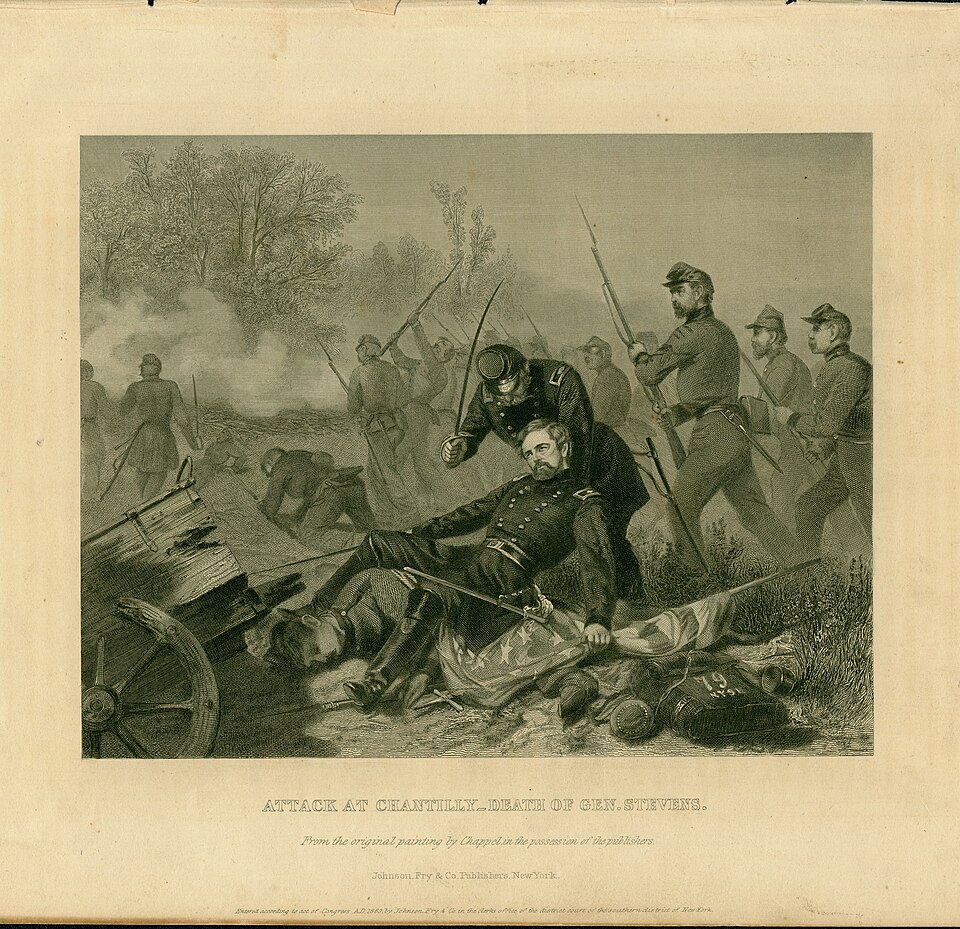
In July of 1862 the 100th Pennsylvania Infantry was sent north to join the 9th Army Corps as part of the Army of the Potomac. On September 5, 1862, Robert Browne wrote to his wife about the recent Battle of Chantilly which occurred after the Second Battle of Bull Run and resulted in the death of General Isaac Stevens. Robert Browne remained with the wounded in the hospital which was taken over by Confederate forces, though they were soon allowed to transfer their wounded back to Union lines under a flag of truce.
“In our battle of Monday, 1st, Gen. Stevens was killed. The last I saw of him was when he asked me to take back his son, Col. S., who had just been wounded. As I returned to the field I met our wounded being carried off. It was now dark and there was a piteous rain. I saw the regiment which had just come back from its engaging the enemy and were being formed in line of battle anew. Gen. Kearney rode up and addressing me, inquired who we were and where was Col. (Leckey), and, when I had brought Col. Leasure to him, asked if we would support his battery just posted in an advanced position. The men answered with a cheer, and supported it amid the whistling balls till the enemy were driven off by the artillery and other divisions of infantry.
I have since visited the battlefield, and seen where the dead of our army lay in a cornfield. They maintained the desperate struggle with the foe within a rod or two of each other. We gained the field, but did not hold it. The evacuation of Centreville, I presume, was necessity; and about 1 or 2 o’clock, A. M. our three divisions fell back, leaving their wounded in hospitals. I concluded with others, to remain and attend to the wounded, of whom we had about 150. Thirty-eight, I believe died before we left – which we did under a flag of truce about 6 o’clock last evening. We had to wait the arrival of our ambulances; they did not come till our provisions had run out and we were in a state of great destitution.
On the 2d a regiment of cavalry, 1st Va., Col. Brien came in, also one of infantry. The former promised us rations on arrival of his own supply, but was ordered away without their arrival as was also the other. We had a beautiful night for the trip with our wounded—23 or 24 white covered ambulances, wagons, drawn by 2 horses, pursuing their way by midnight. We had to leave about 50 or 60 behind to be brought down to-day. We reached the general hospital at Alexandria, about 3 o’clock A. M. I lay down with a portion of the wounded on the floor, the more serious cases being sent to another hospital in which were spare beds. Previous to lying down we all had coffee and soft bread.”
Robert Browne and Further Battles
On October 26, 1862, Robert Browne wrote from Maryland about a recent troop movement carried out in pouring rain.
“The 9th Army Corps are crossing into Virginia on a pontoon bridge. Long lines of cavalry & artillery have preceded us. Now the infantry of Whipple’s Division are going. So will our own do soon. They & a large assemblage of infantry besides are walking here for their turn—all wet as barnyard fowls in a full day of rain. All this I see with my eyes here but not exactly from where I write for I am seated on some rude wash house furniture under a back porch (with an earthen floor) of a Berlin dwelling of a 4th rate character whose door opens right on the canal. The drip of a roof without a gutter comes down in big drops steadily.”
A few months later, on December 15, 1862, Robert Browne wrote a very brief letter from Fredericksburg, Virginia. His son, William, who was around 15 years old and accompanying him with the regiment added additional lines.
“We crossed the river on Friday. Saturday a portion of the army had a very bloody battle. We saw it but were not called to take any part. The 134th [Pennsylvania] were in the fight & lost 50 killed & a number wounded.
Dear Mother,
I have just been over the river and as the regiment was waving, I started for it and Father had to quit writing. There has been some terrible fighting but our regiment has not been in it yet and the worst of it is over. Our regiment moved out of the town just as I came away and will not fight tonight. Father is well…”
Summer found the 100th Pennsylvania Infantry camped outside of Vicksburg, Mississippi. Robert Browne wrote a bit about their location and the ongoing siege in a letter dated June 23, 1863.
“I drop you a few lines at 7 A.M. There is nothing specially important. We are camped where we hear the pounding at Vicksburg which is about 10 miles southwest of this. We are near the Yazoo [river] and about 12 miles perhaps up that river & 3 miles out from the river at what I believe is called Snyder’s Bluff—not as far up as Haines’ Bluff. Last night we got orders to be ready to march on 3 or 4 hours notice with 3 days cooked rations. This morning we find a column has been going past in a south-easterly direction for 3 or 4 hours—said to be to meet Johnston with his army that have come up somewhere near the Big Black for the relief of Vicksburg. Of course all this may be so or may not. A very large amount of artillery went out with this moving column this morning.”
Robert Browne continued to serve with the 100th Pennsylvania Infantry until his resignation on December 28, 1863. He later became a state senator in Pennsylvania and the president of Westminster College. He died in 1902.
We’d like to give a special thanks to William Griffing of Spared & Shared for his work in transcribing and sharing these letters.
To read more of Robert Browne’s letters as well as access thousands of other Civil War letters and documents, sign up for a Research Arsenal membership.
If you enjoyed this article, check out some of our other featured collections like Charles Johnson of the 16th Massachusetts Infantry and Theodore Harman of the 153rd Pennsylvania Infantry.
