
Research Arsenal Spotlight 67: Charles Johnson 16th Massachusetts Infantry
Charles Johnson was born in 1836 and was living in Boston when he was commissioned as a captain in the 16th Massachusetts Infantry. He was married to Ellen “Nellie” Shepard Albree and the two had a son, Charles Berkley “Berk” Johnson, born in 1859. Charles Johnson joined the 16th Massachusetts Infantry very early in the war, receiving his commission in July, 1861. All of the letters in this collection were addressed to his wife, Nellie, though he frequently asked her to pass on messages to his father and mother.
The 16th Massachusetts Infantry at Camp Hamilton, Virginia
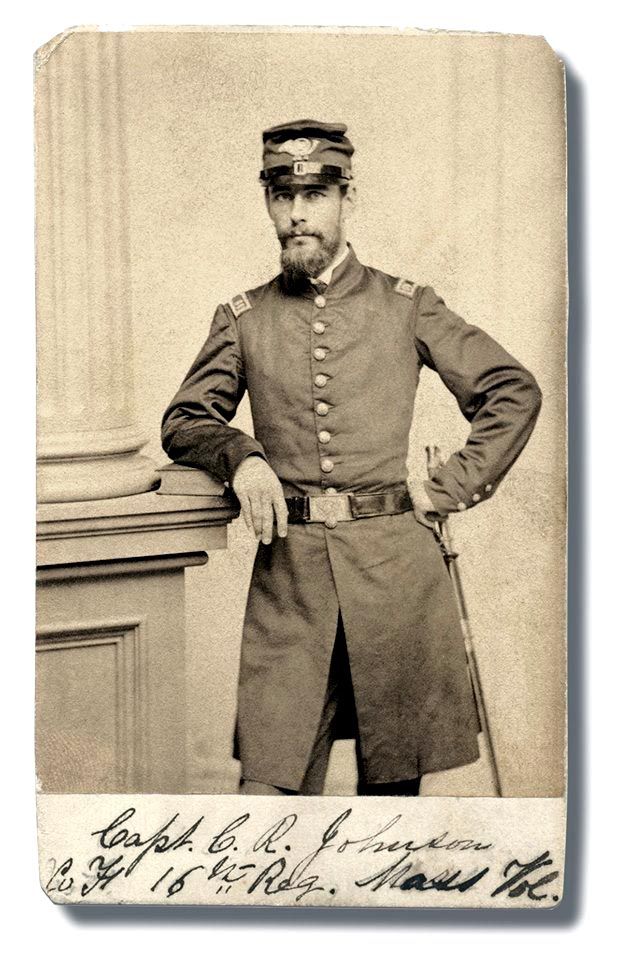
The letters in our collection begin in November, 1861, while the 16th Massachusetts Infantry was stationed at Camp Hamilton, Virginia. The first letter was written on November 4, 1861 and in it Charles Johnson mentions rumors about a disastrous battle at Ball’s Bluff, though he has not received official details yet.
“There are a large number of rumors about. Those in relation to the Naval Expedition are bad; rumor says the fleet landed its forces at Ball Bluff or someplace 25 miles this side of Charleston, S. Carolina. You will hear of it by the newspapers before this reaches you if it be true.”
The Battle of Ball’s Bluff, fought on October 21, 1861, did prove to be another humiliating defeat for Union forces, brought about in part because of the disorganized crossing of Union forces across the Potomac River and the inability to withdraw them quickly after facing Confederate resistance, eventually leading the Union forces to be routed.
However, given that Captain Charles Johnson mentions the Naval Expedition outside Charleston, South Carolina, he may have been conflating the then ongoing Battle of Port Royal with the previous fight at Ball’s Bluff or may have been drawing a comparison to the scattered arrival of ships at Port Royal caused by a violent storm to the disorganized crossing of the Potomac. Unlike the Battle of Ball’s Bluff, the Battle of Port Royal did result in a Union victory and the capture of Fort Walker and Fort Beauregard, though this did not occur until after Charles Johnson’s letter had been written.
Charles Johnson wrote to Nellie again on November 17, 1861, and this time revealed some of the circumstances and difficulties of camp life at Camp Hamilton.
“Last day and night have been quite cold but my company have in each tent a brick furnace, most of which work well, keeping their tents warm through the night. Mice are getting to be quite thick and troublesome. They completely—I almost thought so—spoiled my best coat eating two great holes in the back. One of the holes was three inches long by two wide but a tailor in my company succeeded in getting cloth enough inside of my coat to piece it and it will not show much now.”
A week later, Charles Johnson wrote again and mentioned a large build up of forces in the area, perhaps preparing for an expedition.
“There has been within the last week a great addition to our numbers and troops are continually arriving. We shall have in a fortnight a large army if reports are true. We don’t know whether they are intended for a naval expedition or to make an approach from here which if we do, we shall have the support of the Navy. Four gunboats night before last shelled a Virginia regiment lately encamped causing them to evacuate.”
Winter at Camp Hamilton
After his November 24 letter, there is a gap in Charles Johnson’s letters until January 1862. Now heavy into the winter season, Charles Johnson’s thoughts turned from upcoming expeditions to making it through the cold season as comfortably as possible. On January 16, 1862, he wrote about one surprising planned improvement to their camp: a gymnasium. He also responded to a wish from his wife that she could come down and visit or stay with him.
“We are building a gymnasium for the men of the regiment for their health and amusement during the rainy season. I am afraid that I shall have to say no to your wish as I have not any accommodations. We shall have wet and bad weather for moving about during the next two or three months.”
With the weather making most large scale actions impossible, Charles Johnson instead wrote about gifts from home and the poor conditions of the area, as shown in this except from a letter written January 22, 1862.
“I received from home a large box containing sack from Mrs. Glidden and some gingerbread from Mrs. Leeds. Also peanuts, cake, gelatin, and two bottles currant wine which has not improved any. The weather is and will be unpleasant for the next two months. The roads are in a horrible condition.”
Finally in March the improving weather brought rumors of upcoming movements, though in Charles Johnson’s case it also meant that there would be no chance of him traveling home on a furlough.
“I am sorry to disappoint father but I may stay here. The reasons are against our moving. All the regiments arriving are brigaded and unless we form a brigade of the regiments here, we shall probably remain for some time at least. You need not be surprised to hear that General McClellan has arrived at Fort Monroe. I don’t know nor can I conjecture the number of troops arrived or to come but they are here in large numbers and are continually coming. I saw sixteen large river steamboats entering Hampton Roads together. It was a magnificent sight.”
Charles Johnson at Alexandria, Virginia
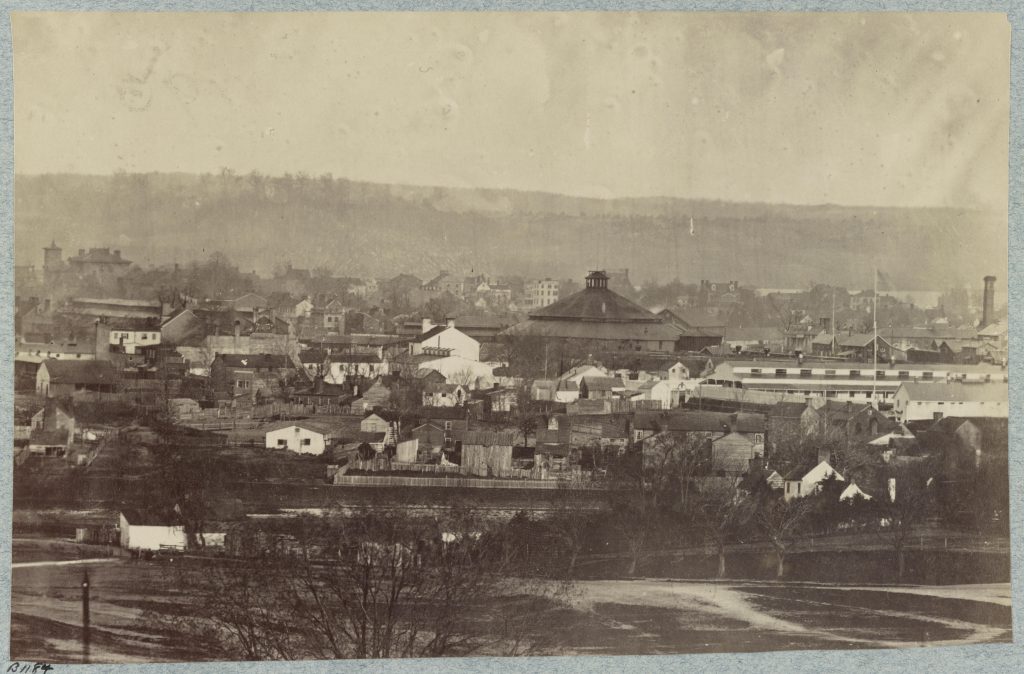
In the fall of 1862, Charles Johnson wrote to Nellie from Alexandria, Virginia, where the 16th Massachusetts Infantry. Unlike his objections in January, Charles Johnson now welcomed a visit from Nellie to their new quarters, provided the regiment stayed at Alexandria.
“In case I had no objection to your paying me a visit what would you have to pay Lottie while you were with me—say you were with me a month either with or without Berk. If we should stay here through the winter, I might be willing you should pay me a visit but you would be obliged to undergo a great deal of inconvenience more than you can imagine. For twenty-five dollars, I imagine I can prepare a place where you would be warm, equal in. size to two wall tents. This is only what I think of it now. I may change my mind when the time comes.
Quartermaster Copeland would have his wife here perhaps at the same time. I bought a few boards today to floor my tent. I hope soon to know whether we shall stay or not. Three weeks will decide the question.”
Unfortunately, it is not clear from subsequent letters whether Nellie ever came to visit Charles Johnson.
In the final letter in our collection, written on March 26, 1863, Charles Johnson wrote that he expected the 16th Massachusetts Infantry to move out soon.
“I will write you a few hurried lines. Indications seem to point to an early move. Officers are to have an opportunity to send all baggage over twenty lbs. for storage. There is also a rumor that they will stop granting leaves of absence after the 1st of April which will prevent my coming.”
Charles Johnson was wounded at the Battle of Chancellorsville in May, 1863, and then again at the Battle of Gettysburg in July, 1863. After being hit in the thigh and limping three quarters of a mile to the rear, Captain Johnson spent several days in a field hospital with inadequate sanitary conditions. He returned home to Boston and Nellie and spent three days with her before dying of his wounds on July 17, 1863.
We’d like to give a special thanks to William Griffing of Spared & Shared for his work in transcribing and sharing these letters.
To read more of Captain Charles Johnson’s letters as well as access thousands of other Civil War letters and documents, sign up fore a Research Arsenal membership.
If you enjoyed this article, check out some of our other featured collections, like Theodore Harman of the 153rd Pennsylvania Infantry and Henry Beckwith of the USS New Ironsides and USS Yantic.
