
Research Arsenal Spotlight 71: Abraham Crumbecker 32nd Ohio Infantry
Abraham Crumbecker was born in 1829 to Isaac and Hannah Crumbecker of Carroll County, Ohio. He was first married to Mary C. Eakin and, after her death, married Hannah Pennock. He was thirty-two years old when he enlisted in the 32nd Ohio Infantry in August, 1861. He was commissioned as 1st lieutenant of company A.
The 32nd Ohio Infantry in West Virginia
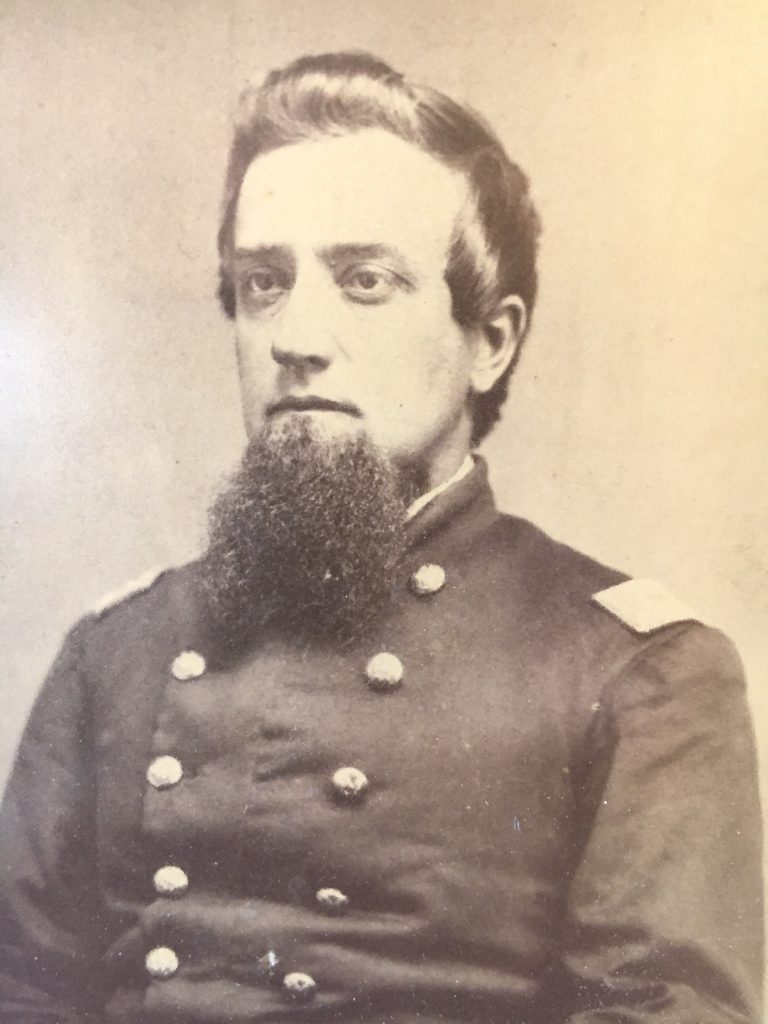
After being organized in Mansfield, Ohio, the 32nd Ohio Infantry was then sent to Grafton, West Virginia (still considered Virginia at the time) and then onward to Cheat Mountain. Abraham Crumbecker’s first letter was written on September 20, 1861, and he describes their journey so far, noting the Battle of Laurel Hill fought several months previous and that the regiment still about eighteen miles out from Cheat Mountain.
“We started from Webster on Tuesday for this place. In coming here, we came through Belington and Laurel Hill where our forces had a fight with the rebels at which place General [Robert S.] Garnett, the Rebel Commander, was killed. You probably remember of hearing me read of the Battle of Laurel Hill. Today we are encamped within 4½ miles of Rich Mountain—the place where the 19th [OVI] Regiment under Beaty had their fight. Mr. Yost pointed out the range of mountains today and if we stay here long enough, we are going up to see the place. We are now within 18 miles of Cheat Mountain Gap—the place of our destination when we were ordered to move from Camp Dennison, but upon arriving here we were ordered to halt and are now here awaiting further orders. The rebels have retreated from their former position. Well, yes, I suppose they heard that the 32nd Ohio Reg. was coming and we have the reputation of being a crack regiment. But I do not write the sentence for truth. I will say the boys are here and anxious for a brush whenever the opportunity offers.”
Abraham Crumbecker seemed to enjoy the posting on Cheat Mountain. On December 1, 1861, he wrote to his wife that they would soon be leaving it.
“When I last wrote you I expected ‘ere this we would have been moved off the Mountain as we had orders to move back to Beverly, Va.—a distance of 24 miles. Colonel [Thomas H.] Ford is now at Beverly and a large portion of our sick have moved there also. We expected to move today but yesterday received orders to remain here until Tuesday when our paymaster will be here and pay our regiment off–or for 2 months—after which I presume we will leave the Mountain. I almost hate to leave the Mountain. The weather is cold here but that is the kind of weather for me. I can stand the cold better than the heat. We have from 3 to 4 inches of snow here now and our boys have fine times hunting. The game here consists chiefly in bear (which are rather scarce), deer, and mountain hare as species of rabbits. I have a beautiful skin that I am going to bring home with me which will make Nora a beautiful muff.”
On January 10, 1862, Abraham Crumbecker wrote about his plans for the future, which included being in the role of aide-de-camp if his colonel was promoted to brigadier general, or being promoted to captain of his company in the weeks to come.
“I am still with Col. [Thomas H.] Ford. We both occupy the same office. I presume we will continue together, as long as I act as his Adjutant. There is strong hopes entertained here that Ford will be promoted to a Brigadier General. He told me if promoted that he wanted me to go with him as his “Aid de Camp.” This you need not show to any person from the reason that he may not succeed in getting a “Brigade” and that I have not yet determined whether I will accept the offer. My pay would be about the same as it now is, but I believe I would not be “Captain” of Co. A, which I think I can be in less than a month. I am waiting my turn which will and shall come, and just as soon as I get my situation secured, and can get an honorable leave of absence, I will come home.”
In March, 1862, Abraham Crumbecker did indeed become captain of company A.
Abraham Crumbecker in the Fall of 1862
In late summer, 1862, the 32nd Ohio Infantry was stationed at Winchester, Virginia. In a letter written August 3, 1862, Abraham Crumbecker hoped that President Lincoln’s call for 300,000 additional troops would lead to a speedy resolution of the war.
“I notice the President has given until the 11th of this month for the citizens to fill up the new call of 300,000 men. If not filled by that time, drafting will be resorted to. Then some of the gentlemen probably will be impelled to go. I think your news about Lee going to war is correct. I do actually think he ought to go and that immediately. The country now needs assistance and it is the duty of all Loyal men—especially young men—to volunteer their services immediately and not wait until they are compelled by draft to go, in which I think there is no honor or credit. But of course other people can do as they please and I am satisfied. One thing certain, the soldiers have been called for an must be had. I am satisfied we will have the most powerful army within the next 60 days the world ever saw and think this rebellion will be speedily and effectually crushed. At least I hope so. I feel anxious once more to enjoy the society of a dear and loving wife. Also the society of our dear little children.”
September proved to be a difficult month for the 32nd Ohio Infantry. The regiment was a captured at the Battle of Harpers Ferry and its Colonel, Thomas Ford, was later dismissed from the service after an inquiry found that he abandoned his defense of Maryland Heights without sufficient cause. The 32nd Ohio Infantry was paroled at Annapolis, Maryland and then sent to Illinois to await official exchange.
In November, 1862, Abraham Crumbecker wrote home to his wife about the large number of desertions that had happened while the regiment waited to be exchanged, estimating that they likely had no more than 300 men still at the camp.
“Efforts are being made in some instances to bring back the men that have deserted. With what success they will meet remains to be told. Our Regiment now only numbers about 300 men all told and I actually believe will not number over 200 in another week.”
Abraham Crumbecker at Vicksburg
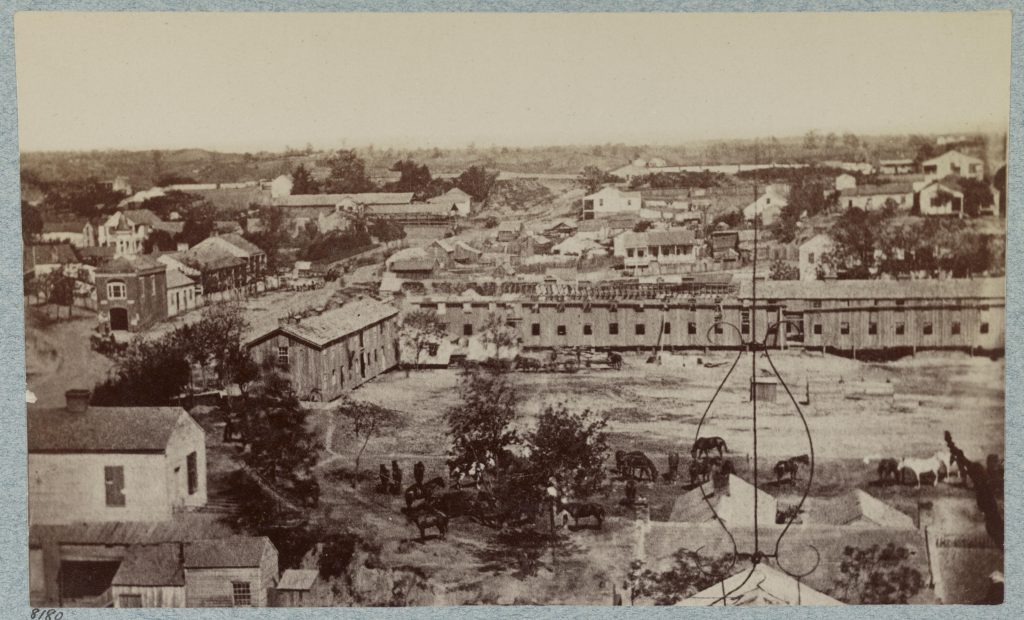
The 32nd Ohio Infantry was officially exchanged on January 12, 1863, but Abraham Crumbecker’s letters don’t resume until July, 1863. By this time he had been promoted to major of the 32nd Ohio Infantry and the regiment was at Vicksburg, Mississippi. On July 9, 1863, Abraham Crumbecker wrote about the recent capture of the city.
“Our Division is likely to remain here. General Logan has command of the post and district. Our capture has amounted has amounted to more than was first anticipated. We have captured one Lt. General, 4 Major Generals, 9 Brigadier Generals, about 50 Colonels. and 30 thousand prisoners, over 120 cannon, and over 60 thousand stands of small arms. Our army is in fine condition and excellent spirits. The Rebels are demoralized and discouraged. Quite a number will take the Oath of Allegiance and come North. Provided our Eastern Army does its duty as I yet think it will, we will soon give rebellion its death blow and the Lord knows quite a number of the enemy would be glad of it.
The weather here is very warm although not as hot as I supposed it would be this time of year. We are now having green corn and I understand there are plenty of ripe peaches at some localities.
We have the report that Port Hudson has been surrendered but do not know whether the report is true or not, but one thing is certain, General Banks have the Rebels in the situation that we had Vicksburg and the place must soon fall it—if has not already—when we will for the first time in two years undisputed possession of the Mississippi from its source to its mouth and the States of Louisiana and Florida are virtually ours.”
A month later, on August 13, 1863, Abraham Crumbecker wrote that he had tried to tender his resignation but it had not been accepted. Evidently, he had discussed this in other letters to his wife which no longer survive.
“I wrote you a few days ago that I had tendered my resignation but that it had been returned disapproved. I have tendered it again. It is more than probable that it will be returned again disapproved. If such should be the case, I dare not tender it again for some time but as soon as there will be any chance, I will do so again. I have made calculations in coming home this fall to stay and if I should not succeed, will be very much dissatisfied. I am bound not to come until I come to stay.”
His resignation was once again disapproved. In December, 1863, Abraham Crumbecker was still at Vicksburg. Though he had given up on trying to resign from the service, he was firm in his desire never to reenlist as he wanted to return home to his family.
“It is my first winter in the South and if I am spared, it will be my last. I am perfectly content to remain the balance of my life with my dear and loving wife, and our dear little children. Let come what will or may. My mind is made up as to my ever again engaging in any undertaking wherein I will be deprived the opportunity of at least visiting my family whenever I please or being able to take them with me. You must give yourself no uneasiness about me re-enlisting for I tell you upon the honor of a man, I will not do it.”
Despite his own feelings about continuing in the service, on January 8, 1864, he wrote that the majority of the 32nd Ohio Infantry chose to reenlist.
“Over ¾ of our regiment has re-enlisted in the Veteran service, and the Regiment will be ordered to Ohio to reorganize and fill up the regiment. We expect to get started within the next few days but may possibly not get off quite so soon. After arriving at Columbus, Ohio, we will be ordered to our respective homes to recruit for 30 days. So you see after all, I will get home this winter on order which is much better than a 20-day leave of absence. I am making calculations and having a glorious good time. While at home and when I come, we will talk the matter over of my remaining in army longer than my term of enlistment. I do not expect to remain that long but I need not write anything about it as we can better understand each other when we talk than when we write.”
Ultimately Abraham Crumbecker served the duration of his initial three-year term of service and resigned on September 21, 1864. He died in 1899.
We’d like to give a special thanks to William Griffing of Spared & Shared for his work in transcribing and sharing these letters.
To read more of Abraham Crumbecker’s letters and access thousands of other Civil War letters and documents, sign up for a Research Arsenal membership.
If you enjoyed this article, check out some of our other featured collections like Henry Murray of the 8th New York Light Artillery and John Madison of the 96th Pennsylvania Infantry.
