
Research Arsenal Spotlight 85: Hosea Paul U.S. Christian Commission
Hosea Paul was born in 1845 to Hosea and Ellen (Gamble) Paul of Cuyahoga Falls, Ohio. While Hosea’s father and some of his brothers served in the Union army during the Civil War, Hosea rendered aid to the cause by serving as a delegate for the U.S. Christian Commission. His letters offer a glimpse at civil aid offered to Union soldiers.
U.S. Christian Commission
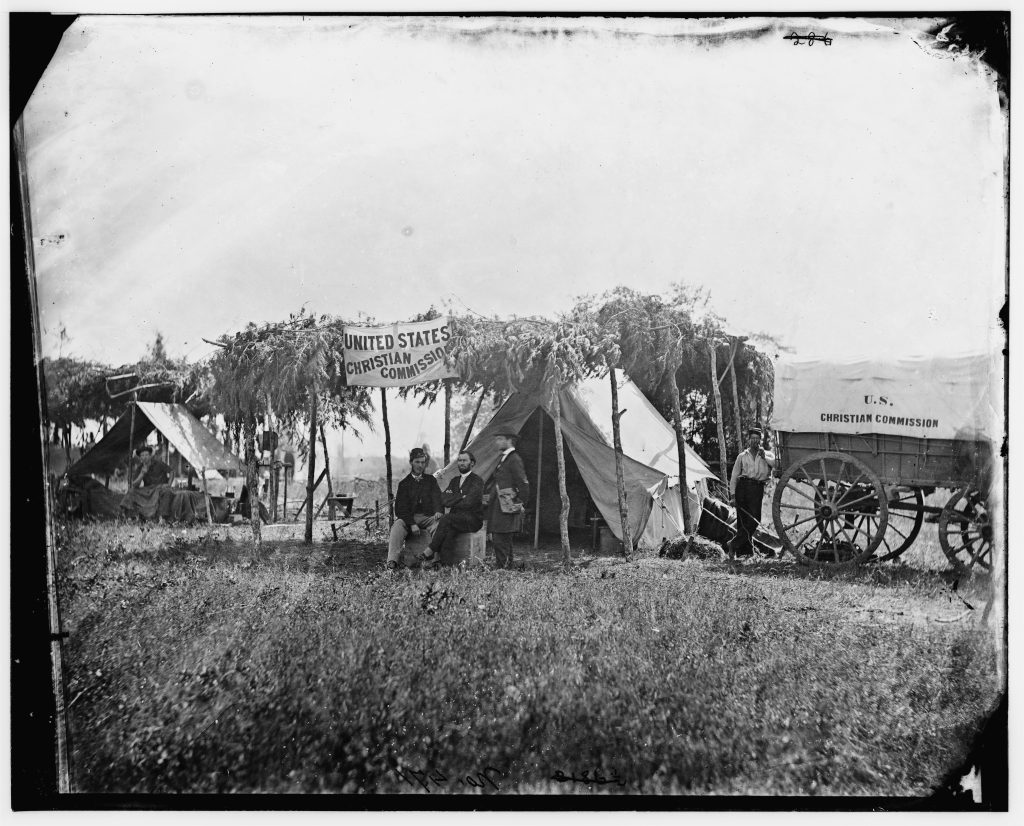
The United States Christian Commission was formed by the Young Men’s Christian Association (YMCA) in November, 1861, in response to the poor conditions after the First Battle of Bull Run. The organization mobilized volunteers to go to Union field camps, hospitals, and battlegrounds and offer aid. Initially intended to offer assistance to chaplains and other religious personnel, the organization quickly turned to helping the overwhelmed hospitals. These volunteers were referred to as “delegates” and were the more religiously minded counterparts to other aid organizations such as the US Sanitary Commission.
When Hosea Paul joined the US Christian Commission in 1864, he was assigned duty at City Point, Virginia. He wrote his first letter on September 3, 1864.
“Yesterday being the day of assignment, I was—at my own request—detailed here which is the General Depot where everything is first brought & delegates first report. But the quarters of the Gen. Agent & accommodations for a large number of delegates are at General Hospital about a mile further up.
I do not think I will have much to do here and my work will principally be in keeping storehouse in order & perhaps doing some writing and acting as kind of assistant to the agent. The delegates at General Hospital are almost entirely preachers and those who are not are theological students. They are going among the wards trying to convert the men, conducting prayer meetings, distributing religious reading matter—mostly testaments, tracts, & religious papers, & to some extent, delicacies.
They are going to send 140 boxes peaches per day to this point. Have had a great many peaches since coming from Philadelphia & expect to have all I want to eat during the season.”
In the same letter, Hosea Paul also described visiting the 10th Army Corps with another US Christian Commission Delegate.
“Day before yesterday, in company with a delegate from New Jersey, I went up to the 10th Corps—that being the nearest & he having friends in it. I saw them firing a 13-inch mortar at Petersburg which was in plain sight, and also they kept firing a battery of 3 30-pounder parrots. The firing was quite heavy & returned to some extent by the rebel works about a mile and a half off. About a mile—or nearly that—lay our advanced picket line, separated from that of the rebels by the Appomattox [river]. The 10th Corps is the extreme right. Most of the fighting is on the Weldon [rail] road about 15 miles from here. I went out six or seven, rode out in wagons & ambulances, but had to walk most of the way back.”
Hosea Paul and Journalist Sylvanus Cadwallader
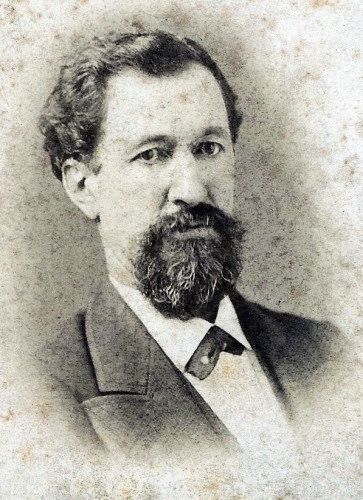
In his letters, Hosea Paul makes frequent references to Sylvanus Cadwallader who was a journalist covering General Grant and his army during the war. Cadwallader worked first for the Chicago Tribune and then for the New York Herald. He also shared a personal connection with Hosea Paul. His wife, Belle (Paul) Cadwallader, was a cousin of Hosea Paul.
On September 14, 1864, Hosea Paul first wrote about visiting Sylvanus Cadwallader and his cousin, Belle.
“This afternoon I went to Headquarters to find [Sylvanus] Cadwallader & found him in his tent. He is chief correspondent of New York Herald in this army and remains at headquarters nearly all of the time. Uncle Daniel carries dispatches for him to Baltimore & is here every third day & will be here tomorrow night.
Belle was down here a few days about the time I came here so I could have seen her. Ed. Paul is with Sheridan in the Shenandoah Valley. If I want to see things now, I have a very good chance. When Belle was here, she had a fine time indeed—a steamboat at her disposal &c. &c. Cadwallader’s quarters are not over sixty rods or a quarter of mile from here and he will do most anything for me. He has a nice ambulance, saddle horses, & the reporters have stations at the various corps.”
In a letter dated September 15, 1864, Hosea Paul detailed the specifics of how Sylvanus Cadwallader got his information from various sources and forwarded it to the New York Herald.
“This afternoon [Sylvanus] Cadwallader came over & I went back with him and staid until nearly dark. He has a very comfortable and quiet place situated in some finely laid out grounds in tolerable preservation, and altogether the prettiest place about the Point. He is the only correspondent about Gen. Grant. The correspondents of other papers are mostly at the front with Gen. Meade or the various corps. But the Herald is the only paper which has an organized corps under one man. Those of the Tribune, for instance, each reporter goes on his own hook.
Cadwallader has a correspondent with each corps and also with each division of cavalry. Their reports reach Cadwallader about nine o’clock & he either cuts them down or sends them by a messenger to Baltimore where it is delivered to another messenger and thus hurried thus to the Herald establishment. If important news it is carried to Washington & telegraphed or it is often telegraphed from Baltimore. This private express system is peculiar to the Herald and Cadwallader says he was forced to adopt it as Stanton would give him no facilities—not even such as he gave to other papers. In fact. Secretary Stanton would not give him a pass & he stays here, I suppose, on Grant’s influence & special order permitting him to do so. But since the adoption of the private dispatch line, he says they are all disposed to accommodate him. But as it is less expensive than telegraphing & answers every purpose, he is not likely to change.”
Things soon became difficult for Cadwallader, as Hosea Paul detailed in a letter from September 24, when Cadwallader received a notice that he had been drafted and was unable to procure a substitute in the area.
“Cadwallader is drafted. He received the intelligence several days ago and went North this morning. He tried considerably to obtain a substitute down here but these darkies have followed the army a good while and have had plenty of opportunities to enlist if they had so desired before this. Uncle Daniel [Paul] was here yesterday and is here today.
During Cadwallader’s absence or until further arrangements, Mr. [James C.] Fitzpatrick who was with the 9th Corps will take his place.”
Hosea Paul oversees stores at City Point
While serving as a delegate for the US Christian Commission at City Point, Hosea Paul frequently detailed the various stores that were coming to the depot to be distributed, usually in large quantities.
In a letter written on September 15, 1864, Hosea Paul wrote about the arrival of new goods for distribution as well as about the other people found at City Point and the competency of the female nurses.
“The work of the Christian Commission is of growing importance. Shipments of stores from Washington are very much increased—so much so we hardly can dispose of some of the stores they send unless they send more men (delegates). I have hardly seen a woman or a dog or a buggy and no cats at all since I have been down here. The women I have seen are either hunting after somebody dead or very sick, or are nurses in the hospitals. And the nurses are essentially strong-minded & could edit a newspaper, keep a large store, or run a farm. Reinforcements are constantly arriving, many of them colored troops, substitutes, &c. They have lots of bounty jumpers, deserters &c. brought in every [day].”
Two days later, Hosea Paul revealed that the US Christian Commission had so many stores that they required more delegates to distribute them. At the same time, he mentioned a recent cavalry raid by Confederate forces that saw a large number of cattle stolen away.
“We are now receiving larger quantities of stores than we can well dispose of unless we have more delegates, stations & teams. We usually send out four or five 4-horse wagon loads each day. Yesterday morning a party of rebs got within 3 or 4 miles of here and drove off 2500 head of cattle. It was a bold operation certainly and there were many confused rumors about it yesterday. A force of cavalry was sent out to intercept them—probably too late. The cavalry force in this army is small, having mostly gone with Sheridan.”
On September 24, Hosea Paul wrote a letter describing in detail the various stores the US Christian Commission sent out.
“I do not have but little to do here but am generally on hand. We send out fifteen 4-horse wagon loads of stuff every week. They consist mostly of canned fruits, extract of Jamaica Ginger, corn starch, Farina, condensed milk, comfort bags, shirts, drawers, socks, pickles, ink, paper, envelopes, soda crackers, cheese, butter, lard, onions, potatoes, beets, dried apples, blackberry root syrup, wines, liquors &c. to some extent. In the tent they have religious newspapers, tracts, bibles, testaments, &c. &c.”
Hosea Paul chose not to stay with the US Christian Commission beyond his initial six weeks of service. He returned home and worked as a land surveyor and later as a city engineer and county auditor. He married Emma Plum in 1875 and had one daughter, Katie, who died young. He died in 1923.
We’d like to give a special thanks to William Griffing of Spared & Shared for transcribing and sharing these letters.
To read more of Hosea Paul’s letters, as well as access thousands of other Civil War letters and documents, sign up for a Research Arsenal membership.
If you enjoyed this article, check out some of our other featured collections, like Uriah Massena of the 6th West Virginia Infantry and Isaac Mead of the 17th Connecticut Infantry.
