
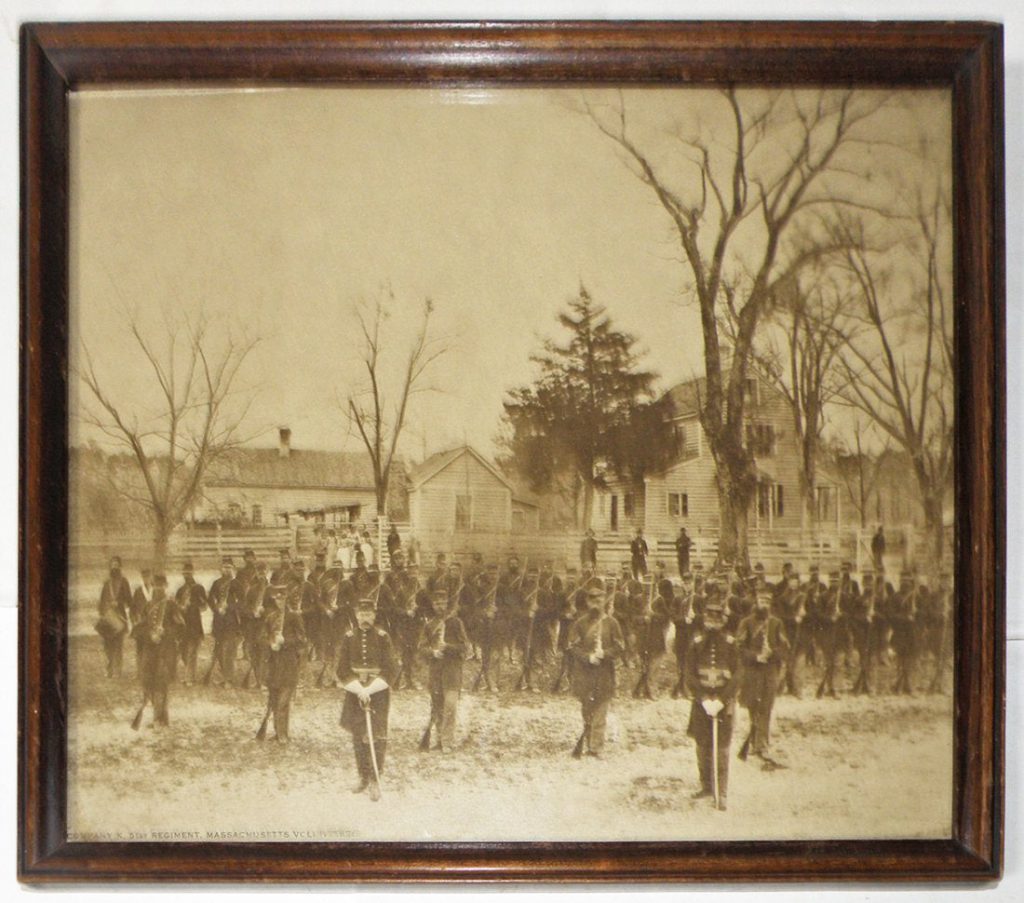
Gustavus Williams was born on October 28, 1834 in Uxbridge, Massachusetts. He married Nancy Bernette Hill in 1859 and had two children with her (a daughter, Myrtle, and son, Hill) when he enlisted in company K of the 51st Massachusetts Infantry in September, 1862. The 51st Massachusetts Infantry was a nine months unit and Gustavus Williams served as a sergeant.
The 51st Massachusetts Infantry in North Carolina
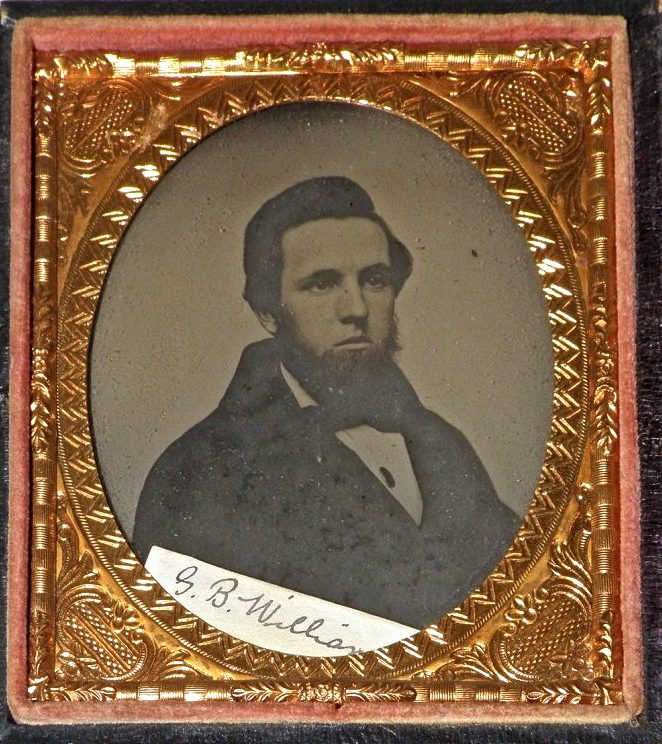
The first letter in our collection was written by Gustavus Williams on February 28, 1863 while he was at Camp Foster, New Bern, North Carolina. By the time this letter was written, he had four months left of service and was eager to return home to Bernette. The regiment had recently moved and Gustavus Williams wrote about his current assignment on guard duty.
“It is Thursday evening after nine. I am on guard commanding nine men who watch the barracks that there may be no thieving done by outsiders. I stay in my quarters but must be up so as to relieve guard every two hours. There seems now to be a definite dispersal of the regiment made in order to check discord. Our company is to take a picket station some six or eight miles east on the right hand side of the railroad as we go east. The 43rd [Massachusetts] have a company there [already]. It is called Evans’ Mills and seems very promising as a station for some weeks or months it may be.”
Shortly after this letter, Gustavus Williams and his company moved to Evans Mills for continued guard duty. He described the quarters he and his men stayed in, in a letter written on March 5, 1863.
“The sergeants and privates have quarters in board huts accommodating from two to a dozen or more each, and the block house — a strong log building of two stories with port holes for cannon and perforations for musketry. There are ten or eleven cavalrymen stationed here as this is an important outpost towards Pollocksville from which an attack — if one were made — might come. The cavalry scour the country around and our pickets comfortably stationed in huts along the road a mile from our company quarters, which are just back of the blockhouse, guard the only approach. The sergeants with corporals remain.
My chums occupy a very comfortable cabin with two tables, three bunks, one chair, two cupboards, and a good fireplace. All the huts have either stoves or fireplaces but ours is the best building and seems quite civilized. When on guard, I stay here, occasionally visiting the pickets, but with not much duty, but having a good deal of responsibility as I command the guard acting Lieutenant.”
In the same letter he described the rather hazardous wildlife in the area.
“It is now after ten P. M. I have just been to visit the outpost guarded by a corporal and 3 privates. Of course I had other posts to pass on the way. All was very bright moonlight, very quiet, but the guard are most watchful. In the creek and swamps we are told are [Water] Moccasins, Copperheads, Rattlesnakes, alligators, wood ticks, and what besides of danger, we don’t know nor wish to know. Our huts have an abundance of rats. We do know but we can guard against them — only keep the Rebs away.”
Gustavus Williams Desires to Return Home
On March 19, 1863, Gustavus Williams wrote home to Bernette and described the difference in conditions for officers and enlisted men.
“Monday I went to Newbern in the little mule cart and drew rations for the company for fourteen days (I did not draw them home).
The spring advances much more slowly than at the North but flowers are quite plenty along the road and in the yards of the city houses where dandy officers — many of them with wives and families — live luxuriantly. After a hard task running for orders on this and that official — for [red] tape is the rule everywhere — I got my work done and in my little wretched springless cart drawn by the smallest and most unhappy of mules, through mud holes, through woods, and difficulties of various descriptions, my companion, Corporal Heath, and I plodded home tired and dirty.
The Captain the same day, on a fine horse, well dressed, gaily rode to town full of business, credit or money, and a good time, good company, a good ride home, a good supper &c. awaited him. No wonder he expects to enter the army again — if spared to return. Could I believe it right to live thus on a country in struggles for life, and had I no wife and bairns to stay with at home, I might try for a commission myself. The ifs are large enough to prevent that, however, and I can’t say I’m sorry I had no commission and I certainly have no complaint to make of either of our officers treatment of me.”
Gustavus and Bernette spent much time discussing articles they read in issues of the Atlantic as well as various books including The Count of Monte Cristo. Another topic of conversation was Bernette’s hope that Gustavus could return on a furlough, which Gustavus felt was very unlikely although he very much wished for it, too.
“You speak of a furlough as possible. I think the nine-months men will not get any; their time is too nearly expired and the claims of the three years men ought surely to be considered before ours. Still it is so hard to have a son at home whose face I have scarcely seen and a daughter I had learned to live with, a wife — the light of my life, and I so far away in a kind of slavery. I am glad my boy is to resemble me so much. At the worst, you can never forget the father while the son resembles him.”
Gustavus Williams at the Hospital
In April, 1863, Gustavus Williams began suffering rheumatism and pain in his feet. He went to the doctors to get it treated, but as revealed in a letter written on April 19, 1863, the treatment seems to have made his condition considerably worse.
“I am now more of a cripple than when I wrote last. My rheumatism is little better, if indeed it is improved at all. The doctor urged me to bathe with iodine and I reluctantly did so a very few times. The result was an eruption on the side and bottom of my foot which appeared and felt like ivy poison. Presently blisters appeared — itching and burning. The doctor said pinch them. I told him I feared erysipelas. He didn’t so I opened one or two of them. They grew worse and my foot began to swell generally so I dismissed the idea of following the doctor’s orders believing as I do now that erysipelas was there surely and must be fought. My good angel — my wife — had sent just the material for bandages long before and F. Washburn was the one to put them on. After carefully applying these just as your mother did to my sore arm and hand for a day or more, the selling and much of the inflammation abated. Now, some three days later, my foot is quite comfortable though still red and inflamed — comparatively less — and requiring great care.”
Erysipelas is a bacteria infection that presents the same symptoms as what Gustavus Williams described. In the same letter Gustavus Williams also wrote what he head about attempts to capture Washington, North Carolina, frequently referred to as “Little Washington.”
“Our troops went out towards Little Washington but soon returned — the men disgusted that they were not suffered after their hard march to fight — the officers declaring the enemy present with twice our numbers. Another expedition has started. Little Washington still holds out. A steamer is said to have run the blockade with provisions for [General] Foster. Night before last, firing was heard over towards the Neuce [Neuse River]. The captain said yesterday the Rebs had planted a battery below New Bern on the Neuce [Neuse] and were firing on passing vessels. They’ve tried the dodge before without success.”
In another letter written on the same day (April 19), Gustavus gave a similar appraisal of his situation and that of the army to his sister, Emily.
“I believe I wrote before of a humor which had appeared on my right foot. It is now on both and nearly prevents my walking — especially as I was lame before. This humor appears just outside of the places of my feet which were lame. It is like poison [ivy] on the foot first attacked. It is deep and has been severe but is, I trust, better, and I hope also when well the lameness will also be gone. Otherwise I am well and comfortable.
Gen. Foster who was ‘shut up’ at Little Washington has been reinforced and since returned to New Bern. He is now off with a large force after the Rebels who are reported to have abandoned the siege of Washington and ‘skedaddled.’ We have never been disturbed here. Have been here since March 2.”
In the final letter in our collection, written May 23, 1863, Gustavus Williams wrote that despite his ill health, he was able to convince his doctor to let him return to his regiment where he hoped to soon muster out rather than remain under care.
“Last night I rode to Foster Barracks to see Dr. [George] Jewett who sent an order for me to go to the camp and as I feared, to the hospital to be drugged under his eye. I dressed in my best and used my best arguments to show that I should be best here. He said that as the regiment was to go home in a very few weeks, he disliked to send me home in my present condition. Indeed, it seems unlikely that Coleman will get his papers signed by the General as his time is so near out. Dr. Jewett was unwell and very affable and courteous, said I might take some medicine he would send me with directions. The medicine had come but no directions. Hence, I wait for further orders. At the Quartermasters was my half barrel — arrived a day or two before. Lery drive me over in the mule cart. So we waded it in and came back, rejoicing in my escape and in my barrel.”
The 51st Massachusetts Infantry was mustered out on July 27, 1863. Gustavus Williams and Bernette had several more children together and he went to work as a lawyer alongside his father-in-law. Bernette passed away in 1880 and Gustavus Williams died in 1910.
We’d like to give a special thanks to William Griffing of Spared & Shared for his work in transcribing and sharing these letters.
To read more Gustavus Willliams’ letter and access thousands of other Civil War letters and documents, sign up for a Research Arsenal membership.
If you enjoyed this article, check out some of our other featured collections like Benjamin Blatchford of the 2nd Massachusetts Heavy Artillery and Elbert Corbin of the 1st New York Light Artillery.
