Research Arsenal Spotlight 54: Charles Brayton 3rd Massachusetts Infantry

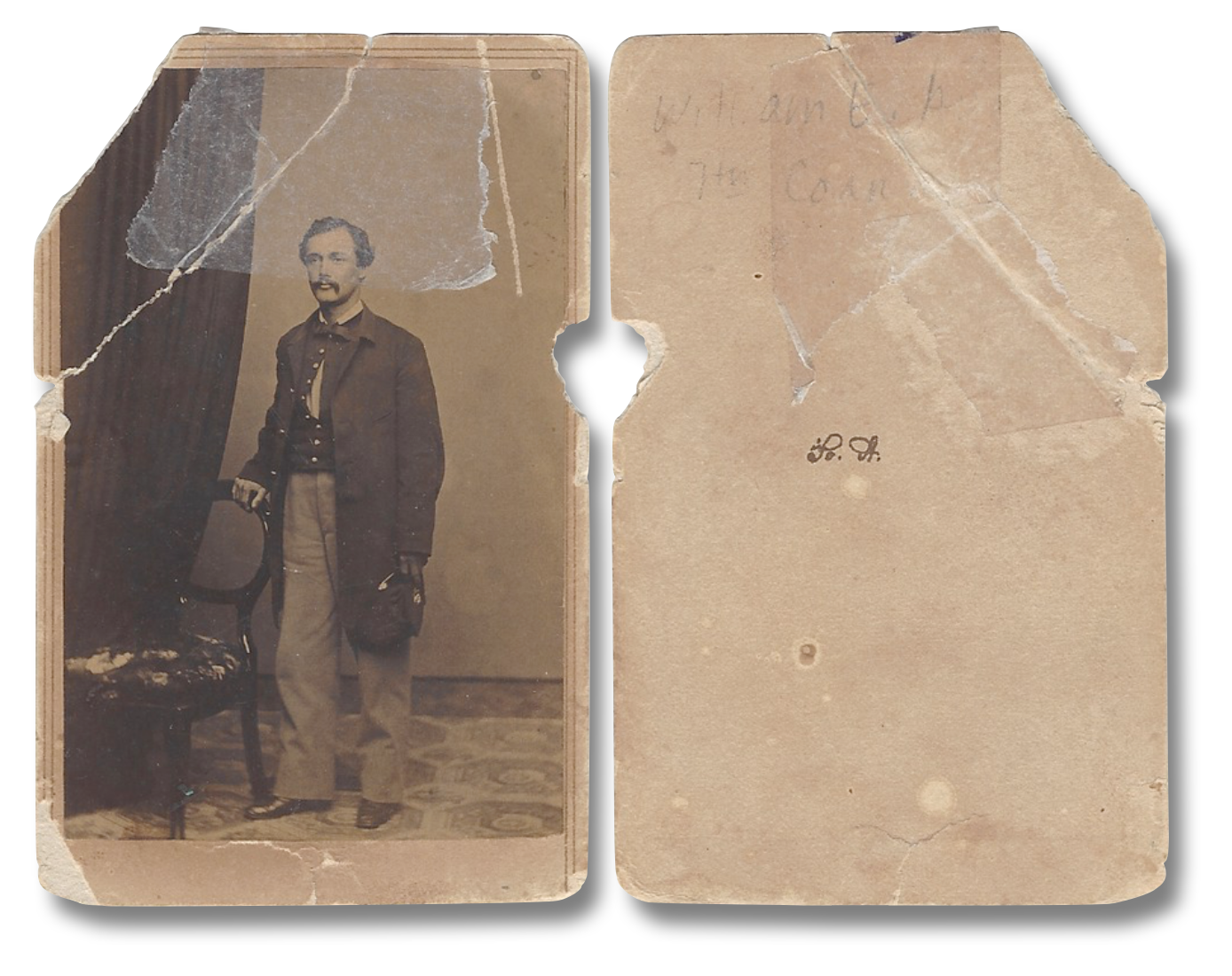
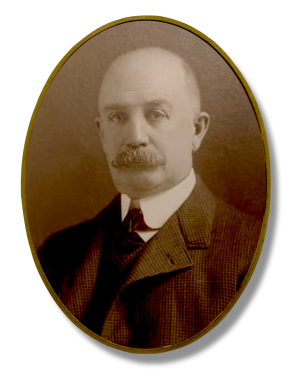
Charles Brayton was born in 1843 to Shubael F. Brayton and Mary M. (Bunker) Brayton of New Bedford, Massachusetts. Before the war, Charles Brayton worked in an apothecary. He served in Company E of the 3rd Massachusetts Infantry when it was organized for 9 months duty in September, 1862.

Thanksgiving in North Carolina

Charles Brayton wrote his first letter in our collection on November 30, 1862 from Camp Richmond near New Bern, North Carolina. He had just finished regimental inspection, which he was not fond of.

“We have just come in from Regimental Inspection by the Colonel. It takes about 2 hours to go through the routine, musket, knapsack, haversack, and canteen. It is the only thing I dislike in the military life for I only have Sunday to clean up for I am busy the rest of the week.”

Further in the same letter, Charles Brayton went on to describe how the regiment celebrated Thanksgiving, which included some of the officers and men exchanging roles as well as a large feast.

“We had a splendid dinner Thanksgiving. We had 6 turkeys, 6 geese, 5 chickens which cost us $20 and a beautiful stew we had. It tasted as good as any I ever had to home. Anyhow, I had 3 plates full. You may laugh because they made a stew out of them. It was the only way we could cook it conveniently. I suppose you was thinking that we had nothing but hard bread and meat. Thanksgiving is made a holiday in the army—at least Major Gen. Foster gave the orders for services in the morning and pleasure in the afternoon so we had no drills during the day. At the close of the afternoon we had a mock Dress Parade. The sergeant major acted as colonel. The quartermaster sergeant as lieut.-colonel. and sergeants as captains and lieutenants in our company. E____ ___ was captain. Jim ___son was lieutenant. The officers was spectators and said that we done better than on the regular Dress Parade. In the evening we went and serenaded the captain [John A. Hawes] and he called us in and treated to apples. We generally have taps at 8 o’clock but being a holiday, [ ] the next camp to us the 44th Massachusetts. There was one company that raised $100 for a dinner. As a general thing, the whole regiment had a great dinner. Tables spread and invited their officers in to dine with them. In the evening they had a dance and kept it up till 12 o’clock. Our Colonel, Lieut.-Colonel, and Major had an invitation over. I had as good a time Thanksgiving as I ever had to home.”

3rd Massachusetts Infantry at New Bern

Lithograph of New Bern, North Carolina from 1864.
Lithograph of New Bern, North Carolina from 1864 via Wikimedia Commons.

By December 7, 1862, duty in North Carolina was becoming routine for Charles Brayton. The monotony of the duty also made it more difficult to write home with anything new to report. As before, inspections proved to be the most irksome duty for Brayton.

“Every Sunday morning we have to go on inspection which is 10 o’clock and lasts about an hour. After that there is nothing to do till Dress Parade which is at ½ past 4. You say that I ought to write a little every day but if you was here you would think different for we drill about 5 hours a day and what little time there is we take to clean our muskets. Those we have to keep as clean as a pin for if the Capt. should find any dirt, we would be sent to our quarters to clean them but if I am in guard or picket, I may get a few moments to write a few lines. And another thing, there is not much news out here. The 3-year boys say that they don’t write so much as they did when they first came out for the very reason that there is no news of importance out here.”

During this time Charles Brayton was assisting the hospital steward because of his experience as an apothecary before the war. In April of 1863, Charles Brayton found himself rushing back to camp after hearing that the 3rd Massachusetts Infantry was about to move out on an expedition.

“…As quick as we got to camp, everything was in confusion for we were to start in an hour with 3 days rations.

Dr. [Alfred A.] Stocker and Hospital Steward got ready and left for Dr. [Woodbridge R.] Howes and the “Apothecary” to look after those left behind. The regiment started at 5 o’clock for Foster’s Wharf to board transports but when they got there, they had to wait ¾ hour (military necessity) for the transports were not ready just then. A “Dispatch Boat” arrived from Gen. Foster at Little Washington, so the regiment had orders to return to their camp where the “Boys” arrived at ½ past 6, much pleased with their Expedition. Today the regiment is under marching orders to be ready to move at a moment’s warning with 3 days rations cooked and 7 uncooked, but at the same time we may not start at all. If the regiment does go, it is doubtful whether I go or not for Dr. Stocker generally goes, and Dr. Howes stays behind, and when Dr. Howes is left behind, I stay too.”

Charles Brayton also noted that the news of the expedition also led to a large increase in the number of men coming to the hospital claiming to be sick.

“Every regiment in Newbern is under marching orders. I had considerable “Business” this morning at morning call. We had 90 cases, and I tell you I had to “fly around some.” If I had as many prescriptions to put up to home, I should be doing a ‘big business.’ Yesterday we had only 30 cases so you can see what the idea of an Expedition will do. If I was some of them, I would be ashamed of myself. There is one thing I can say—that I never missed a day’s duty while I was with the company.”

Charles Brayton Develops Rheumatism

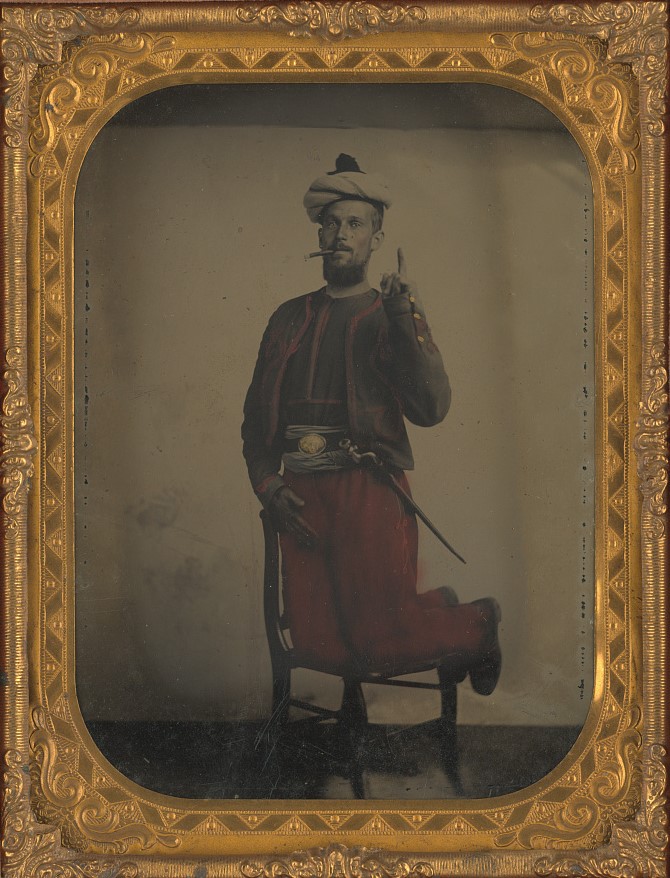
Photo of Charles Brayton taken sometime after his promotion to sergeant while serving in the 15th Massachusetts Infantry.
Photo of Charles Brayton taken sometime after his promotion to sergeant while serving in the 15th Massachusetts Infantry via Spared & Shared.

On May 3, 1863, Charles Brayton revealed that his rheumatism, which appears to have been a longstanding issue, developed to a point where it became difficult to do his duty as an apothecary.

“Well my rheumatism has got out of my legs into my feet, and there it has stopped. For how long, I can’t tell you. My feet and ankles are so swelled that I can’t wear my boots so I am wearing the carpet slippers that Phebe gave me. I don’t know what I should do without them.

My feet don’t ache only when I walk so Dr. [Woodbridge R.] Howes has stopped me from attending the morning call and makes me lounge on the bed. Says if I walk on them, it irritate them so he wants me to keep as still as I can, and he thinks I shall soon get over it which I hope I shall. I have lost 10# of flesh, but Dr. Howes says I will gain it again as soon as I get rid of the rheumatism.”

Charles Brayton also suspected that there would be a pause in military activity as the summer heat made it very difficult for either side to accomplish much.

“I don’t think that we will go on another Expedition—our time is so near out—and besides, they are placing the 3 years troops in summer quarters. Some are up to Little Washington; others are guarding the railroad from Newbern to Morehead City, and that looks as if there were not much to be done till next fall, for the Rebels can’t march in hot weather any better than we can.”

In a letter written a few days later on May 6, 1863, Charles Brayton revealed that the temperatures had climbed very high even in the shade.

“The weather with us is very warm so that yesterday down in the city the thermometer was 105 in the shade. It is so hot that we have drill from 7 to 8½ in the morning and from 4 to 5½ in the afternoon. So you see they have to take the cool of the day to drill in.”

The 3rd Massachusetts Infantry mustered out in June, 1863. Charles Brayton went on to serve in the 15th Massachusetts Infantry where he was promoted to sergeant and mustered out in June, 1865. He died in 1916.

We’d like to give a special thanks to William Griffing of Spared & Shared for his work in transcribing and sharing these letters.

To read more of Charles Brayton’s letters as well as access thousands of other Civil War letters and documents, sign up for a Research Arsenal membership.

If you enjoyed this article, check out some of our other featured collections like Charles Hobbs of the 13th New Hampshire Infantry and Gustavus Gould of the 17th Vermont Infantry.


Research Arsenal Spotlight 53: Charles Hobbs 13th New Hampshire Infantry

Charles Hobbs was born in 1844 to Moody Hobbs and Elizabeth P. (Spofford) Hobbs of Pelham, New Hampshire. Moody Hobbs served as a state senator in New Hampshire in 1863. Charles Hobbs enlisted on August 18, 1862 and was mustered in as a corporal on September 20, 1862.

Charles Hobbs Enlists and Gets Sent to the Hospital

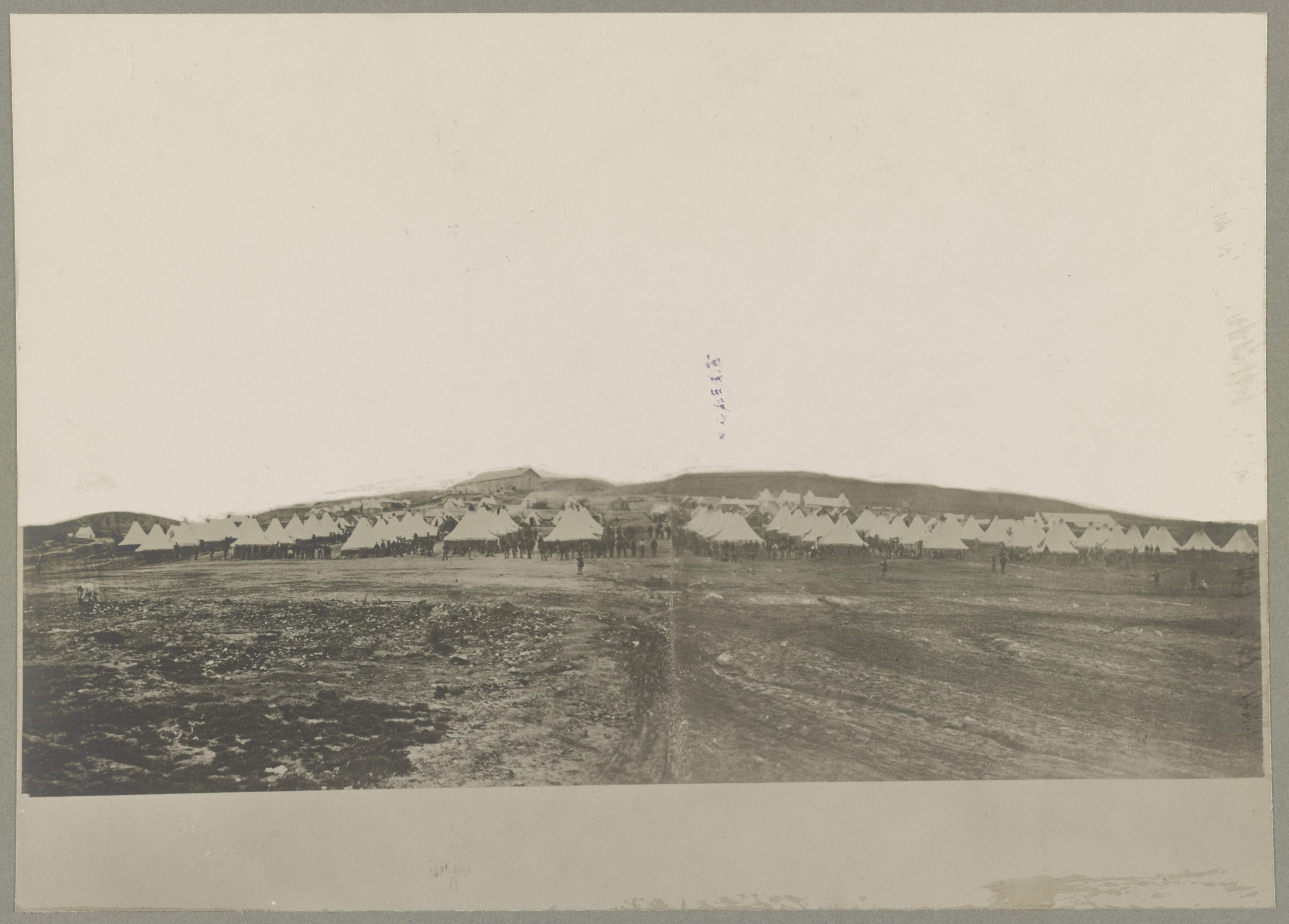
Image of Camp Carver with Columbian College in background. During the war Columbian College served as a hospital and Charles Hobbs wrote several letters while there.

The first letter in our Research Arsenal collection was written by Charles Hobbs on October 12, 1862 from Camp Chase, Virginia. He wrote to a friend named Louisa Richardson and recounted his travel from New Hampshire to Virginia.

“Here we are encamped on the sacred soil of ‘Old Virginia’ and are enjoying ourselves as well as can be expected in such a miserable place. We had a splendid time coming on till we left Philadelphia and from there we didn’t have so splendid a time. Our ride from Norwich to Jersey City on the steamboat was splendid but some of the rides in the freight cars rather annihilated the pleasant feelings about the boat ride. We took the steamboat the first night after leaving Nashua and got to Philadelphia the second night and had a splendid time there and got to Washington the third night and had a splendid time there sleeping on the ground among the hogs — or not exactly among, but they were all round us. Slept as sound there, however, as I ever did at home.”

Charles Hobbs’ second letter was wasn’t written until April 15, 1863, and by that time he was away from his regiment and at Columbian Hospital in Washington, D.C., recovering from long term sickness. He described his eagerness to return to duty and noted that his ward was overseen by a woman nurse named Miss Snow.

“I hear that my name is put down to do duty round the Hospital as he thinks I ain’t able to go to the field. Well, I guess he is right there, but he won’t keep me a great while after I am able. I am tired of staying in a hospital.

We enjoy ourselves here pretty well but there isn’t the excitement that there is with a regiment in the field. I thought before I came here that almost any place was better that the regiment, but I have changed my mind. The nurse on this ward is a nice, lively woman — always having some fun going on and the boys are all such lively fellows and we have some good times.”

Later in the same letter Charles Hobbs lamented the indifference to death that permeated the hospital.

“There has three men died this ward since I came here — one of them from my regiment, and one from it in the next ward. He belonged to my company. There is enough to do here but I don’t like to do it.

There is no more notice taken after men’s dying here than there is a killing a fly at home or not much more at any rate.”

On June 5, 1863, Charles Hobbs wrote again from the hospital where he hoped to rejoin the 13th New Hampshire Infantry soon.

“I wish about 40 times a day that I was with the regiment but I can’t go as I know of. I am in hopes to get a chance to go. I don’t like the name of staying around the hospital when I am well and I am pretty well now. I tried to get the doctor to let me go a few days ago but he said he couldn’t.”

Despite Charles Hobbs hoping to leave the hospital soon, he was still there at the end of July. On July 20, he wrote to Louisa about the way the men in the hospital had celebrated the Fourth of July.

“The 4th passed off here very well. We had speeches, singing &c. in the day and fireworks in the evening. The soldiers not contented with the fireworks they had been through amused themselves by firing rockets and other kinds of fireworks at each other and on the whole we had quite a lively time.”

Conscripts and Substitutes join the 13th New Hampshire Infantry

It wasn’t until September 15, 1863 that Charles Hobbs sent his first letter to Louisa from his regiment. While he was happy to have finally been discharged from the hospital, duty with the regiment proved to be quite arduous.

“I will write a few lines to you to let you know that I am still alive and you will see by this that I have arrived at the haven of my hopes — that is the regiment. Well I am with it and I am glad of it. It seems almost like getting home only not half so good.

I got a letter from you about a year ago, I should think it was. At any rate, it was just before I left the hospital and I have not had a chance to be where I could write to you and stand any kind of a chance to get an answer. I have been through Washington Convalescent and Distribution Camp, from there to Alexandria, then down the Potomac to Point Lookout where we left some of our boatload, thence down the Chesapeake Bay to Fortress Monroe where we went over to Norfolk, by the wreck of the Merrimac and the Rebel Battery at Craney Island that so much was said about at the beginning of the war.

Crossed over to Portsmouth that night and stopped there till the next forenoon when I came up to the regiment which is about 3 miles from Portsmouth and have been pretty hard at work shoveling and shopping since then. We are busy building roads, fortifications, and felling the trees to get a good range for the cannon when the Rebels come.

We have to work like dogs all the time and live worse still.”

On October 8, 1863, Charles Hobbs wrote about the arrival of the first conscripts and substitutes to the regiment. Many of them tried to desert almost immediately.

“Conscripts or substitutes came to the Regiment last Sunday and it took all the old men that were here to keep them in camp that night. Quite a number of them have deserted already and some of them are under arrest an in the guardhouse now. One fellow, they say, has enlisted 6 times and has about $2,000 with him that he has got as different bounties. He says he don’t want to enlist but once more. Well I don’t want to enlist but once more and I think I shan’t enlist for more than 2 more — 3 years in the service.

I should kind of like to enlist in the Home Guards. That is about as good an organization for soldiering as these. It is good fun to be a soldier and board and lodge at home but it ain’t quite as pleasant here. Still I can stand it good if I am only well. But if a fellow feels a little sick, he thinks of home — or at any rate, I do.”

Substitutes in particular put the discipline of the regiment to the test. Charles Hobbs described the harsh punishments used against them in a letter written on October 21, 1863.

“We are having great times with our “Subs.” They get drunk and get to fighting or some such “deviltry” every day and then they take 4 or 5 of them everyday and fasten logs of wood to their legs and they have to drag them till they get tired out. Yesterday they had one fellow with a barrel on for a coat and a log tied to each leg and he had to travel from 9 in the morning till 5 in the afternoon and if he hadn’t been mightily tough it would have killed him. Most of them are so tough that they can’t be killed. We had before they came a steady, quiet regiment, but now we have got anything but that. There was some of the worst men I ever saw amongst them and a very few good men.”

Fighting at Drewry’s Bluff

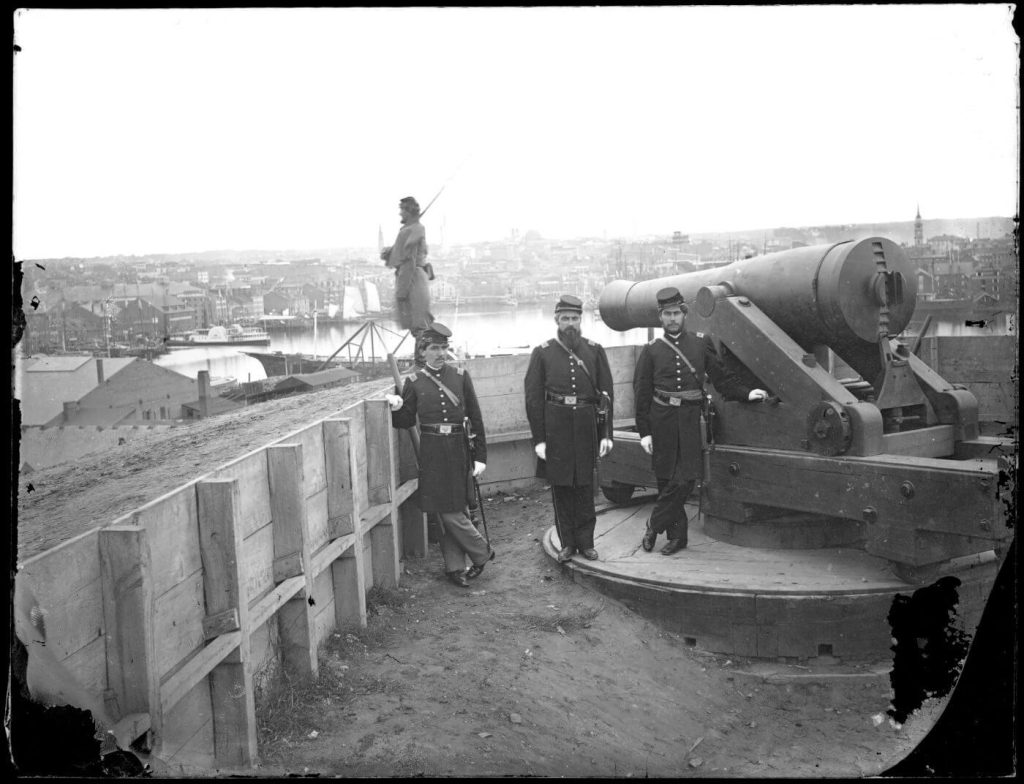
Confederate Defenses at Fort Darling, Drewry’s Bluff, Virginia.

On April 18, 1864, Charles Hobbs wrote about a raid the 13th New Hampshire Infantry participated in.

“In my last I said I was going to write to you as soon as I got the regiment and now I begin this. I got here a week ago tonight and the next night we started out on a raid and were gone till Friday. We marched like fury all the time we were gone and by the time we got back, we were a sore set of boys.

Had quite a time coming on here. Got among a pack of thieves and cutthroats and lost some of my things and was some afraid of losing my life for awhile.”

On May 18, 1864, Charles Hobbs wrote a long description of the recent battle near Drewry’s Bluff as part of General Benjamin Butler’s campaign.

“It was a week ago today (that was last Monday) that we had a pretty hard fight with the Rebs and our brigade gave them a good thrashing but they drove our men on the right of us and we had to fall back. They charged on us 3 or 4 times 4 columns deep but we gave them such a fire that they had to fall back. Our company took 13 prisoners that day.

The Saturday before we were out skirmishing (our company) and had quite a lively time with the Reb sharpshooters. They pelted us hard as we crossed an open field but we were none of us hit. Then we came to some woods and then according to skirmish rules, each man took a tree or stump and watched for them. It is rather exciting business to stand behind a tree, look out to see a reb, and have a bullet plunk into the tree in front. But then it would be our turn to him a crack while he was loading. We were in plain sight of the rebel fort near Drury’s Bluff and when we were skirmishing, were within rifle shot of it.

We have had quite a turn at fighting for the last 2 weeks and I must say I want to see no more of it. We have been under fire 8 days and only lost some 60 men in the regiment. You may want to know who we are under so I will tell. We are in Burnham’s Brigade, Brooks’ Division, Smith’s Corps (the 18th) under Butler.

Enough of war. I wish there was no such thing known. All I want is to get home in safety. Then if I go to war again, I shall do so with the expectation of getting shot. Charlie Philbrick (Lucy’s brother) of the 3d had an arm shot off in one of our fights. We have lost none of our company.”

In the fall of 1864 Charles Hobbs took sick with malaria and once again found himself hospitalized. He remained in various hospitals until his discharge on July 5, 1865. In 1870 he married Sarah Abbie Jane Sleeper. He died on April 21, 1924.

We’d like to give a special thanks to William Griffing of Spared & Shared for his work in transcribing and sharing these letters.

To read more of Charles Hobbs’ letters sign up for a Research Arsenal membership.

If you enjoyed this article, check out some of our other featured collections like Gustavus Gould of the 17th Vermont Infantry and Theodore Vaill of the 2nd Connecticut Heavy Artillery.

Research Arsenal Spotlight 53: Gustavus Gould 17th Vermont Infantry

Gustavus Gould was born in 1843 to Joseph Gould and Lucinda (Sanders) Gould of Montpelier, Vermont. He enlisted in Company E of the 17th Vermont Infantry on February 24, 1864. The regiment finished organizing in late April, 1864 and was assigned to the 9th Corps of the Army of the Potomac.

Gustavus Gould Arrested as a Deserter

Post War photograph of Gustavus Gould who served in the 17th Vermont Infantry.
Post War photograph of Gustavus Gould who served in the 17th Vermont Infantry via Spared & Shared.

Gustavus Gould’s letters in our Research Arsenal collection begin on a serious note. On December 18, 1864 Gustavus Gould wrote home to his father from the Guard House at City Point, Virginia.

“I take this opportunity to write a few lines to you to let you know where I am. I am here in the guard house. They have sent me here as a deserter. I don’t see how they can make out desertion against me for you know that I was arrested before my furlough was out and was right there at home.”

While there aren’t any more details about how he ended up being arrested for desertion while on furlough, evidently he was able to clear things up relatively quickly because his next letter was written from Fort Davis, Virginia, in January, 1865, where he had returned to his regiment. After writing about small occurrences to his brother, Jerome, Gustavus Gould then addressed his parents.

“I suppose you and father have worried yourselves a great deal about me and I don’t wonder at it for I had a hard road to travel but never mind that. Trouble is all over with now so I hope you won’t worry anymore for I am alright now and I shall come home again sometime. Perhaps the time will not be long before I shall be there.”

The 17th Vermont Infantry at Petersburg

On February 12, 1865, Gustavus Gould wrote home to inform everyone that the 17th Vermont Infantry had moved to Petersburg, Virginia. By this time the siege of Petersburg had been ongoing since June, 1864. At least initially, Gustavus Gould found their duty there preferable to that at Fort Davis.

“We moved here yesterday morning. We have moved about two miles to the left of where we was. The order came about 1 o’clock that night for us to pack up and be ready to march at any moment. We got ready and started about 3 o’clock in the morning. We moved in the night so as to conceal it from the Rebs. The whole Army of the Potomac is on the move now. We found very good quarters here. They are good log huts. We was busy all day yesterday repairing them, Four of us tent together—Frank Taylor and two other fellows tent with me. This is a good place but I don’t know as we shall stay here long. Our duty is not near so hard as it was in the fort.”

A few days later on February 23, 1865, Gustavus Gould wrote again and mentioned the ongoing cannonading going on between Union and Confederate forces.

“They say that Charleston is taken with a heavy loss on the Reb’s side. They talk up peace pretty strong out here but I think there will be a hard campaign this summer than ever was fought. They are a fighting now on both sides of us—to the right and left we hear heavy cannonading most every day.”

The 17th Vermont Infantry continued to do duty outside of Petersburg but on March 2, 1865, Gustavus Gould had an unwelcome surprise with his pay. He wrote to his family:

“The Rebs are deserting very fast now-a-day. I see squads of them that come in most every day. They desert from the picket line. 48 came in the other morning. They says they can’t stand it much longer.

We was paid yesterday here but I did not get a damned cent. I have got money enough. The boys was owing me enough so I can get along first rate as far as that is concerned but that ain’t the thing of it. The regiment was paid four months pay—that would be 64 dollars. They stopped 30 dollars of my pay on the payrolls. I was sent here as a deserter [and] my pay was stopped while I was under arrest so of course they was only two months pay earning to me. The Adjutant told me that he would fix it so I should get the other 2 months pay next time we was paid but they will stop 30 dollars for charges of arrest. I don’t care a damn about that but that provost marshal will catch hell sometime if I live.”

As the fighting continued, desertion was a problem on both sides as Gustavus Gould revealed in a letter written on March 9, 1865.

“Four men deserted from our regiment this week. The Rebs are deserting over here fast. Frank Hoget and Wilder have got here.”

On March 13, 1865 Gustavus Gould wrote about an accident that occurred in his regiment and claimed the life of one man.

“We had a hard accident happen here in our regiment last night. When we went out on dress parade, one of the boys took his gun—as he supposed—but he made a mistake and took another man’s gun that was loaded. When the dress parade was over, we came back to our company streets as usual [when] this fellow commenced fooling with his gun. He put a cap on his gun and aimed it at this fellow’s head and fired. The ball struck him on the top of his head and came out on the back part of his head. He fell instantly and did not live but a few moments. The fellow that done it will be court-martialed and severely punished for it and perhaps fined.”

Return to City Point and Discharge

City Point Docks.
City Point Docks via Wikimedia Commons.

On April 23, 1865 Gustavus Gould wrote to his father after an arduous march from Petersburg back to City Point, Virginia. Despite his tiredness, he was excited by the prospect of soon being discharged.

“Well we have had a pretty hard march. We started from Burksville last Thursday morning about daylight, marched from daylight till dark everyday. Today is Sunday. We marched about 80 miles in 4 days. We got here about 3 o’clock today. We have camped here for the night. I expect we shall take the boat and go to Washington. That is the report. It is getting dark and I must close till morning.

April 24th—I will try and finish my letter this morning. I am well and feel first rate this morning. after the march I was pretty tired. Last night the order has come for us to take the transport at 2 o’clock today and go to Washington. The whole Corps is a going there. When we get there, I don’t know what will be done. A good many think we are a going home on discharged furloughs and some think we go South to Texas or some other place but none of us know where we shall go. I don’t think it would be strange if we should come home but I shan’t be disappointed. Let them go where they will.”

Gustavus Gould’s final letter was written from Alexandria, Virginia on April 29, 1865.

“We arrived here yesterday. We had a very good time on the boat coming from City Point here. We was two nights and one day on the boat.

I received your letters of the 21st and 23rd yesterday. We are getting good news here today. If it is true, I shall be at home before long. The paper states that the army is to be discharged as soon as possible. The 1st Division of the 9th Corps is at Washington and they are mustering them out as fast as possible. The 2nd Division comes next—that is ours. I need not write anymore about it for you will see it in the papers. We don’t have anything to do here except to eat and keep ourselves clean. I think we shall be mustered out before long. I think I shall be at home to go to the 4th of July at any rate.

We was mustered today for pay. They have made a hell of a mistake about my pay and if they don’t find out, I shall come out pretty well. I saw the pay rolls and they hadn’t got anything charged to me excepting what I was paid at Burlington. There is $240 dollars due me on the pay rolls bounty which ought to be 160. They hadn’t got any monthly pay charged to me. If they don’t find it out, I shall get a pretty good haul. I am acquitted of desertion and 32 dollars stopped to pay expenses of arrest.”

Gustavus Gould and the rest of the 17th Virginia Infantry musted out on July 14, 1865. He married Mary H. Adams after the war and lived in Montpelier, Virginia. He died in 1910.

We’d like to give a special thanks to William Griffing of Spared & Shared for his work in transcribing and sharing these letters.

To read more of Gustavus Gould’s letters as well as thousands of other Civil War letters and documents, sign up for a Research Arsenal membership.

If you enjoyed this article, check out some of our other highlighted collections like Theodore Vaill of the 2nd Connecticut Heavy Artillery, and Henry Chandler Smith of the 1st New York Mounted Rifles.

Research Arsenal Spotlight 52: Theodore Vaill 2nd Connecticut Heavy Artillery

A few weeks ago we highlighted our collection of letters by Joseph Vaill, this week our focus is on his brother, Theodore Vaill of the 2nd Connecticut Heavy Artillery.

Theodore Vaille was born in 1832 to Reverend Herman Vaill and Flora (Gold) Vaill of Litchfield Connecticut. He originally enlisted in the 19th Connecticut Infantry in 1862. On November 23, 1863, the 19th Connecticut Infantry was redesignated as the 2nd Connecticut Heavy Artillery.

Theodore Vaill on duty near Washington, D.C.

Before becoming the 2nd Connecticut Heavy Artillery, the 19th Connecticut Infantry spent most of its service as part of the defenses for Washington, D.C. On November 29, 1862, Theodore Vaill wrote home about his current duty of guarding large amounts of commissary stores.

“I am on guard from 10 till 12 tonight in a building as long as from our west barn to John Plumb’s, and filled with boxes of nothing but Army bread. All I have to do is to sit here with a light, or stand here, and protect this mountain of bread on a box of which I am now sitting. Three [civilian] watchmen are here besides, but I am here, I suppose, to represent the military power of the government.

Wm. Hull is doing similar duty in a precisely similar building only his charge consists of several thousand barrels of pork, beef, coffee, rice, sugar, & molasses. You would think by the squealing & galloping & clawing & nibbling that the rats were trying to carry off the whole vast concern. We like this duty better than being in camp & we hope to stay here a long time yet.”

On February 3, 1863, Theodore Vaill described the area around Fort Worth, a Union fortification outside of Alexandria.

“There are 15,000 acres of stumps right here where the trees have been cut about two feet from the ground to impede the enemy’s artillery in case of an attack on Washington and we have to cut these stumps off lower down or freeze which isn’t nice.”

A few months later he shared an amusing anecdote of several soldiers sneaking out after taps was called, only to return and find that their companies had been ordered to move during the night.

“Last night (at 1 o’clock this a. m.) we were waked up very suddenly by orders for companies A, D, & C to fall in with arms & blankets which they did (as soon as they get their eyes open), & marched to relieve the garrison at redoubts A, B. & C near Fort Lyon. It was done so still that hardly a man of the other companies knew of it until this morning. Of course I don’t go, being wanted here. Leonard Bissell leaves for home with Hen. Kinney today. So I shall have all the tent to myself. One tent squad of Co. D have got themselves into a sweet pickle. They went off after taps last night on a lark (as they frequently do) to “Allicks” or somewhere intending to get back & tun in toward morning so as to be on hand at reveille. But the order for their company to move instantly was not down in their programme & the company went without them. In due time they came skulking home and were nabbed instanter, and are now putting up at the hotel de garde house & will probably ride out for exercise this morning on the prancing steed with fast legs. Two or three corporals & sergeants among them will probably lose their stripes.”

The appointment of Elisha S. Kellogg as Colonel

Colonel Elisha S. Kellogg of the 2nd Connecticut Heavy Artillery.
Colonel Elisha S. Kellogg of the 2nd Connecticut Heavy Artillery via Connecticuthistory.org

On October 27, 1863, Theodore Vaill was very anxious over who would be the new colonel of the 2nd Connecticut Heavy Artillery (still designated the 19th Connecticut Infantry for a few weeks more). He was in hope that the colonel would be Lieutenant Colonel Elisha S. Kellogg, but there were worries that a previous confrontation with Major Nathaniel Smith might have taken him out of consideration. Theodore Vaill forwarded a copy of a letter written by Anna Welles, the niece of Elisha Kellogg, describing a meeting she and her father had with the governor of Connecticut.

“The Governor stated fully & frankly the objections in his mind—summed up in the statement that while he acknowledged your [Kellogg’s] superior ability as a military officer, he had reason to believe you were overbearing, passionate, and sometimes lost control of yourself. In other words, you had been known to be under the influence of liquor, & at such times overworked your men. And last Spring you sent for Maj. Smith to come to your tent, you turned over to him the property &c, of the regiment—your language to him was very profane & finally you kicked him.

Though we had not heard that circumstance, Father & I denied emphatically the kicking part of the story. Father presented to him the subject in this light. That you were restored to your command last Spring, without trial, or even a reprimand, by order of the Secretary of War, upon the recommendation of General Heintzelman & that was sufficient to cancel whatever was inconsiderate at the time.”

Along with the copied letter, Theodore Vaill included his own thoughts about the matter.

“About the kicking story, &c., I don’t know just what the truth is, but I know that Kellogg & Smith are thick enough now, and have been all summer. That affair was settled between them by a very humble apology on Kellogg’s part & I believe that Maj. Smith would rejoice in Kellogg’s promotion as well as the rest of the regiment.

The matter stands just here. The regiment understands its own needs better than Gov. [William A.] Buckingham or any other man in Connecticut, and the regiment feels that Kellogg is too valuable a man to lose. And if his appointment is denied on account of his former misconduct, then the innocent regiment suffers or order to punish him.”

Petitioning the governor proved to be a success and Elisha S. Kellogg was promoted to colonel of the regiment.

Theodore Vaill gets Commissioned as a Lieutenant

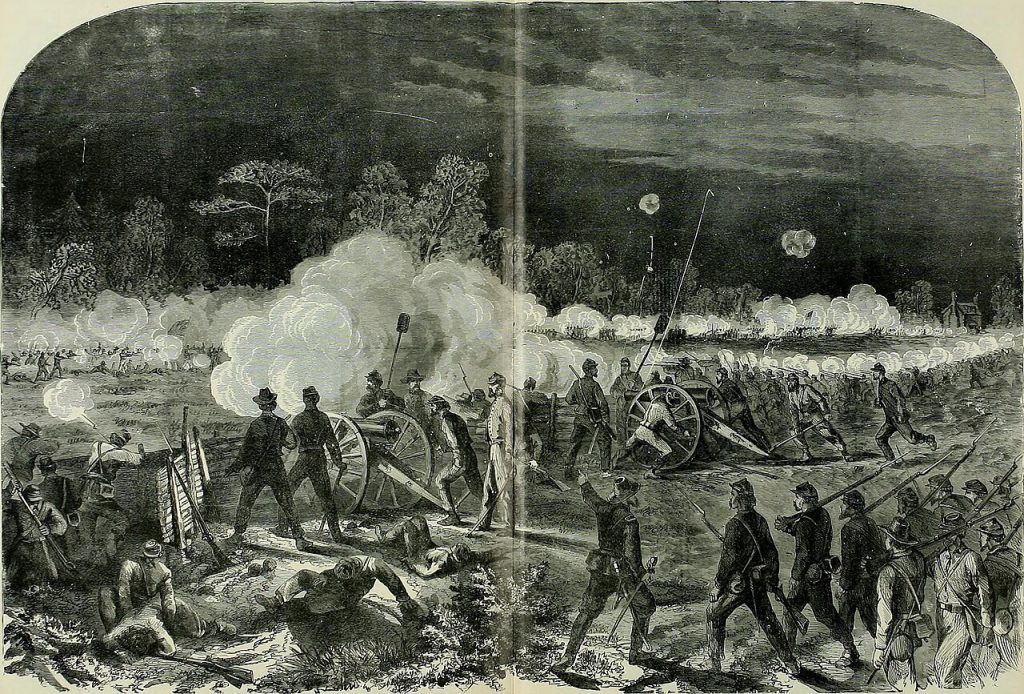
Illustration of the Battle of Cold Harbor based on a sketch by Edwin Forbes.
Illustration of the Battle of Cold Harbor based on a sketch by Edwin Forbes via Wikimedia Commons.

On February 23, 1864, Governor Buckingham made another appearance in Theodore Vaill’s letters, but this time for a much more personal reason. Theodore opened his letter by mentioning two recent communications he received.

“…the other was a curious epistle from one Wm. A. Buckingham that read something like this—“His excellency, Wm. A. Buckingham, Commander in Chief of the Militia of the State of Connecticut to Theodore F. Vaill, Gent., Greeting—-Reposing the highest confidence in your fidelity, ability, patriotism, &c. &c., I do hereby &c. &c. First Lieutenant, &c &c., and I do charge you &c. &c. –Given under my hand, &c. &c.”

I have seen several Connecticut papers with my name in, and I knew that these commissions were ordered to be made out by the Governor as long as February 6th, but they did not come until today, and it may be that their not coming before had something to do with my neglect of letter writing for I thought it would be easier to write if I had something to write about. The aforesaid document is a very pretty one, and is ornamented with an oval embellishment something like this.

I do not rank nor receive pay as 1st Lieutenant until I am mustered into the U. S. Service as such, which will not be under several days. As for a sword & fixings, I think I can do better by fitting out down here that by sending for the sword that Joe found. And as for a horse, I shall have no occasion for one unless I am detailed as Adjutant (which some folks think probable) and even then I shall not own my horse but use a government beast. (An adjutant in Infantry is an extra Lieutenant, and belongs to the staff only, & never to a company—but in artillery, the adjutant is a company officer, and is detailed as adjutant by the commanding officer, & can be sent back to his company at the pleasure of the commanding officer.

I am assigned to Co. K. but if I am detailed as adjutant, I shall of course not serve with my company.”

True to his predictions, Theodore Vaill did serve as adjutant of the regiment. The 2nd Connecticut Heavy Artillery faced a devastating loss at the Battle of Cold Harbor on June 1, 1864. Colonel Kellogg was killed while leading a charge and the regimented suffered 323 men killed or wounded at the battle.

On June 16, 1864 Theodore Vaill wrote about his brigade commander, Colonel Emory Upton, and the newly appointed colonel of the 2nd Connecticut Infantry.

“Col. Emory Upton is a West Pointer, 25 years old, a resident of Batavia, New York, & one of the finest men I ever saw. When I saw him, it was a case of love at first sight. His coolness in fight, his kindness, his military judgement & vigor, his freedom from bluster & fuss, & his upright conduct & good habits make him the perfectest soldier I have seen. He has been commissioned a Brigadier, I understand. After Col. Kellogg’s death, Col. Upton recommended to the officers of this regiment a classmate of his—Ranald MacKenzie, a Captain of Engineers, & so great was our confidence in Upton that all the officers signed a petition for his appointment to the Colonelcy, & in view of the probability of his appointment, Gen. Meade ordered him to take command. We like him very much but he is a tiger of a disciplinarian.”

Theodore Vaill served with the 2nd Connecticut Infantry until the end of the war and mustered out on August 18, 1865. He married Alice Mercy Dudley and later wrote a history of the 2nd Connecticut Heavy Artillery which is available to read on archive.org. He died in 1875.

We’d like to give a special thanks to William Griffing of Spared & Shared for his work in transcribing and sharing these letters.

To read more of Theodore Vaill’s letters as well as access thousands of other letters and Civil War documents, sign up for a Research Arsenal membership.

If you enjoyed this article, check out some of our other featured collections like Henry Chandler Smith of the 1st New York Mounted Rifles and William Walker of the 17th Illinois Infantry.

Research Arsenal Spotlight 51: Henry Chandler Smith 1st New York Mounted Rifles

Henry Chandler Smith was born in 1838 to Chandler Smith and Electra Marie (Wilcox) Smith of Canaan, New York. His father, Chandler, died in 1861. Henry Chandler Smith enlisted in Company I of the 1st New York Mounted Rifles (also sometimes designated the 7th New York Cavalry) on August 18, 1862.

The 1st New York Mounted Rifles was first formed as a squadron with companies A and B in July, 1861. Companies C and D were mustered in during October, 1861, with further companies following. The final companies, which became I, K, L, and M, were mustered in during August and September of 1862, making over a year of difference between when the first companies mustered in and when the regiment reached full strength. This time difference proved to be very significant later on as will be shown in Henry Chandler Smith’s letters.

The 1st New York Mounted Rifles in Virginia

Recruitment poster for 1st New York Mounted Rifles.

Henry Chandler Smith’s letters in our collection begin in 1863. Most are written to his sweetheart, Kate Gertrude Cooke, and to his sisters Isadore and Mary Branch “Branchie.” While in Suffolk, Virginia one June 26, 1863, he wrote about recovering from a recent illness and his belief that the 1st New York Mounted Rifles would soon be moving to Norfolk, Virginia.

“I am feeling first rate now and hope I shall not have any more sickness right away. Mother wanted to know if I bled at the lungs as I did before. Tell her that I did not but in other respects the attack was the same and was well again as soon as when at home though I often thought of Mother and wished she could be here for an hour or so.

We came from South Mills last Tuesday and have been very busy ever since. Suffolk is being evacuated and almost everything is already moved. We have got our things packed and are in readiness to move at any time. Most likely we shall be stationed at Norfolk but you may direct as usual till I send you word. Only be sure to direct in care of Capt. Fairgraves. I have received 2 letters and one paper this week that belonged to a man in Co. C just because his Captain’s name was not on it. It would have made you laugh to have seen the spelling in those letters.”

By the fall of 1863, the 1st New York Mounted Rifles had moved to Williamsburg, Virginia where they faced guerilla attacks, as Henry Chandler Smith detailed in a letter written October 25, 1863.

“There was a scouting party went out last Friday and in the night when they came back within sight of where I was on post a party of guerrillas fired on them and then ran for the woods. The same night three colored soldiers came in who were taken prisoners at the Battle of Winchester.”

On December 31, 1863, Henry Chandler Smith wrote about some rather devastating news for the men of his company and many of the others that had formed at the same time. When the men had enlisted, most believed that they would be serving a shorter term of a year and ten months to match when the older companies would muster out. However, the chaplain brought news that they had instead been enlisted for much longer.

“Our chaplain got back last Saturday and brought rather bad news to us from the War Department. There are not three men in the whole regiment but what were enlisted by Col. Dodge for the term of one year and ten months, and he pledged us his solemn word of honor as a soldier and gentleman that we should be mustered out with the old men but now he turns around and says that he remembers nothing about it so we shall have to stay eighteen months longer. The men were so outraged at being humbugged in this way that Col. Patton (who is now Lieut. Col.) went immediately to Gen. Butler’s Headquarters and under the circumstances got permission to reenlist us for three years or during the war and our time to commence from the first of January 1864. By reenlisting, we stand nearly as good a chance to get home as soon as though we remain as we are for no one can hardly think the war will last for two years longer. The bounties that we get now are the U.S., State, and N.Y. City bounties, amounting in all to nine hundred and fifty dollars. We get a furlough of not less than thirty-five days immediately after being mustered and if I join with the rest, shall be at home without fail in about twenty-five days. I have been humbugged so that I want to make everything sure before I go any further. Our chaplain says that anyone would be foolish in the extreme under the present circumstances who didn’t enlist.”

Henry Chandler Smith in 1864

In 1864 much of Henry Chandler Smith’s correspondence was with Kate Cooke and concerned their blossoming romance. On April 6, 1864, Henry Chandler Smith wrote about a recent dream he had about Kate.

“I don’t know but I ought to tell you what a pleasant dream I had not long ago when I imagined myself at home and while there I “escorted” you to a party and of course enjoyed it in the extreme. Kissed you (I dare not say how many times) and all of ladies present too, and then waked only to hear the disgusting reveille when all my fun was at an end.

Dearest Catharine, I am anxiously looking forward to a time when such imaginations will be realities yet I cannot nor must not be impatient but wait until our Heavenly Father wills it to be so. I know that my absence has made all of my friends a thousand times dearer to me than they were before and I am sure I never loved you before as I have since I have been in the army. I shall commence reading the bible with you next Sunday and hope it will be a great assistance to me as well as a pleasure. I have prayed for you very much lately and trust that we shall meet in the ‘Better Land’ if not on earth.”

Henry Chandler Smith was a religious man and he and Kate often read the same bible verses as a way to be close with each other even while separated many miles. In a letter dated April 18, 1864, Henry Chandler Smith wrote about how religion gave him strength.

“When I was reading the eighth chapter of Romans yesterday, I was very much affected by the precious promises that are found there. I think after all that there is nothing can make us half as happy as religion.”

On May 23, 1864, Henry Chandler Smith wrote from the Headquarters of the 10th Army Corps at Turkey Bend, Virginia where he was stationed quite close to Confederate troops.

“A telegraphic dispatch to General Butler says that General Meade & Lee are engaged again so I expect that we will soon make another move when there will doubtless be a desperate engagement too awful for any woman to witness and I pray that you, dearest, may never be obliged to be very near such times. The enemy’s forts are not over a quarter or half mile from ours and our pickets are not over six rods apart. I can now hear the whistle of the Richmond-Petersburg train so they must have the road repaired again. We have a large number of rifle cannon mounted so that we could throw shells beyond the Petersburg Railroad if we chose. I think that our artillerists could plant one of their guns near our house and after firing three shots, could burst every shell directly on the roof of your house. A week ago Saturday during the fight near the Halfway Hotel, the rebel sharpshooters occupied a large house and were doing fearful execution on our officers & men so a piece of artillery was ordered up and the first shot burst directly in the house and it was instantly in flames.”

Continued Duty in Virginia and North Carolina

Lithograph of New Bern, North Carolina from 1864.
Lithograph of New Bern, North Carolina from 1864 via Wikimedia Commons.

On June 8, 1864, Henry Chandler Smith was at City Point, Virginia which was overall calmer than the previous places he had been, with only the occasional exchange of artillery fire.

“I have very pleasant & easy times here at Col. Plaisted’s when “all is quiet” and by the way, we have not been disturbed only once since Sunday afternoon. About the time when you & Jane were enjoying that pleasant walk, we had an artillery duel (if I may call it by that name). Yesterday the rebs chucked over a few solid shot and since then it has been entirely quiet.”

Just a few days later, Henry Chandler Smith wrote about ongoing preparations to attempt to capture the city of Petersburg, Virginia.

“General Grant arrived here yesterday and his army has been crossing the James on pontoons ever since. I suppose he means to get in the rear of Petersburg. Today we have heard heavy firing in that direction though it has been very [heavy] for several days.”

On July 24, 1864 Henry Chandler Smith wrote from somewhere near Point of Rocks, Virginia about a fatigue party that came under fire.

“There was very heavy firing at Petersburg last night lasting about two hours. I got up and could see a large part of the tragedy. I heard today that it was caused by a fatigue party of ours being sent out to throw up some earthworks.”

By November 13, 1864, Henry Chandler Smith was at New Bern, North Carolina and had fallen rather seriously ill. He wrote to his mother with an unusual amount of detail of his affliction.

“When I recovered from my last turn of chills, I was a going to write pretty often but no sooner that I recovered from the chills than a diarrhea took hold of me & has kept me down so weak that I have kept putting off writing in order to feel better. I am now nearly or quite as well as ever. The severest turn I have ever had for forty-eight hours I run to the sink as many times & the pain I underwent was almost beyond description. From Sunday night until the next Saturday I never took my clothes off. I could do nothing but run, run, run. It was the worst type of diarrhea, nothing passing my bowels but blood & slime. My bowels were so sore occasioned by the pain that it was with difficulty I could move. I had the good luck to be attended by Dr. Holcomb. He tried almost everything but with no effect. At last on yesterday he ordered an opium injection in fifteen minutes, I felt easier & in half an hours time I was entirely free from pain & did not have to go out again until this morning. I took another this morning & have felt first rate all day. It is seven in the evening.”

The final letter by Henry Chandler Smith in our collection was written on December 25, 1864 from Oak Grove Church, Virginia.

“We had a very good Christmas sermon this afternoon but it is astonishing how few of the great army take any interest in religion. I don’t suppose that on an average there is really over one religious man to seventy that are irreligious. Perhaps you will think this strange when so many good Christians (apparently) have joined the army. But as far as I have been able to observe, this is about the ratio to the whole army. Such is the degrading influence of war. I hope & pray, and more, I believe that it will end before next July. I would like to be in the service till it is ended and then I want my discharge forthwith.”

Henry Chandler Smith mustered out on June 12, 1865. On September 13, 1865 he married Catherine “Kate” Cooke. He died in 1882.

We’d like to give a special thanks to William Griffing of Spared & Shared for his work in transcribing and sharing these letters.

To read more of Henry Chandler Smith’s letters and access thousands of other Civil War letters and documents, sign up for a Research Arsenal membership.

If you enjoyed this article, check out some of our other featured collections like William Walker of the 17th Illinois Infantry and Francis West of the 31st Wisconsin Infantry.
Research Arsenal Spotlight 50: William Walker 17th Illinois Infantry

William Walker was born in 1839 to William Hammer Walker and Ann (Harris) Walker of Mason City, Illinois. All of the letters in this collection were written to his brother, James, who worked as a physician.

William Walker enlisted in as a musician in the 17th Illinois Infantry on May 25, 1861. He served in company K, and his cousin, James Philander Walker, was its captain. The letters in this collection were written to William Walker’s brother, James A. Walker.

Departure for Missouri

Photo of Captain James Philander Walker, the cousin of William Walker and captain of Co. K, 17th Illinois Infantry.
Photo of Captain James Philander Walker, the cousin of William Walker and captain of Co. K, 17th Illinois Infantry via Spared & Shared.

William Walker’s letters begin in Peoria, Illinois on May 16, 1861. At that time the regiment was still forming and he was getting acquainted with the life of a soldier. He was also interested in the upcoming election of officers and thought that his cousin, James Philander (J.P.) Walker might be elected major.

“There is lively times here now. There is ten companies here on the ground now — a full regiment. Companies are drilling all over the ground — some in uniform and some not. We are of the not kind. We will elect our regimental officers soon — perhaps today. There is a fair show for Capt. Ross of Fulton Co. for Colonel and some talk of J. P. [Walker] being our Major. I’ll tell you Jim, it’s no fun to be a soldier. There is a strict guard kept now of 100 men and if we bat our eye once, they tell us to halt — and if we repeat it, they call the officer of the guard — and if we do it again, they charge bayonet. Everybody is well, I believe. No very late news.”

On July 21, 1861, William Walker wrote about a train ride through Missouri, which the soldiers spent with their arms ready for any guerillas or bushwhackers that might attempt to attack the train.

“In the morning at 4 o’clock, we struck our tents and moved up in town and got on the cars and such a train I never saw in my life before. Two engines was hitched on and a third went on before to see that all was right and then with a shriek and a jerk and the Gallant 17th was thundering along through the Rebel country of Missouri. It was a ride full of interest. Our train was nearly 400 yards long and the soldiers all [ar]ranged along at an outward face with loaded guns grasped in our hands, peering in the dark woods as we passed looking for the bands of guerrillas that we heard was watching the road. But we was not molested although we saw one company of men in the woods but they fled in terror. It is said our regiment is the first Union band that has escaped being fired on as they passed this way. I guess there is truth in it for the sides of the cars had lots of fresh bullet holes in them.”

In Fredericktown, Missouri, William Walker and the 17th Illinois Infantry encountered the army of General John C. Frémont, which they were very glad to see as William described in a letter  dated August 28, 1861.

“I ate breakfast and laid down in the tent and was soon buried in sleep but was soon aroused up by some of the boys. I went out to the land where nearly all the 17th was gathered and soon beheld the cause of all the noise my ears was nearly deafened with. It was part of Fremont’s army coming up. Oh Jim, it made us feel as only soldiers can feel. Here we had been for a week 30 miles from any Union troops and the sneaking citizens a hinting to us every day that the 17th [Illinois] Regiment would soon be no more — that [Gideon J.] Pillow & [William J.] Hardee would soon cut us to pieces. I tell you, Jim, when we heard the rolling of the drums and saw the head of one column coming through the woods from the direction of Pilot Knob with the old Star Spanged Banner proudly floating in the breeze, then we knew the camels were coming. First came Old Hecker’s Regiment [24th Illinois] — the terror of all evil doers, then the savage 17th [15th] Illinois and Buell’s Battery close behind. They passed on to their camping ground a little the other side of Frederick, then came the Iowa 2nd with M. M. Crocker  (now Colonel) at their head mounted on a cream-colored horse. He presents a fine military appearance. The next was the Iowa 7th, then the 7th Illinois, Col. Curtis commanding. I seen an old Mason City Dickinson in their martial band beating a drum like blazes. Lastly came a company of cavalry 100 strong and the baggage wagons stretching out 2 or 3 miles.

They were about 6,000 strong. Their columns were nearly two hours passing our camp. They are now pitching their tents close by us. They will stay here a day or two and tomorrow we will go on as the advance guard. I do not know our destination.”

The 17th Illinois Infantry at the Battle of Fort Donelson

Illustration of Fort Donelson after it’s capture by A. L. Rawson for Harper’s Weekly.
Illustration of Fort Donelson after it’s capture by A. L. Rawson for Harper’s Weekly via Wikimedia Commons.

The Battle of Fort Donelson was fought from February 11-16, 1862. The Union victory brought General Ulysses S. Grant to national prominence as was the key to further Union advances in Tennessee. On February 20, 1862, William Walker wrote home to his brother about the battle and the role of the 17th Illinois Infantry in the fighting.

“I feel so full of enthusiasm that I must give vent to some of it by writing to you. I cannot give you much of an idea of the big battle in which we were engaged but it was terrible indeed. The enemy had once one hundred cannon playing at us for four days. I thought I had heard nearly all kinds of music but I never heard such music as was played over our heads around Fort Donelson.

Jim, you must not be startled when I tell you my idea of the loss. I speak of both sides. I wrote to Captain and told him I thought the loss on both sides would come up to three thousand. Since then I have been over the field and have heard lots of officers’ opinions in regard to it and I believe that on both sides in killed and wounded will exceed seven thousand. The loss on both sides are about the same. Perhaps the Federal loss was the heaviest. Just think of it. Last Wednesday we attacked the Fort, and this is Wednesday again and there are still poor soldiers laying on the battlefield unburied.

You may want to know how I like fighting. I will only say that I will follow the 17th [Illinois Infantry] to the gates of death but I am in hopes we may never get in such a place as we was last Thursday. Look a here, James, last Thursday 10 minutes after 2 o’clock P.M. until nearly 3 o’clock, we were within 100 yards of the enemy’s entrenchments with two field batteries playing on us all the time besides about 2,000 infantry. They rained a perfect storm of iron hail amongst all the time. Our regiment and the 49th Illinois stood the whole brunt without flinching till we was ordered to fall back under the hill. Almost every tree and bush was cut off and some of our boys was hurt by the falling timber. A bomb shell burst within two feet of [Andrew J.] Bruner and me and flew all over us and tore one man’s gun that was next to us all to pieces. How our company escaped so well, I don’t know without it was owing to our laying so close to the ground.”

William Walker also described some the celebration after the fort was capture as well as some of the souvenirs he took from the fort.

“This is a lovely place now. Our camp stretches for miles up and down the river. It was worth a lifetime to see the State of Illinois marching into Fort Donelson. Our bands came in playing Dixie and then covered it up with Yankee Doodle. The Rebels all had blankets made of fine Brussel’s carpet. They was fixed as well as I ever seen soldiers anywhere. If I had have had any way to have got them home, I could have got a great many things that I would have liked to have had. As it was, I only got a fine English rifled musket (shoots 900 yards) and a big knife of the Mississippi Butcher notoriety and a secesh blanket (having thrown mine away in the fight) and a canteen and some other little things home as mementoes.”

William Walker Serves as Cook

In the spring of 1862, William Walker came down with chronic diarrhea. He received a discharge for disability on April 24, 1862 and returned home. However, this was not the end of his service to the union cause. After some time recovering, he took a job as a civilian cook for the officers at the headquarters of the 85th Illinois Infantry. Like the 17th Illinois, the 85th Illinois Infantry had many soldiers from William Walker’s home town of Mason City. His cousin, James Philander Walker, was also the lieutenant colonel of the regiment.

On July 26, 1863, William Walker wrote from Nashville, Tennessee and described the difficult conditions in the south, especially regarding having adequate food.

“I went to Murfreesboro and just before starting back an old citizen came to me and asked me for a little salt that was left lying on the table where we had eaten our dinner. I told him he could have it as our people was not so badly spoilt as to be saving of salt. He said it cost them one dollar a pound. I told him it cost us two cents in America. Can Copperheads ask which side the war affects. I went in to prisons at Murfreesboro and I speak truth when I say that I saw no one that expressed a wish to fight us longer. The time draws near. The end approaches. The giant skeleton of starvation is stalking through the South with fearful strides. They know it. We see it on every hand. I pity the women and children. Nearly the last ear of corn is off the crib. The pig sty is empty. The men all gone (thousands will never come back), and the support of the Rebellion, the hope upon which all their affections were centered.”

After the war, William Walker married Margaret “Maggie” Montross in 1869. The couple later moved to Los Galos, California where William Walker worked as printer. He died on November 29, 1907.

We’d like to thank William Griffing of Spared & Shared for his work in transcribing and sharing these letters.

If you want to read more of William Walker’s letters, or access thousands of other Civil War letters and documents, sign up for a Research Arsenal membership.

Check out more about our recent featured collections, like Francis West of the 31st Wisconsin Infantry and Joseph Vaill of the 8th Connecticut Infantry.


Research Arsenal Spotlight 49: Francis West 31st Wisconsin Infantry

Francis West was born in 1825 in Charlestown, New Hampshire. He moved to Wisconsin in 1845 and served in the Wisconsin State Senate representing Green County in 1854 and 1855. In August, 1862, he was commissioned as lieutenant colonel of the 31st Wisconsin Infantry. During his service he wrote many letters home to his wife, Emma Moore (Rittenhouse) West.
Francis Henry West wrote a great many letters home throughout the war. For this spotlight feature we’ll focus on those written in 1863 while the 31st Wisconsin Infantry was stationed in Columbus, Kentucky.

31st Wisconsin Infantry in Columbus, Kentucky

Engraving of Francis West.
Engraving of Francis West via Wikimedia Commons.

The journey of the 31st Wisconsin Infantry to Kentucky began on a tragic note, as Francis West wrote in a letter dated March 4, 1863.

“We left Racine Sunday morning and arrived Cairo on Tuesday morning all right except the loss of one man’s leg who was run over by the cars. His name is [Joshua] Davis and he belongs to Capt. [Robert B.] Stephenson’s Co. Davis on Dr. Roster’s farm. His leg was amputated and he was left at Centralia.”

Once at Columbus, the 31st Wisconsin Infantry received repeated reports about rebel forces in the vicinity, but very few of them panned out.

“Night before last it was reported that a large force were attacking Hickman twenty miles from here. I was ordered to have my men ready with ammunition and rations to start on a moment’s notice for the scene of action. I got them ready and have held them so since, but have had no orders to leave. I think it all a false alarm.”

Francis West also voiced irritation with the colonel of regiment, Isaac E. Messmore, who he described in a letter written April 5, 1863.

“I am very unpleasantly situated in this regiment owing the peculiarities of our Colonel [Isaac E. Messmore] but I have stood it so far and am in hopes I can continue to stand it. He has the ambition of a Napoleon with ten times the jealousy that Old Dr. Fisher ever had, together with the most sordid avarice. He is perfectly unscrupulous as to means used to further his interests and entirely devoid of all feeling as to the rights or feelings of others. You can judge by this that I have a hard row to hoe. This, however, is all private matter but I cannot help, my dear one, of apprising you of all my troubles.”

Tension between the two men would continue for some time.

Francis West asks his Wife to Visit

In May, 1863 Francis West began hoping that his wife would come down to Kentucky to stay for him a bit. On May 13, 1863, Francis West wrote about his new quarters and mentioned that several other officers’ wives had come to stay, though he appeared to have mixed feelings about his wife, Emma, coming down as well.

“I am moving my quarters today into a couple of quite comfortable log houses. If it were not for the fleas, mosquitoes, heat, dust, and various other annoyances, I should be in favor of your coming down here. As it is, you are certainly much better off at home although it would be a great comfort to me to have you here. There are seven or eight of the officers’ wives here but it is rather a sorry place for them to stay.”

Just a few days later, on May 18, 1863, Francis West was much more enthusiastic about Emma coming to visit.

“As I was eating breakfast this morning thinking what a pleasant house I had, I made up my mind that I must send for you. Just then an orderly came in with your very kind letter of the 10th in which you say you wish to come. You must stay here at least three or four weeks. If Mary will keep house for you, everything will go on just as well as though you were at home. The only trouble will be that you will get sick and tired of staying in this God-forsaken place before you have been here three days and I shall not enjoy your visit so much as I otherwise should knowing how sick you are. Some of the ladies here ride on horse back and some take rides out into the country in ambulances (a kind of stage) and I suppose manage to kill time some way.

Mrs. Capt. Burdick with two little children stops next door to me. The log huts are all close together and there is not a spear of grass to be seen from one of them. I have one large square room for office and sleeping room, and a room across the street for a dining room with a cook and wash room attached. Here my ostler and his wife—a very nice young woman from Darlington—stop, she doing the cooking and washing.

I do not want you to bring any of the children with you. You cannot bring any more than baggage enough for yourself and I want you relieved from all care of children once just to see how it will seem.”

Emma’s reply was not what Francis West wanted to hear, and on May 24, 1863 he wrote another letter expressing his sadness at her refusal to come visit.

“I have just received your very cool reply to my letter of invitation to you to come down here and am very much disheartened that you are not coming immediately to see me. You say you do not know as you have given me any encouragement that you would come. I will give an exact quotation from your letter which I certainly took as encouragement, “If you cannot come home, I must come and see you.” It is quite certain that I shall not be able to go home until after the war. We have not got long to live anyway and we might as well enjoy ourselves as much as possible while we do live. And I know of nothing that would afford me so much pleasure as a visit from the person that I love more than all the world. Besides, I had taken a great deal of pains and got everything fixed up as nice as possible to make your visit pleasant. And I am so disappointed that you are not coming.”

Evidently Emma changed her mind about visiting, because there is a pause in their correspondence until June 18, 1863 when Francis West writes  that he was glad to hear about her safe arrival home.

Skirmishes in Kentucky

Photograph of Colonel Isaac Messmore from his obituary in 1902
Photograph of Colonel Isaac Messmore from his obituary in 1902 via Wikimedia Commons.

In the same letter written on June 18, 1863, Francis West also revealed that the colonel of the 31st Wisconsin Infantry had gone to Washington and that there was a rumor of a large Confederate presence in the area.

“The rebel generals Forrest and Cheatham are supposed to be advancing on us with a large force. I think they will have a merry time of it before they take us. I have no idea myself that they will try it at present but the general thinks they are sure to. Day before yesterday we sent out 20 of our regiment in cars to make a reconnaissance. When they had proceeded some distance, the train was fired upon by a large force when the engineer immediately took the back track. Not one of our men was hit. They returned the fire and saw some of the rebels fall. Yesterday we sent Companies B & E (Stephenson’s and Mason’s) but they saw no enemy. The cavalry that were sent out while you were here have been repulsed on the Tennessee river with what loss we have not learned. It seems a little more like war here than it did, though not enough to suit most of us yet.”

Small skirmishes continued though the 31st Wisconsin failed to meet any large forces as Francis West detailed in a letter written on June 27, 1863.

“It has rained nearly all the time for a week. I wish you had some of it in Wisconsin. Everything is very quiet here just now. We sent another expedition out to look for rebels day before yesterday but they all “skedaddled” on the approach of our boys. They ascertained that our boys of the first expedition in returning their fire killed a captain and one man of the rebel party.”

On July 4, 1863 Francis West told his wife that an expedition of the 4th Missouri Cavalry suffered heavy losses.

“The expedition that left from the 4th Mo. Cavalry when you were here has been “gobbled up” together with the Lt. Col. commanding. They were defeated on the ‘Big Obion’ with a loss of one hundred and fifty in killed, wounded, and missing.”

The 4th Missouri Cavalry suffered additional losses a few days later and the 31st Wisconsin Infantry was in high readiness for an attack, as Francis West described in a letter from July 10.

“The general sent up to the Fort this morning to have every man ‘fall in’ instantly. I was sick in bed but jumped out and had the long roll sounded and the men in fighting shape in short order. I was really in hopes we were going to have a “little brush” at last but was disappointed. The enemy not showing themselves, the 32nd Iowa were sent out to look for them and have not returned yet. We understand the Rebs have gobbled up two more companies of the 4th Missouri Cavalry. I wish they would let me after them with the 31st. I feel first rate since there was a prospect of a fight. It did me more good than a dose of medicine. I don’t think, however, that there is the slightest probability that they will attack this place.”

On July 19, 1863, Francis West reiterated that there seemed to be no large force of Confederates in the area, but persistent raiding by guerillas left the situation dangerous.

“There are just rebels enough a raiding around here to keep the general scared to death without being enough so that we can corner them and get up any fight. They are well mounted and in this timbered country it is impossible for infantry to catch them. They simply prowl around and “gobble” any small squad they can find away from the main force.”

The 31st Wisconsin Infantry remained in Columbus, Kentucky until October, 1863. By that time Colonel Messmore had been forced to resign and Francis West was promoted to colonel of the regiment.

Francis West served through the end of the war and was made a brevet brigadier general in March, 1866. He died in 1896.

To read more of Francis West’s letters, sign up for a Research Arsenal membership.

We’d like to give a special thanks to William Griffing of Spared & Shared for his work in transcribing and sharing these letters.

If you enjoyed this article, check out some of our other featured collections like Joseph Vaill of the 8th Connecticut Infantry and William Heldman of the 17th Missouri Infantry.


Research Arsenal Spotlight 48: Joseph Vaill 8th Connecticut Infantry

Joseph Vaill was born in 1837 to Reverend Herman Landon Vaill and Flora (Gold) Vaill of Litchfield, Connecticut. Joseph’s brother, Theodore, severed in the 2nd Connecticut Heavy Artillery and wrote the regimental history of it after the war. A group of 26 letters written by Theodore are also part of the Research Arsenal Collection.

Joseph Vaill served in the 8th Connecticut Infantry and later as clerk in the quartermaster’s office of the 1st Brigade, 3rd Division of the 25th Corps.

The 8th Connecticut Infantry at Roanoke

Image of Joseph Vaill of the 8th Connecticut Infantry
Image of Joseph Vaill of the 8th Connecticut Infantry via Findagrave.com

Joseph’s letters in the Research Arsenal collection begin with him on board the steam ship “Admiral” which was captained by his cousin, Edward “Ned” Vaill. In a letter  written on December 14, 1861, Joseph mentions writing from the stateroom of the “Admiral” which was currently transporting men from the 24th Massachusetts Infantry. It was not clear from the letter how Joseph Vaill ended up on the ship with his cousin, but he was evidently returning to his regiment.

On February 9, 1862, Joseph Vaill wrote to his father from Roanoke Island and gave a lengthy account of the recent battle there. Joseph began by recounting the bombardment of the Confederate fortifications on the island while he was on board the ship “Sentinel” with the rest of the 8th Connecticut Infantry.

“On Wednesday morning the 5th, we weighed anchor and brought up the rear of the fleet. We were on the Propeller “Sentinel” carrying 4 guns and being in the 3rd Brigade, were ordered to the rear as guard. The weather was fine but rather cool and it was thought that we would reach our destination by 4 P. M. and have warm work before sundown. But our boys were in good spirits and every man was ready to do his duty. At about 4 or 5 P. M. we dropped anchor in the rear of the fleet and about 10 miles from the island. The weather came on thick at evening with rain. The Sentinel and Chasseur were put back about a mile to guard the fleet in the rear and several small gunboats sent ahead to sound and reconnoiter.

The next morning we did not move but the small boats were in advance to lookout the ground. Friday morning the 7th orders were to move on and so we did—the gunboats in the advance. At about 10 A. M., we saw smoke several miles up the channel which we took to be from the enemy on shore. For an hour or so, firing commenced in earnest from our gunboats and was answered quite rapidly from a fort on shore and by rebel gunboats above the fort. The rebels had previously obstructed the channels by driving in spiles so that our gunboats could not go by the fort without passing directly under the fort. During the whole afternoon the firing was continual by our vessels and answered less rapidly as the day wore on. A dense cloud of black smoke told us that the fort was on fire.”

The Sentinel was held back from the main fight, but late on the night of February 7, the 8th Connecticut Infantry was put ashore on the island. As this was the first time most of the regiment had seen any fighting, the men were a bit jumpy.

“At 11 P. M. we lay down upon a sandy cornfield about 100 rods from shore. There must have been 10,000 men on the field before 12 midnight. We lay down on our rubber blankets two together so had one rubber blanket over us which we very much needed for it soon began to rain and kept it up nearly all night. We got wet some but made the best of it for we were in an enemy’s country, and the enemy near us. It was raining some when we got up in the morning and before we had a chance to think of breakfast and before all of the men were out from under their blankets, we were startled by several shots from our pickets who were not more than 80 rods from us and the order was, “Fall in!” We had the order hundreds of times before but under very different circumstances. The rush for guns may be ‘imagined but not described.’ We were soon in line just as the firing from the pickets ceased. We were ordered to stack arms. You may consider that there was some little excitement for it was the first time the most of us were ever invited to face death on the battlefield.

At 7:30 the 1st Brigade left the field for a march to the interior to attack the battery discovered the night before. At 8:30 we heard rapid firing of musketry and an occasional field piece or gun from the battery. Regiment after regiment were ordered out from time to time and the firing was kept up with little cessation till 11 A. M. when Hawkins Zouaves (9th N. Y. V.) charged upon the battery and carried it at the point of the bayonet with a loss of only one killed and five wounded. Other regiments had stood and fired at the battery and had lost quite severely—among them one or two Massachusetts regiments. Several regiments were ordered to make an advance on the battery which lay across a terrible swamp but after making the attempt, fell back till the 10th Connecticut were ordered on and went through with a heavy loss—Col. Russell being among the killed.

The enemy were put on the run, our troops close upon them. I believe all the regiments with the expedition were ordered on except the 8th which was held in reserve under arms all day in order to cover the retreat of our troops in case they were driven back. We were in readiness to march to the battlefield at any hour. The regiments that went out into the fight and chase yesterday have not returned as yet but we learned this morning that they had taken between 2 and 3 thousand prisoners—among them Gov. Wise of Virginia, and O[badiah] Jennings Wise who it is reported was shot this morning while attempting to escape. Of course we cannot tell how much to believe as there are all sorts of reports. But it is very plain we have done a great work although our loss is quite heavy—probably nearly 50 killed and wounded. Our boys are all very well but are not able to write on account of the scarcity of paper. Our knapsacks being left onboard the boats. But their friends need not be alarmed about them for they are all well.”

Contrary the rumor about Governor Henry Wise being taken prisoner, he was in fact ill during the Battle of Roanoke and was not captured. His son, Obediah Jennings Wise of the 46th Virginia Infantry, was killed in the battle.

Joseph Vaill at Knight General Hospital

Knight U.S. General Hospital where Joseph Vaill stayed and worked. It later became the Yale New Haven Hospital.
Knight U.S. General Hospital where Joseph Vaill stayed and worked. It later became the Yale New Haven Hospital via Spared & Shared.

There is a gap of letters in our collection covering most of 1862 and 1863. The letters resume in 1864 with Joseph Vaill in the hospital. In the intervening time he had been promoted to Quartermaster Sergeant on May 28, 1862 and promoted to 1st Sergeant on February 20, 1864. In May of 1864, he transferred to the Veterans Reserve Corps.

On September 5, 1864, Joseph Vaill wrote home from Knight General Hospital in New Haven, Connecticut. In it he discussed his plans to become a clerk for Captain George Mason, Assistant Quartermaster.

“As to my plans, I can only say that they are not fully developed as yet, but there is a prospect of my going to be chief clerk for Captain George W. Mason, A. Q. M., as he has made me the offer, if he is situated as he expects to be, and as he probably will be. Major [Pliny Adams] Jewett  expects me to remain here but I shall enlighten him tomorrow, and when he finds that I have an offer from Capt. Mason, he will see at once that he will have to dispense with my services as he is only allowed to pay $24 per month with rations & quarter for his help — though I suspect from what Dr. [Levi D.] Wilcoxson told Bill Hull that the Major would increase my pay from the Hospital fund, but he would not think he could to more than $10 per month, I presume, making my pay $34 & board. But that would not do, for I can get $84.00 including rations if with Capt. Mason, and I could board myself for $20 per month, leaving a balance of $60 & +.”

On September 20, 1864, Joseph Vaill was discharged from the service. He remained at the hospital and temporarily took up a position in the quartermaster’s department at the hospital which he detailed in letter written November 29, 1864.

“He [Major. Pliny Adams Jewett] said he would like to have me take charge of the Quartermasters Department and he said he would try Capt. Bullock, the Quartermaster at New Haven, who is responsible for the issue of clothing &c. and perhaps he could get some extra pay for me. I told him I would take all he could get for me, but don’t suppose there is any great probability of my getting anything extra.

Since I took charge of this Department, I have been very busy, but shall not have very much to do after I get caught up. I have a cozy little office all to myself with my bed in it, a little coal stove, and everything comfortable. I have an orderly to make my fire at 6, make my bed, and sweep out while I am at breakfast, and to look after the wants of the office generally.”

Joseph Vaill in the Quartermaster’s Department

Though it took some time, Captain Mason made good of his offer of making Joseph Vaill a clerk under him. On January 4, 1865, Joseph wrote about taking a position in the Assistant Quartermaster’s Office of the 3rd Division of the 25th Corps. His journey there included a surprise stop at the camp of the 2nd Connecticut Heavy Artillery, where his brother, Theodore, was currently the adjutant.

“Col. Hodge went with me to the Pro Marshall’s Office to get me a pass to the “front” by railroad and he (Col. H.) went to the 6th Corps Headquarters and I to the 2d Connecticut. I found Charley Hinsdale just about dark in front of the staff quarters and he secreted me until the adjutant started for supper when he said, “Here, Adjutant, do you know this fellow?” whereupon I received the grandest hugging and kissing I ever did from the same sex of myself. I was at once shown to the supper table and introduced to Col. Hubbard, Major Skinner, and Jones, who with Theodore compose the “mess.” I stayed over night and at noon the next day (Tuesday, Jan. 5th) went to the 6th Corps Headquarters to see Willis Gold who is chief clerk at Maj. Mellen’s, Pro. Mar. of the Corps.”

Joseph Vaill also looked forward to the increased pay he would receive as a quartermaster’s clerk.

“As Brigade Quartermaster clerk I find the established rate of pay is $75 per month and one ration per day. For Division clerk, $100 and 1 ration. And Chief Quartermaster Clerk, $125 per month and 1 ration. So that my pay now will be 75 & 1 ration. And when Capt. Mason get a Division, I shall have 100.”

Joseph Vaill continued to serve as a clerk through the end of the war and remained in North Carolina through at least 1866 which is when the letters in our collection stop. After the war he married Cornelia Elizabeth Smith. Joseph Vaill died in 1915.

We’d like to give a special thanks to William Griffing of Spared & Shared for transcribing and sharing these letters.

To read more of Joseph Vaill’s letters as well as thousands of other Civil War letters and documents, sign up for a Research Arsenal membership.

If you enjoyed this article, check out some of our other featured collections like William Heldman of the 17th Missouri Infantry and Halsey Bartlett of the 6th Connecticut Infantry.


Research Arsenal Spotlight 47: William Heldman 17th Missouri Infantry

Frederick William Charles Heldman, (who was carried on rosters as Charles Heldman but signed his letters William Heldman) was an immigrant from Germany who served in Company A of the 17th Missouri Infantry. William Heldman was born in 1840 to Anton Karl Heldmann and Bertha (Falkmann) Heldmann. The family came to the United States in the 1840s. In 1851 William Heldman’s father died and his mother later remarried Eberhard Fuhr.

The 17th Missouri Infantry was also called the “Western Turner Rifles” and was made up of Union supporting German immigrants. William Heldman enlisted in the 17th Missouri Infantry in August, 1861. Previous to that he had served in the 3rd Missouri Infantry, a 90 day regiment formed in April, 1861.

William Heldman and the 3rd Missouri Infantry

Illustration from Harper’s Weekly of the Battle of Carthage.
Illustration from Harper’s Weekly of the Battle of Carthage via Wikimedia Commons.

The 17th Missouri Infantry was formed largely from officers and men that served in the First through Fourth Missouri Infantry regiments. William Heldman’s letters home begin during his time in the 3rd Missouri Infantry. In a letter written on August 13, 1861, William Heldman talked about his experience at the Battle of Carthage fought on July 5, 1861, and most of his company being taken prisoner.

“Sigel found Jackson on a large prairie where he found him with about 5,000 men but they were not very good armed. Sigel attacked one or two o’clock in the evening. We heard the cannons at Neosho and at three o’clock there came a man from Sigel and brought the orders for us to go back and we were all ready to go [when] there came about 1,500 secessionists from Arkansas and Texas commanded by General McCulloch.

We were all in the Court House where we had our place to stay. As soon as we seen them come, we knocked [out] all the windows and shut the doors, [and] got ready to shoot through the windows. The secessionists stopped and two men came up to the fence with a white handkerchief and asked our Captain to surrender and our Captain came in to us and told us. We told him we would sooner die. Our Captain told us we could not fight against so many and our Captain asked them if they would treat us just [if] we would surrender to them and they promised by their honor and so we give up. They kept us three days and then we had 85 miles to go without anything to eat.  We got back to St. Louis and we have been here a good while waiting for our money and our discharge but I think we will soon get it.”

Soon after his return to St. Louis, William Heldman, along with many men of his regiment, joined the 17th Missouri Infantry.

Fighting in Missouri and Arkansas

The 17th Missouri Infantry fought throughout Missouri and Arkansas in fall of 1861 through summer 1862. On October 5, 1861, William wrote  about some recent skirmishing near Sedalia, Missouri.

“We have left St. Louis and we are in a little town called Sedalia. We have to wait for a battle every day. Yesterday our pickets had a fight. We lost one man. How many the enemy lost, we do not know but we are not afraid now for we have a good many soldiers up here now. The enemy entirely surrendered. The only got one way about 40 miles to get out. We took three prisoners last night and they had hardly any clothes on and they said that the whole army was the same way.”

On March 1, 1862, William was writing  from Osage, Arkansas when he detailed the 17th Missouri Infantry’s pursuit of the Confederate forces under the command of General Sterling Price.

“At two o’clock we started in pursuit of Price. We had a hard time then. We had to march very hard. We marched ten miles without stopping and without cooking, but we could not catch Price. General [Jefferson C.] Davis took another road and got to chase Price’s rear guard and he fired two cannon shells at the men and killed 7 men and wounded many and they galloped away.

The next day we marched too Cassville. About 10 miles behind Cassville, our cavalry had a fight. They took 60 prisoners and killed a good many. Our cavalry was always close behind Price and our flying batteries troubled him a great deal. We has 12 from our cavalry called flying batteries. We marched from Cassville and marched to the Arkansas line. Near the line is very high mountains and the valley is so small—just wide enough for the road.

The next day we had a fight at [Little] Sugar Creek and that was the last was seen of him. We lost 15 men killed and 5 wounded.”

The fighting in Arkansas was quite gruesome, and William Heldman detailed the horrific treatment of a captured Union soldier by guerillas in a letter dated July 18, 1862.

“You have not heard of us for a long time for we have been traveling around in the wilderness of Arkansas. We had to fight with miserable robber [guerrilla] bands most every day. General Steele’s troops had a fight with them. They killed 130 of them. How many they wounded I do not know for they took them all along. Our men lost 17 killed and 42 wounded. The secesh took one of our men prisoner and they took him and tied his arms behind him around a tree and then they cut his arms off in the shoulder and give him 7 shots in the lower part of his body. Who would save the life of any such a miserable being?”

The 17th Missouri Infantry at Vicksburg

Confederate fortifications at the rear of Vicksburg, Mississippi.

William Heldmen’s brother, Theodore, enlisted in the 17th Missouri Infantry in the fall of 1862. Unfortunately, he was soon taken ill and discharged for disability. In January, 1863, the 17th Missouri Infantry began fighting around Vicksburg. On January 15, 1863, William Heldman wrote to his brother about the recent battles.

“We have had two battles since we left Camp Steele. The first near Vicksburg and the second one at Arkansas Post. We took about 600 prisoners on that place and a good many cannons. Our regiment was in the hottest fire all day. I used 80 cartridges in about two hours but we did not lose many men. Our company did not lose any this last time though we were in a hotter fire than at Vicksburg. Our regiment lost 3 killed and about 10 wounded.

The bombardment at that place [Arkansas Post] was awful. The whole fort was tore to pieces. The men on it were nearly all dead or wounded. There were 125 artillery men in it and only 20 were left when they surrendered.

At Vicksburg we had to go back without gaining anything. Our company lost five men there—one killed and four wounded. Two of our recruits were wounded. You do not know them but the others you know. [Julius] Zinzer is dead and [Fred] Klingel and [William] Rascher are wounded. This place [Vicksburg] is very hard to take. We are just now going down to try again.”

Taking Vicksburg did indeed prove to be long and difficult task. On March 6, 1863, William Heldman wrote about information he had received from German deserters from Confederate forces.

“There are deserters coming from Vicksburg most every day. They are all Germans. I have talked to one for a long time. He told me that they had to suffer a great deal of hunger. They get only three-quarters of a pound of bacon a week, half a pound of cornbread a day. They don’t know how coffee looks any more. Sugar they have plenty of it and molasses too. Salt is very scarce. They cannot get anything across the river anymore now.”

Another letter from June 20, 1863 details the ongoing Siege of Vicksburg and the increasingly difficult position of the Confederate forces.

“We are still in our old place near the river above the city on the right wing. I believe they will soon surrender now. Deserters come over most every night. They all belong to Tennessee regiments. They say they get something to eat once a day. We have got them penned up this time. They can never get out of that place if we won’t let them. Let them attack us in the rear. They will burn their nose if they do. We have got men enough to keep them off. The country is so hilly and rough so that fifty thousand men can keep of a hundred thousand rebels.

It would have been very hard for us to get to where we are if they would have had any of their field artillery left [that] they had out at Black River. They brought 60 cannons from Vicksburg out there. After the battle of Black River Bridge, they had 3 left. The rest we took away from them. They were all scattered and everyone ran for his life to Vicksburg and here we now are.

When we first came here, we had to fight pretty hard. Now we have not much to do. The first day me and [Theodore] Wiegreffe kept a heavy battery from shooting half a day. We crawled up to it in about a hundred yards ad did not let them load their cannons. But the rest of our company would not come there—not a single one of them. The whole company likes us very much for that. The second day I went to the same place and fired about 200 shots. The next night they moved the battery away from that place. Our cannons are all at work today but they do not answer a single shot on this side. The ground is trembling under our feet so hard is the cannonading. Right now one of their large forts is on fire inside right before us on the hill. The powder magazine blowed up just now. Our cannons throw in about 500 shells an hour all around the line.”

On July 4, 1863, the Union army finally took control of Vicksburg. William Heldman survived the war and married Anna Therese Mathilde Summa in 1874. He died in 1912.

We’d like to give a special thanks to William Griffing of Spared & Shared for his work in transcribing and sharing these letters.

To read more of William Heldman’s 41 letters as well as access thousands of other Civil War letters and documents, sign up for a Research Arsenal membership.

If you enjoyed this article, check out some of our other featured collections like Halsey Bartlett of the 6th Connecticut Infantry and Herbert Daniels of the 7th Rhode Island Infantry.


Research Arsenal Spotlight 46: Halsey Bartlett 6th Connecticut Infantry

Halsey Bartlett was born in 1831 to Richard Bartlett and Christina S. (Fisher) Bartlett of Killingly, Connecticut. He enlisted in Company A, 6th Connecticut Infantry on September 3, 1861. Most of his letters were written to his mother and to his sister, Christina Bartlett.

Halsey Bartlett at Hilton Head, South Carolina

Photo of Fort Wallace, Hilton Head taken after the Battle of Port Royal in November, 1861.
Photo of Fort Wallace, Hilton Head taken after the Battle of Port Royal in November, 1861. Halsey Bartlett mentions the battle briefly in one of his letters.

On January 6, 1862, Halsey Bartlett wrote to his mother from Hilton Head, South Carolina. In it he described the recent Battle of Port Royal.

“There was a smart battle on the opposite shore on the other side of this island. Our troops gained the victory by taking the fort at the head of Hilton Head Bay and 10 field pieces of artillery (brass) and 3 Columbiads with a loss of 17 men on our side and (80) eighty on the other side. Our regiment was not in the battle. After which our troops followed them up to Bluffton and they had another fight which was in our favor. Our troops followed them to a creek where they could not get away and they had to surrender. They raised the flag of truce and we took seven hundred prisoners with a great loss of lives on both sides. Our loss was small compared to the other side. We expected to go to the fight with them. Our regiment was called into line of battle on New Years Day. The orders were to be in readiness to march at any moment, but we did not go for the order was countermanded and we returned to our quarters. Our boys are anxious to go into battle.”

The 6th Connecticut Infantry remained in South Carolina for quite some time. In August, 1862, the regiment saw its beloved Lieutenant Colonel William G. Ely leave to accept the position of colonel in the 14th Connecticut Infantry. In a letter written on August 4, 1862, Halsey Bartlett described the gift made to the departing colonel from the regiment.

“Lieutenant Colonel Ely of our regiment has been promoted to Colonel of the Fourteenth Connecticut Regiment. He went from here to take his command yesterday. Col. Ely was a nice man. He was a gentleman in every respect. Our regiment — or most of them — miss him. as a soldier he is fitted for the post which has been assigned to him. Major [John] Speidel is to take his place. He too is a gentleman in every respect. Don’t know who will be major of this regiment but think Captain Tracy of Company G will take his place. He is a good man and fully competent for the post. Our company in respect and for the love we had for Col. Ely subscribed seventy dollars towards getting a sword on which will be engraved, ‘Presented by the Soldiers of Windham County in Company A, 6th Reg. Conn. Vol. to Col. Wm. G. Ely for the respect they showed him as a Soldier and a Gentleman. Arnold Leach, Captain Commanding.’ I gave one dollar towards the sword.”

6th Connecticut Infantry in Beaufort

The 6th Connecticut Infantry remained at Beaufort, South Carolina for several months, making it their winter quarters. On November 20, 1862, Halsey Bartlett wrote home with an account of a man in Company C being drummed out of the regiment for cowardice.

“There is one of the soldiers belonging to Co. C to be drummed out of this regiment tomorrow for cowardice in the late [Second] Battle at Pocotaligo. He, when [near where] the battle was, heard the first gun from the Secesh and it scared him so he run and left the ranks. He said he was not going to have his brains blowed out. He was taken and court martialed and sentenced to have head head shaved and drummed out of the regiment. Oh what a disgrace to him. But he will get home. I would not disgrace myself so for all the world.”

There continued to be small skirmishes, as Halsey Bartlett recounted in a letter dated December 1, 1862.

“A party of Rebels tried to land at the Capen Plantation where we go on guard but were relieved the trouble by the firing of muskets — a whole company firing on them (two boatloads of the Rebels some thirty in number) and killing quite a number. They skedaddled and went back as fast as they could. This is the third time they have tried to land but Yankee too much for them.”

Halsey Bartlett wrote about another expedition on January 17, 1863.

“There was an expedition started from here made up of a small force from the several regiments here and Hilton Head. They went down on the coast of Florida to capture a lot of lumber from the Rebels but when going up Nassau River, they were fired at by the Rebels. Our men fired back and by their tell, some of them were killed or wounded. Our men went ashore and found that the Rebels had burned the lumber and they had to go farther down on St. John’s River and get a lot of lumber that was there. They got their lumber and came home. Was gone ten days. Went some ninety miles. Two of the Third Rhode Island boys got killed but none out of our regiments either killed or wounded. I did not go but 20 — twenty — out of our company went.”

The 6th Connecticut Infantry at Fort Wagner

Illustration by Frank Vizetelly of the assault on Fort Wagner.
Illustration by Frank Vizetelly of the assault on Fort Wagner via New York Public Library Digital Collections.

The 6th Connecticut Infantry fought at the Second Battle of Fort Wagner on July 18, 1863. Though the Union was unsuccessful at taking the fort, the role of the 54th Massachusetts Infantry in the fight inspired countless African-American soldiers to enlist. Fort Wagner was ultimately abandoned by Confederate forces in September, 1863.

On August 1, 1863, Halsey Bartlett wrote home about the 6th Connecticut Infantry’s role in the battle.

“But a few days ago I wrote you a small detail of what we were doing on Morris Island and now I will tell you farther of the doings. We left (our regiment) Morris Island night before last and was I not rejoiced to get away. I rather think I was — not that there was anything cowardly on my part but I got sick of hearing so much noise. It was nothing but boom — boom, night and day on both sides and men to the average of four or five per day from some regiment brought down from the deadly missiles of the enemy.

The night of 29 July our regiment had orders to report to Hilton Head immediately and in the night we moved our tents and baggage to the dock at Morris Island and soon it was aboard the General Hunter and all hands aboard, we were ready to proceed on our way to Hilton Head. And here I am. I tell you, it seems more like home to me now. But God has been good in preserving my life until now. Now I am out of danger for awhile. On Morris Island, if I lie down at night to sleep, I knew not whether I should wake up in the morning safe or not for they shelled our camps as much as they could, and to be there was perfect misery. The night we came away, I saw a young soldier belonging to the Eighty-fifth Pennsylvania that was struck by a shell. He had one arm taken off just below the shoulder; the other taken off just below the elbow. Poor man — no hands at all.

The next day after the Battle of the 10th, I took a look on the battlefield, I see some twenty lie dead on the field where the Seventh drove them from their rifle pits while on Morris Island. Our regiment had to go up on picket within fifty yards of the Rebel Battery Wagner. This is the battery I told you about making a charge on July 16. I told you of the casualties in our company. Hugh McShene I spoke of being wounded is dead. The rest is doing well. Hill and Palmer are in Richmond [as] prisoners. Nothing have been heard of Sergeant [Delbert] Hoar and Private [Maxim H.] Sherbeone, both [of] Danielsonville — supposed to be killed.”

Unfortunately, Halsey Bartlett did not survive the war. He was killed at Bermuda Hundred by a sniper on June 17, 1864.

To read more of Hasley Bartlett’s letters, sign up for a Research Arsenal membership.

We’d like to give a special thanks to William Griffing of Spared & Shared for his work in transcribing and sharing these letters.

If you enjoyed this article, check out some of our other featured collections like Herbert Daniels of the 7th Rhode Island Infantry and Kimball Pearsons of the 10th New York Cavalry.

JOIN THE RESEARCH ARSENAL COMMUNITY TODAY.