Digitizing Diaries and Books with an Overhead Scanner
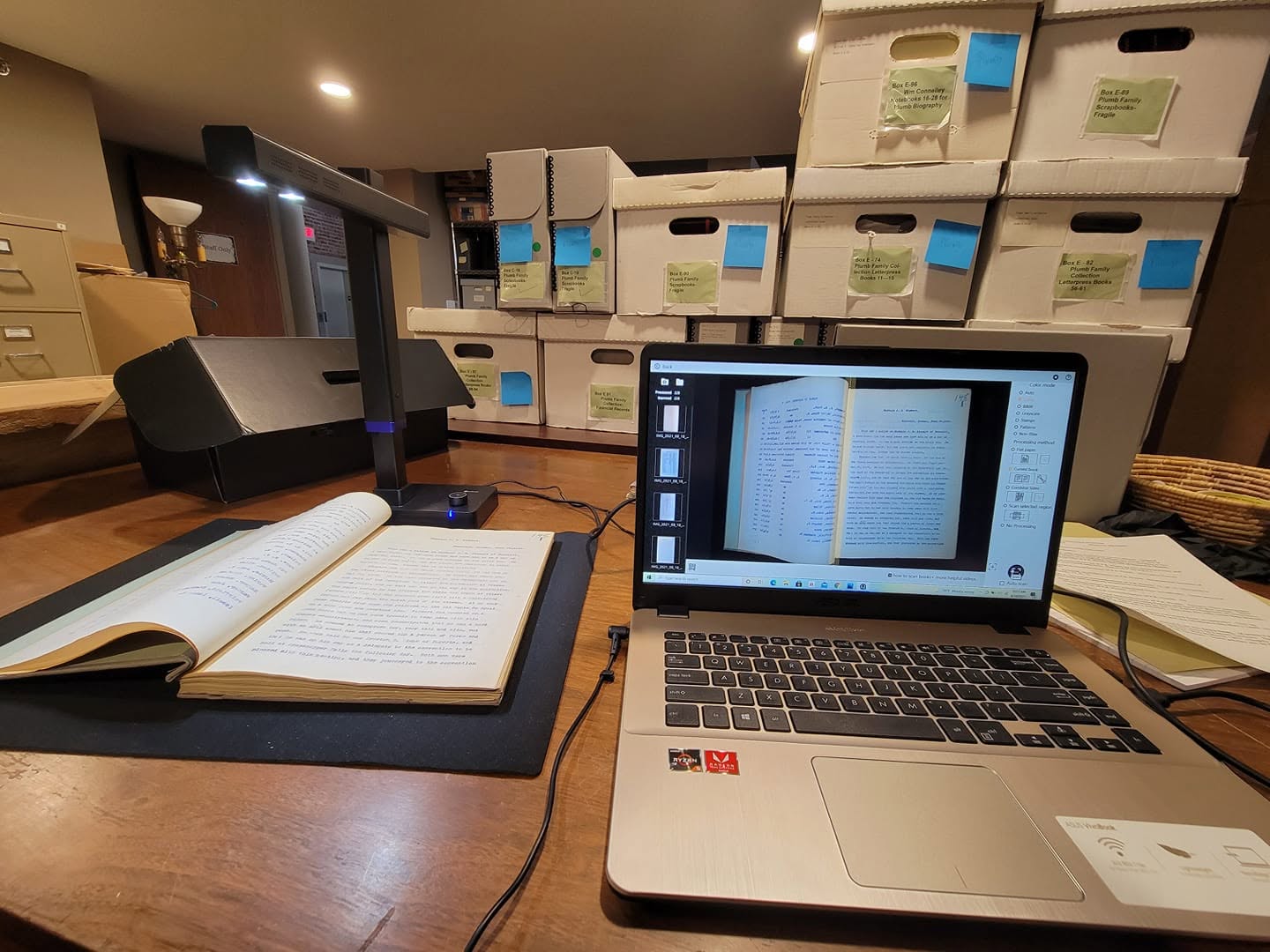
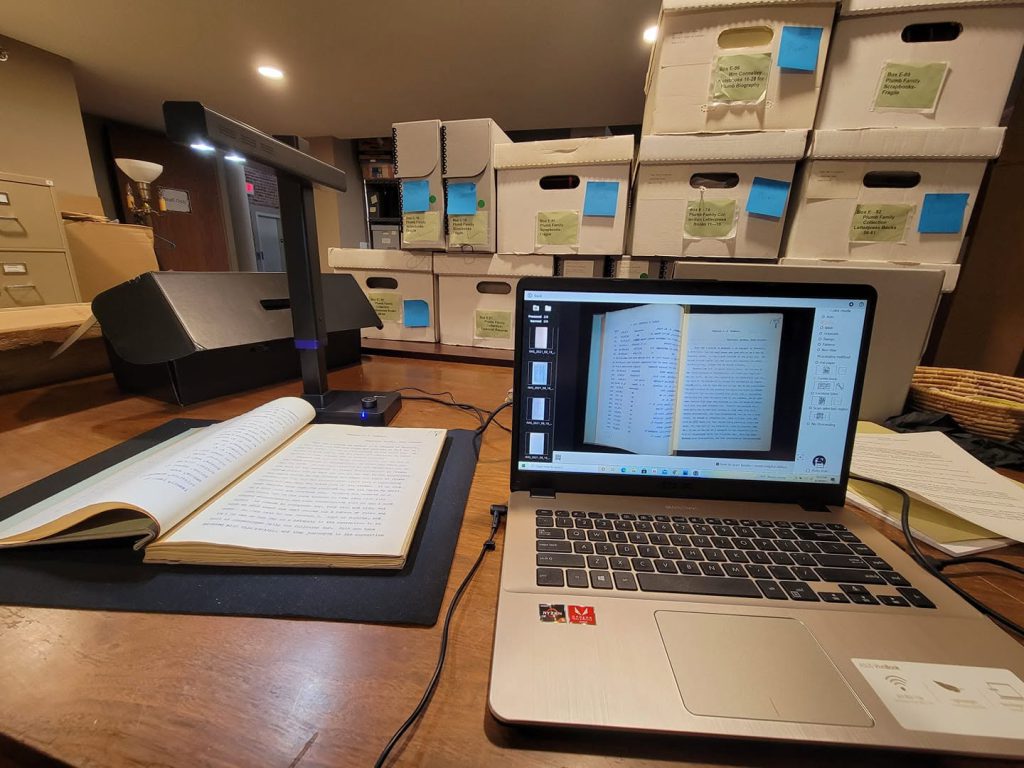
Here you can see a CZUR overhead scanner hooked up to my laptop to digitize bound volumes of archive material. All those boxes stacked behind my computer were full or more bound volumes that I need to scan during my research trip. I was able to scan about 1800 pages per day with this system.
Digitizing your collection is something that I have recommended in several past posts, and for most cases, that is a pretty straightforward thing to do. Photograph your objects and scan your photographs. But diaries and other bound archive material can be a bit more difficult. This quick guide using an overhead scanner may give you some helpful tips to digitize diaries and other bound books without damaging them.
Whenever you’re digitizing something, making sure that the original item is not damaged in the process is the most important goal. Scanning bound books can be damaging when using a flatbed scanner. Opening the book wide, placing it facedown on the glass, and then closing a lid and pressing that down creates stress on the binding. For old books, that stress can be especially catastrophic and you may end up with a split binding, separated pages, or even tearing. To combat this, I recommend using an overhead scanner.
Overhead scanners work more like cameras than scanners but deliver high-quality scans without damaging the source material and digitize much faster than a flatbed scanner. I have used the CZUR brand for several years now and have used various models. The Aura Pro is a great travel friendly model that takes up less space and is easy to transport. For the highest resolution images, I use their newer model, the ET Max which images documents at 38 megapixels. There are now other brands selling similar products, but I cannot speak about their quality or features.
What’s great about this type of scanner is that the book or document lies flat on the included black pad which causes no stress to the artifact. The overhead scanner can automatically determine the document and digitally separates it from the background so that you end up with a perfect image of the document only. If you place the paper on the black pad crooked, it will be automatically straightened and the background removed. For books, the scanner has a special book mode that you can select which will digitally compensate for the curved pages at the spine. This means that it can scan two pages simultaneously, adjust for the curve in the text at the spine, and present you digital files of each page. From a time perspective, this allows you to set a book below the overhead scanner, click “scan,” image it as quickly as taking a picture, turn the page, and repeat the process. You can scan books that are hundreds of pages long in a matter of minutes. The CZUR scanners also include foot pedals to activate the scanning, which means you can move even more quickly.
Now, with antique books, things are always a bit more complicated, and at times the scanner can have trouble adjusting for the curve in the text at the spine. I have encountered this most often with old diaries that are small, tend to have light pencil handwriting, the writing goes close to the spine, and the pages do not carry enough weight to lay flat on their own. To compensate for this, I take the scanner off of its book scanning mode and set on flat imaging as if it is photographing flat sheets of paper. I use a thin sheet of clear acrylic and place that on top of the diary to hold the pages flat. This is not a lot of pressure, just enough to keep the pages from flying up, and it is enough to allow the scanner to get a full image of both pages. The acrylic plastic is used for picture frames, and you can buy it by the sheet in standard sizes such as 8X10 or 9X12 at places like Home Depot for a few dollars a piece. If your scanner has overhead lighting (as the CZUR does) you will likely have to turn that off when using the acrylic as it can glare.
If you have any interest in digitizing large volumes of paper, books, or fragile documents, I highly recommend an overhead scanner for the simple fact that it is non-damaging to the archive materials. Yet in addition to that, it will allow you to scan documents much more quickly and efficiently. If you are looking for very high resolution scans (such as 600 dpi or higher) you will need to use a flatbed scanner. But if you are simply trying to digitize and preserve a large volume of material, the overhead scanner is the most efficient way to go.
Caring for Historic Photographs: A Guide to Preserving Your 19th Century Images
Historic photographs are among the most valuable objects in a family archive or Civil War collection. A photograph may be the only surviving likeness of an ancestor, soldier, or historical figure, and the information written on its back can sometimes be just as valuable as the image itself. Yet photographs from the 19th century are surprisingly fragile. The photographic image, the paper or metal it is attached to, the cardboard mount, and even the original case or album can all deteriorate over time.
Fortunately, preserving historic photographs does not necessarily require a museum. A few basic precautions—proper handling, appropriate storage, a stable environment, and protection from light—can greatly extend the life of these irreplaceable objects.
Understand What You Have
One of the first steps in caring for an old photograph is understanding what kind of photograph you have. Different photographic processes have different preservation needs. The 19th century saw an extraordinary variety of photographic processes. Daguerreotypes and ambrotypes were housed in protective cases, while tintypes placed the image directly onto a thin sheet of lacquered iron. Paper photographs eventually became common, including the carte-de-visite (CDV) and cabinet card.
Cartes-de-visite were particularly popular from the late 1850s through the 1870s. Measuring approximately 2½ by 4 inches, these small photographs were mounted on cardstock and were frequently produced in multiple copies for family and friends. Cabinet cards, which became increasingly popular during the 1870s, were larger, generally measuring approximately 4¼ by 6½ inches. Both formats became important forms of family and social history before inexpensive amateur photography made snapshots commonplace.
Tintypes are especially common in Civil War-era collections. Despite their name, tintypes were not actually made from tin. The photographic image was created on a thin sheet of lacquered iron. They were produced in a variety of sizes, from tiny “gem” photographs to much larger plates. Their metal support makes them somewhat different from paper photographs, but it does not make them indestructible. Bent edges, scratches, corrosion, and damage to the photographic surface can all threaten the image.
Knowing the photographic process can help you decide how to handle and store the item.
Handle Historic Photographs Carefully
Perhaps the simplest preservation measure is also one of the most important: handle historic photographs as little as possible. Before handling photographs, make sure your hands are clean and dry. Oils and perspiration from your fingers can transfer to photographic surfaces and cause damage over time. When possible, hold photographs by their edges and avoid touching the image itself. Support the entire photograph rather than allowing it to bend or flex.
Photographs should also never be dragged across one another. This is particularly important with tintypes because their metal edges can scratch neighboring photographs. Keeping individual photographs separated in protective enclosures greatly reduces this risk.
Be especially careful with cased photographs such as daguerreotypes, ambrotypes, and some tintypes. If an early photograph is housed in its original case, do not attempt to remove the photograph from the case simply to put it into another enclosure. The case is part of the object’s history and may provide important physical protection.
Keep Photographs Away From Heat, Moisture, and Light
The environment in which photographs are stored can have a greater effect on their survival than almost anything else. The National Archives recommends keeping family papers and photographs in a cool, stable environment. Temperatures should remain below 75°F, while relative humidity should remain below 65 percent. At the same time, extremely dry conditions should be avoided because relative humidity below approximately 15 percent can make materials brittle.
For most collectors, the practical lesson is simple: don’t store historic photographs in an attic, basement, garage, or other location subject to extreme temperature or humidity changes.
Avoid places where water leaks or flooding could occur. Photographs should be stored off the floor and away from pipes, windows, and known sources of moisture. Food and water should also be kept away from collections because they can attract insects and rodents.
Light is another major threat. Historic photographic materials can fade or deteriorate when exposed to light for long periods. If you display an important photograph, keep it out of direct sunlight and away from fluorescent lighting. UV-filtering glazing can provide additional protection when framing photographs.
In other words, that beautiful antique photograph probably shouldn’t spend years sitting in a sunny window.
Choose the Right Storage Materials
The materials touching a photograph matter. Ordinary paper, cardboard, adhesives, and plastics can release chemicals that contribute to deterioration. The National Archives recommends storage containers made from acid-free, lignin-free, or appropriately buffered materials and notes that photographic storage materials should pass the Photographic Activity Test (PAT). Containers should also be appropriately sized so that photographs do not bend, fold, or shift around inside them.
Archival paper and certain stable plastics, including polyester and polyethylene, are commonly used for photographic storage. Polyester provides a clear, sturdy enclosure for individual photographs, while polyethylene is a more flexible alternative. Acid-free paper enclosures are also useful and have the advantage of allowing the material to breathe rather than trapping moisture.
For a collection of CDVs and cabinet cards, individual archival sleeves or envelopes can protect each photograph from dust, fingerprints, and abrasion. The protected photographs can then be organized in appropriately sized archival boxes.
When writing identification information, write on the enclosure rather than directly on the photograph whenever possible. An archival pencil or appropriate archival marker can be used on suitable card stock or envelopes.
Special Care for Tintypes
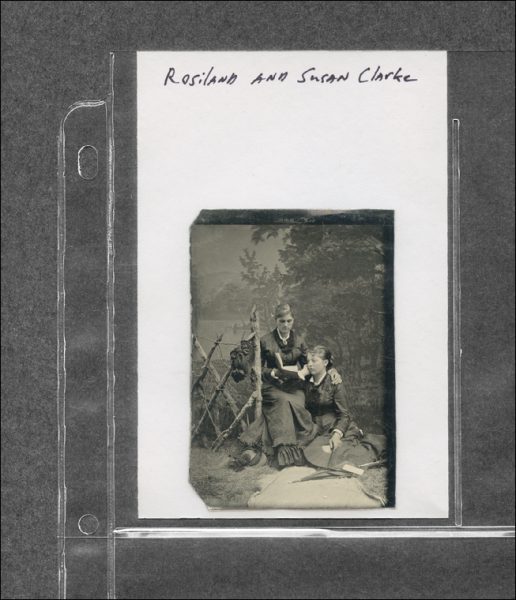
Loose tintypes can be abrasive to other photographic materials. If stored in sleeves (or binder sleeves as pictured) you can back them with archival cardstock and write any relevant information on the cardstock (collection number, name, regiment, price paid, etc.). This keeps them organized without damaging each other. Photo from Archival Methods: https://www.archivalmethods.com/blog/tintypes-archival-preservation/?srsltid=AfmBOop9hWudPeDyvM_pT0TgYeM2OBWyJHC9iBUkGZq7aO5lrJpAuGXz
Tintypes deserve particular attention because they are so common in 19th-century collections and Civil War photography. Because the image is on a thin metal plate, tintypes can have sharp or bent edges that may damage other photographs. Individual archival polyethylene envelopes are an effective way to keep them separated. Acid-free card stock can also provide additional support for thin or vulnerable tintypes. (
If a tintype is housed in an original 19th-century album or case, resist the temptation to dismantle it. Instead, consider digitizing the image while preserving the original album or case as an artifact.
Tintypes can also contain remarkable amounts of detail despite their small size. Creating a high-resolution digital copy allows you to enlarge the photograph, share it with relatives, or use the digital version for research without repeatedly handling the original. If there is writing or a photographer’s imprint on the back, digitize that side as well.
Don’t Forget the Back of the Photograph
For historians and genealogists, the back of a photograph can be as important as the front. A photographer’s studio imprint can identify where the photograph was taken. A handwritten name can identify the sitter. A date, address, military unit, or family note can provide clues that help connect the photograph to other records.
For this reason, always digitize both sides of a historic photograph when possible. The information on the reverse should not be overlooked simply because the photographic image is on the front. Archival Methods specifically recommends scanning the backs of CDVs, cabinet cards, and tintypes when information is present.
This is particularly important for Civil War photographs. A seemingly ordinary photograph may contain an identifying notation such as a soldier’s name or regiment that transforms an unidentified portrait into a documented historical artifact.
Digitize Before You Handle and Share
Digitization is one of the best ways to reduce unnecessary handling. Creating a good digital copy means that family members, researchers, and friends can view and share the image without repeatedly handling the original. It also gives you a backup should the physical photograph ever be damaged or lost.
Scan photographs at a sufficiently high resolution to capture the detail present in the original. Small CDVs and tintypes can contain considerably more detail than is apparent when viewing them in their original size. High-resolution scanning allows those details to be enlarged and examined.
If you do not have a scanner, a carefully made digital photograph taken with a phone or camera can still be useful. The important thing is to create a faithful record while the original is still in good condition.
Be Careful With Old Albums
Historic photograph albums present a special preservation challenge. Nineteenth-century albums may contain CDVs, cabinet cards, tintypes, and other photographs that were inserted into specially designed pages. Although it may be tempting to remove the photographs and reorganize them, doing so can destroy evidence about their original arrangement and relationships.
Whenever possible, preserve the album as an object. Digitize the pages and photographs, but avoid attempting to flatten, repair, or disassemble a fragile album yourself. Archival Methods recommends protecting historic albums with archival materials and, where appropriate, using buffered tissue between pages.
The same principle applies to old scrapbooks: don’t attempt a restoration project simply because something looks old or damaged. Stabilization and preservation are often safer than trying to make an object look new again.
Display With Care
Of course, historic photographs are meant to be enjoyed. Preservation does not mean hiding everything in a box forever.
If you want to display a particularly important photograph, use archival matting and framing materials. An 8-ply archival mat can provide more space between the photograph and the glazing than a standard 4-ply mat. This is especially useful for cabinet cards and tintypes because the photographic surface may have some depth or curvature.
Use UV-filtering glazing and keep framed photographs away from direct sunlight. Even with protective glazing, permanent display should be approached cautiously. Consider rotating photographs periodically rather than leaving an original on display for years.
Preserve the Photograph—and the Story
A 19th-century photograph is more than an old picture. It can be a piece of family history, military history, local history, or social history.
The best preservation strategy is therefore a combination of proper storage, careful handling, environmental control, and documentation. Identify the people pictured whenever possible. Record photographer information, dates, locations, inscriptions, and family stories associated with the image. Digitize both sides. Then protect the original using appropriate archival materials.
For collectors of Civil War photographs, these precautions are especially important. A tintype of an unidentified soldier, a CDV bearing a photographer’s imprint, or a cabinet card with a handwritten name may represent a piece of history that cannot be replaced.
You don’t need a museum vault to become the caretaker of that history. Keeping photographs cool, dry, protected from light, safely enclosed, and carefully documented can help ensure that the faces captured by 19th-century photographers remain available for generations to come.
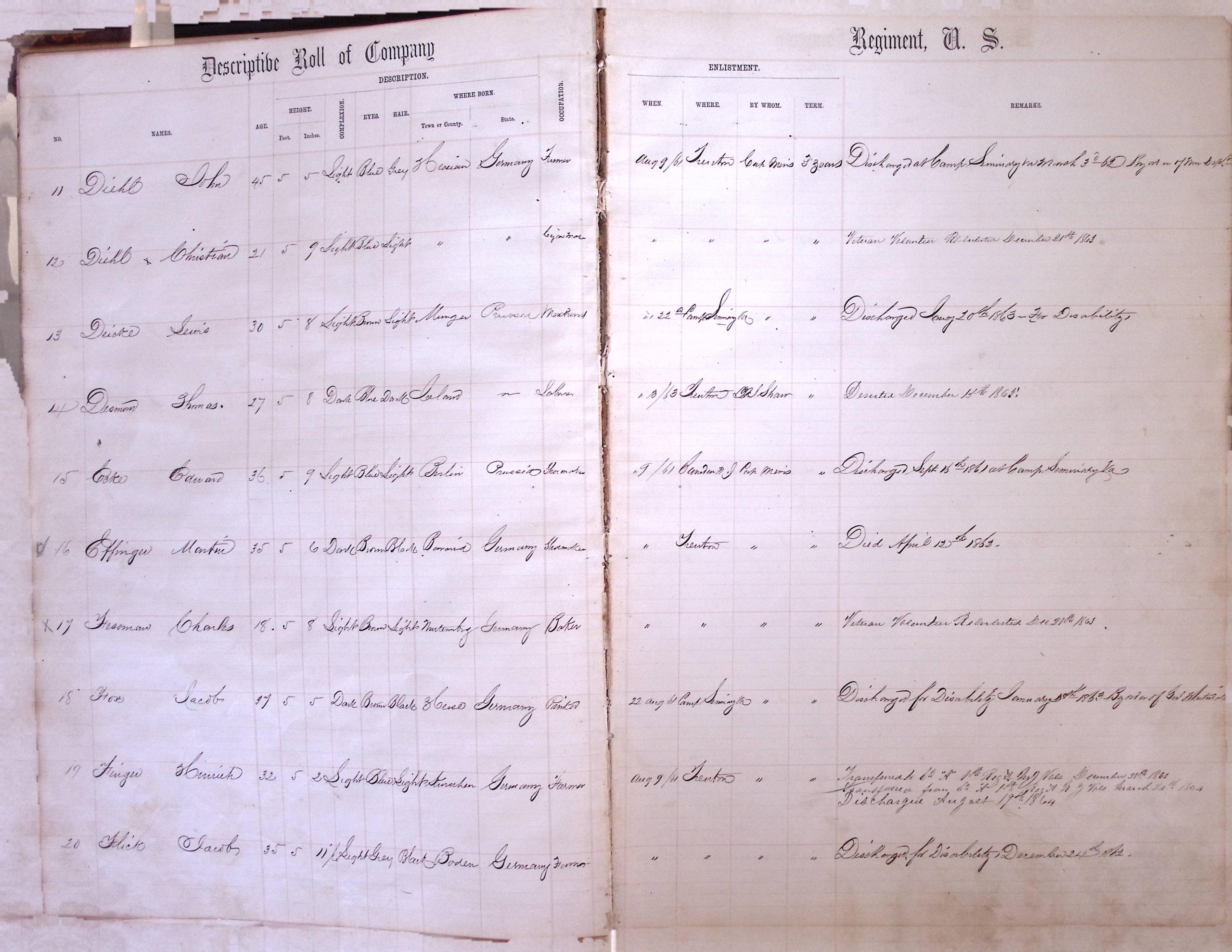
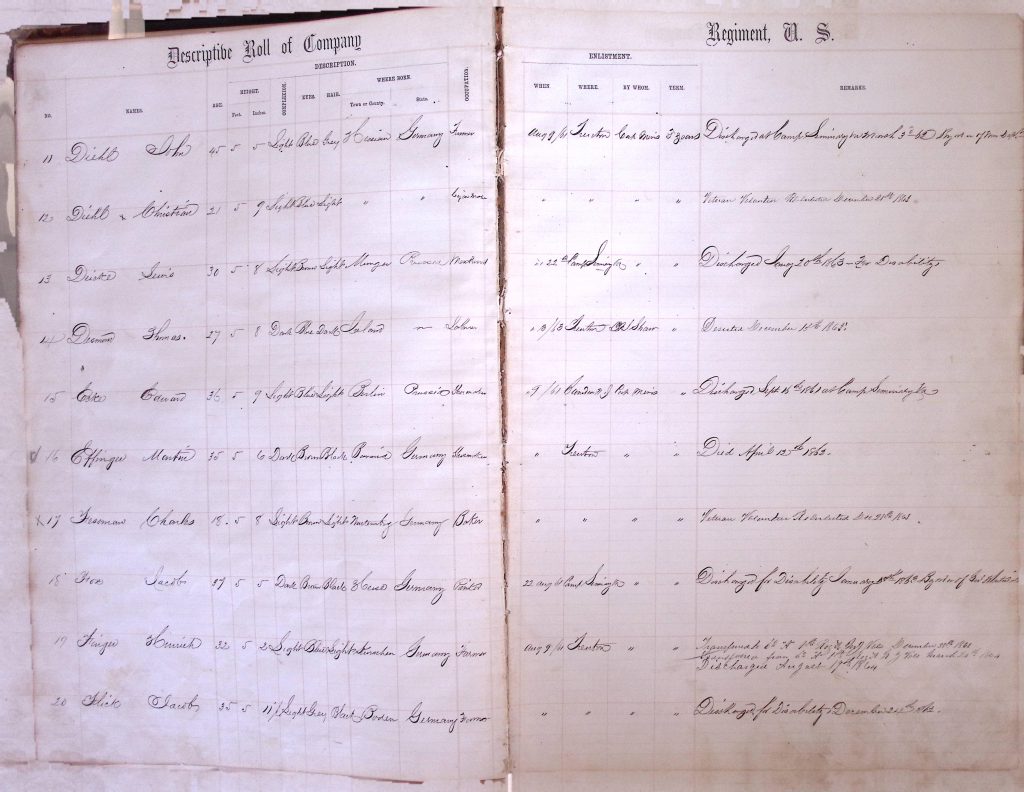
Descriptive Roll of the 4th New Jersey Infantry for companies A-E. This image is taken from one of our scans of documents located in Records Group 94.
Over the past year or so, the Research Arsenal has been digitizing regimental books from Records Group 94 at the National Archives and adding them to our searchable database. But for those who many not be familiar with Records Group 94 and its contents, we thought it might be wise to put a bit of a primer out on it.
Understanding National Archives Record Group 94: A Treasure Trove for Civil War Research
For anyone researching the American Civil War, few collections at the National Archives are as important as Record Group 94 (RG 94), the Records of the Adjutant General’s Office. This massive collection contains millions of pages of military records created and maintained by the U.S. Army between the Revolutionary War era and World War I. For Civil War historians, genealogists, and descendants of Union soldiers, RG 94 is one of the most valuable sources available because it preserves the administrative records that documented the service of volunteer soldiers and military units throughout the war.
The Adjutant General’s Office served as the Army’s central recordkeeping agency. It was responsible for maintaining personnel records, recording military orders, collecting reports from units in the field, compiling returns, and preserving information about officers and enlisted men. As a result, Record Group 94 contains an enormous range of documents relating to the Civil War and the soldiers who fought in it. Today, it remains one of the primary collections used by researchers seeking to reconstruct military service histories.
What Is Record Group 94?
Record Group 94 encompasses the records of the Adjutant General’s Office from the late eighteenth century through 1917. The collection includes correspondence, orders, muster rolls, returns, personnel records, registers, indexes, and numerous specialized record series created by the War Department. The National Archives estimates that the record group contains more than 137 million pages of textual records, making it one of the largest military collections in federal custody.
While the collection covers many periods of American military history, Civil War researchers most often use the portions relating to volunteer organizations raised by the states for federal service between 1861 and 1865. These records provide both individual soldier information and detailed records concerning entire regiments and companies.
Regimental Descriptive Books
One of the lesser-known but extraordinarily useful record series within RG 94 is the collection of Regimental Descriptive Books and Company Descriptive Books.
These books were maintained by regimental adjutants and contain personal information about soldiers when they entered service. Researchers can often find details not available in the CMSRs.
Information commonly recorded includes:
Age at enlistment
Place of birth
Occupation
Height
Eye color
Hair color
Complexion
Date and place of enlistment
Name of recruiting officer
Remarks concerning service, transfers, desertion, death, or reenlistment
These books effectively provide a physical and biographical snapshot of a soldier at the time he entered the army. Modern historical databases and demographic studies of Civil War soldiers have relied heavily on these records.
Muster Rolls and Muster-In/Muster-Out Books
Muster rolls form the backbone of Civil War military recordkeeping.
Every company periodically submitted rolls listing the soldiers assigned to the unit and noting their status. These records documented whether a soldier was present for duty, absent, hospitalized, on detached service, captured, wounded, or deceased.
Researchers can often trace a soldier’s wartime experience through consecutive muster rolls. They may reveal:
Dates of service
Temporary absences
Transfers
Medical issues
Promotions and reductions in rank
Deaths during service
Muster-in and muster-out rolls additionally record the formal entry and exit of soldiers from federal service. These records served as the primary source material later used to create the Compiled Military Service Records.
Returns and Morning Reports
Another important category consists of military returns and reports.
Regiments, posts, and departments regularly submitted returns that summarized their condition and strength. Morning reports recorded the daily status of soldiers in a company or regiment.
These records may reveal:
Number of men present for duty
Sick soldiers
Soldiers absent on leave
Prisoners of war
Casualty figures
Unit locations
Changes in command
For researchers interested in reconstructing a unit’s activities rather than focusing on a single soldier, returns and reports can provide a detailed picture of day-to-day military operations.
Letters, Orders, Registers, and Correspondence
RG 94 also contains extensive correspondence series created by the Adjutant General’s Office.
The collection includes:
Letters received
Letters sent
Registers of correspondence
Telegrams
Administrative reports
Orders and circulars
These records can be especially useful when researching officers, disciplinary matters, promotions, resignations, courts-martial, recruiting efforts, or unusual service situations. The accompanying registers and indexes frequently allow researchers to locate individual pieces of correspondence concerning specific soldiers or military units.
Why Record Group 94 Matters
Record Group 94 remains one of the most important collections for Civil War research because it bridges the gap between individual soldiers and the larger military organizations in which they served. The records document not only who served, but also where they served, how they served, and what happened to them during their military careers.
A researcher studying a Union soldier can often use RG 94 to reconstruct an entire military history—from enlistment and physical description, through battles, hospitalizations, and promotions, all the way to discharge. Likewise, researchers studying a regiment can use muster rolls, returns, and Record of Events books to trace the unit’s movements and activities throughout the war.
More than 160 years after the Civil War, the records preserved in Record Group 94 continue to serve as one of the foundational sources for understanding the experiences of Union soldiers and the administrative machinery that supported the Union Army.
How to Access These Sources
The Research Arsenal currently has over 122,000 pages of Records Group 94 material online. These include a variety of books such as Regimental Descriptive books, Morning Reports, Letter Books and more. An important thing to remember is that the amount of information available for each regiment can vary wildly. Some regiments may have a nearly complete record of service, while others may only have a few books available at the National Archives. Presumably, the missing volumes have been lost or were perhaps never donated to the National Archives to begin with. Using the Research Arsenal to access the records saves you a potentially costly trip to Washington D.C. and is currently the only online database with these records available.
Visit the Research Arsenal, click on “Search NARA Records” then select “RG94” and then select the regiment of your choice from the drop-down menus. If the regiment you are looking for is not listed, then it likely has not been digitized yet. If you’d like to sponsor a regiment you can do so via the link here: https://www.11thovc.com/shop-2
The Importance of a Well-Documented Private Collection: Part 3
The last two weeks we’ve discussed the importance of a well-documented private collection, and this week we’re going to dive into some ways to keep all of that information with your items. Although this “can” be done with paper, pencil and a filing cabinet, I strongly recommend you go the digital route. I know we all love our historic things, but record-keeping should definitely be in a 21st century style.
Excel (or Google Sheets)
This is probably the simplest way to do this. Create an Excel sheet with fields for the item, purchase date, cost, and purchase information. I would also recommend including where you are keeping the item if possible, so that it is easy to locate if you have a large number of items. Here is an example of what that might look like:
Here is a very simplistic catalog record using Excel. While it does track some information, as you can see, it is very limited.
While this technically works on a basic level, do you notice any issues with it? For example, how descriptive can I be about the item in that short Excel line? Would it be easier to have a photograph of the item tied in with this information? Especially when you have several tintypes of Union cavalry soldiers with carbines? This brings me to my second option.
Use a Program like CatalogIt or ReCollector
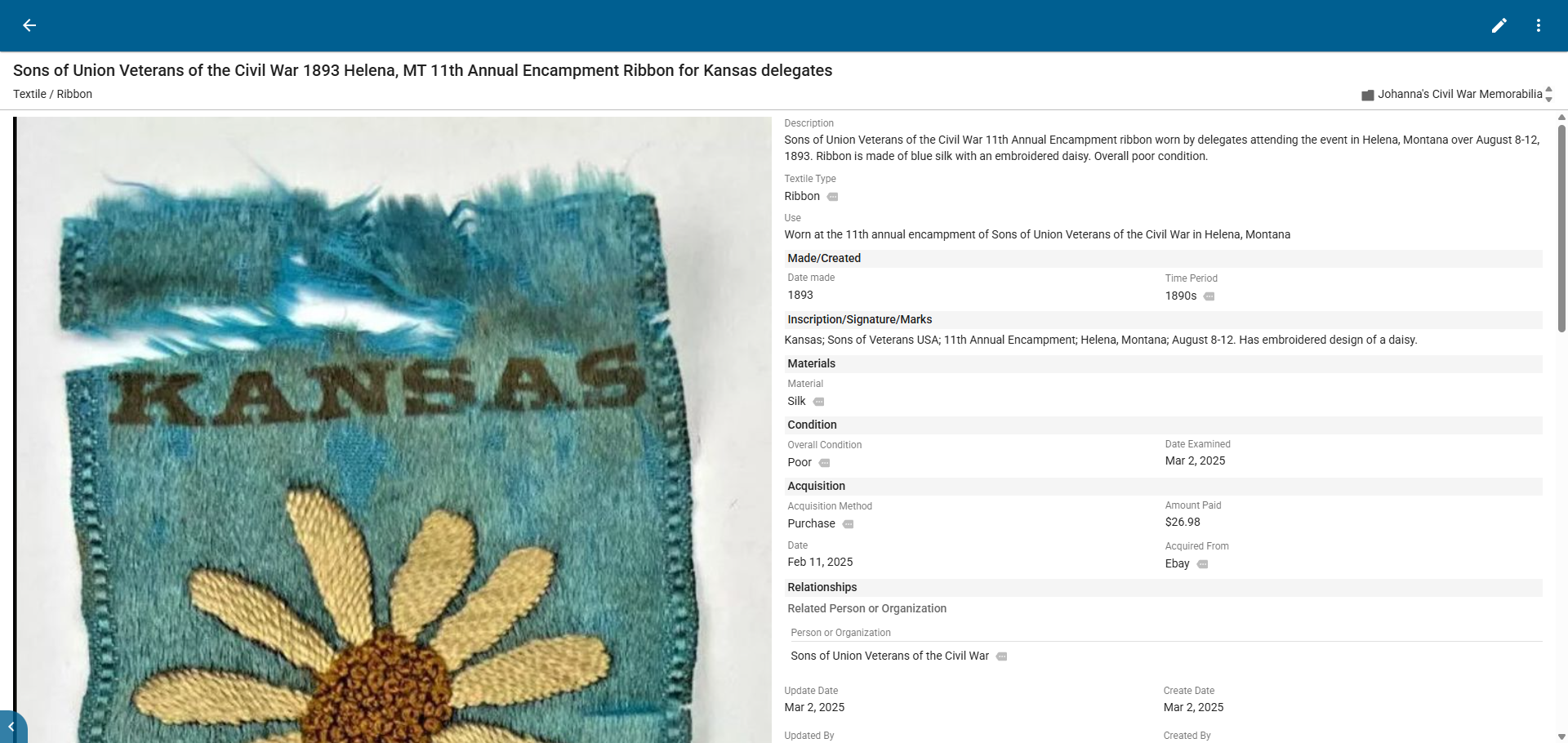
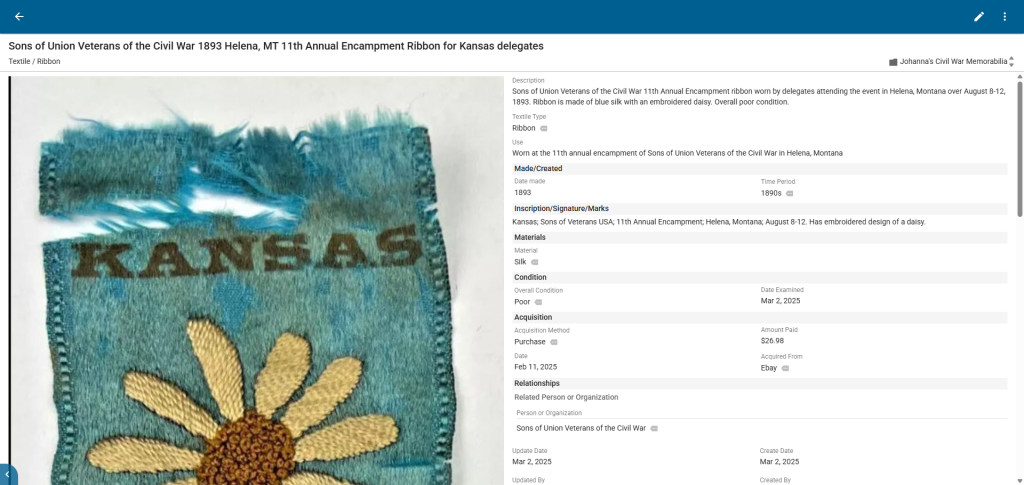
There are programs designed for this sort of thing, and I have featured them both in the past. Both CatalogIt and ReCollector allow you the space to input all of the information above, and then some. Here is an example of a catalog record using the CatalogIt software. Notice all of the information that this software tracks for each item.
Here is a screenshot of a catalog record using CatalogIt software. Can you see the vast difference between this and Excel? Which one is better suited for supporting a well-documented private collection?
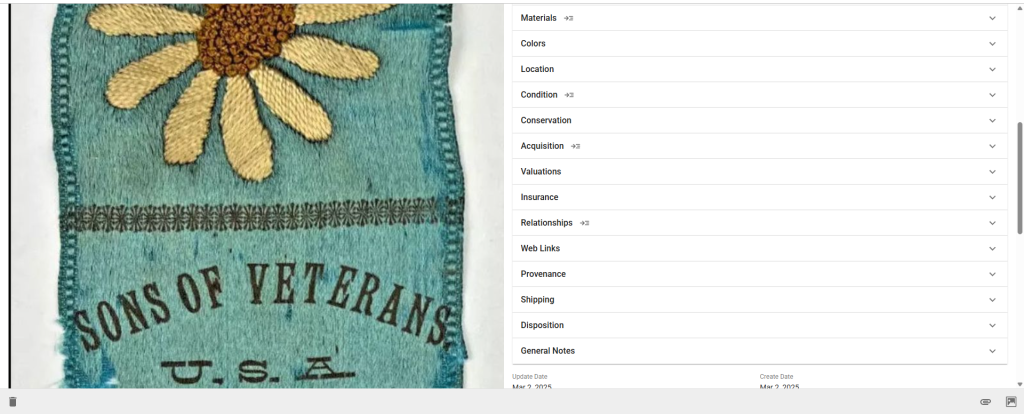
This photo shows you what it looks like on the backend for inputting information and what sorts of fields of information it tracks.
This is a screenshot showing just some of the categories available to input data for collection items using CatalogIt. Each of these expands with multiple fields of information available. They do not have to be filled out, but the more information the better.
This may look like a lot or seem intimidating, but it really isn’t tough at all. Once you create your first catalog record, it starts to move very quickly. Plus, you can always go back and add more information.
Pros and Cons
Obviously, going the Excel route is simple and something that most folks are already familiar with. However, it is extremely limited and would be cumbersome to use to add a large amount of information to. Whereas CatalogIt is new software so it does have a learning curve, but the value in the type of information it can track far outweighs that learning curve. And if the amount of options for information to be added on CatalogIt seems overwhelming, you do not have to fill in each available box, but the space is there for you to if you want to. Both give you search functionality which far outweighs the “historic” paper and filing cabinet method.
As we discussed in the beginning, the point of this is to keep track of all of your collection information. It’s far too much information to just be rattling around in your head. It needs to be written down, and it should be done in a way that you can actually put everything down that you need to. On top of that, it should be done in a format that the information can easily be passed on to others or accessed by others in the event that your family or loved ones are trying to figure out your collection for resale purposes. In addition, should you decide to donate your collection, this will offer the museum a whole wealth of information on your collection so that they are not starting from scratch. Having worked in museums for nearly two decades, you would be surprised at the amount of information that can be lost when an item is donated by someone who doesn’t really know what it was. This kind of information is absolutely crucial. Remember, context is everything and this is how we keep the context with our collection.
Now that we’ve reached the end of this series, what will you do? Do you already have a system in place that tracks all of this information? Will you start one?
The Importance of a Well-Documented Private Collection: Part 1
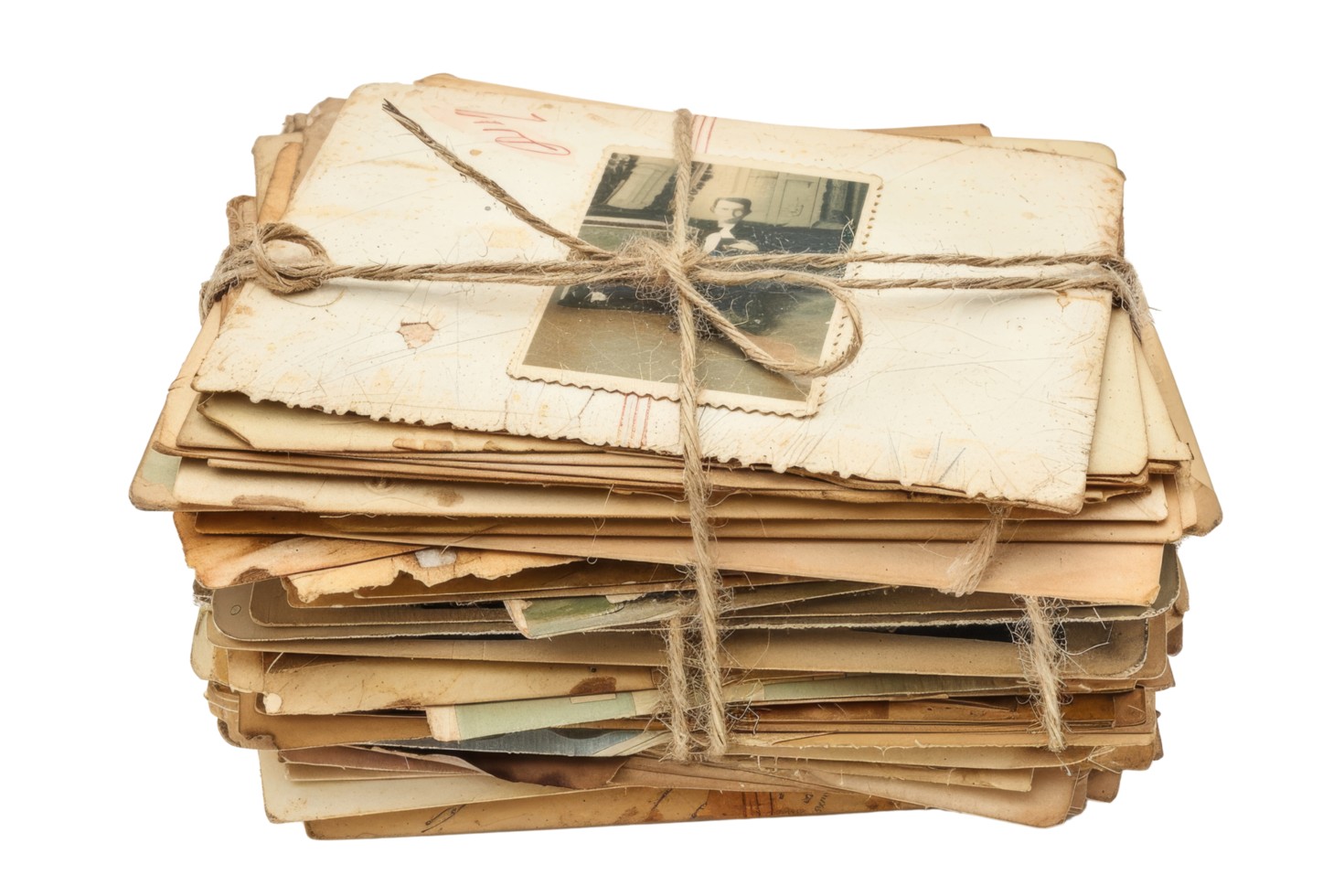
The bundle of old photos is a great example of a pile of history that has lost its context. Without the information of who these people were, this stack of at one time significant memories, becomes nearly worthless as it is reduced to just photographs. A well-documented collection can help prevent that.
I have discussed the importance of cataloging your collection over the course of a few blog posts in the past, and today I want to highlight the importance of having a well-documented private collection.
As collectors, we often know our collections inside and out—where and when we got something, who we got it from, what we paid for it, the significance of it, why we got it, etc. But what we often don’t take into account, is that there may come a day when we can’t remember that information. And there also will come a day when we’re gone from this earth, and unless we’ve written that information down somewhere, it dies with us.
How many of you have come across an old CDV and written on the back is “mother”? Who’s mother? What was her name? That information is just plain gone. Sift through the box of vintage photos at your local antique store and you’ll find pictures like that in droves, or the ones that are just blank on the back. They often sell for only a few dollars each because the context of who these people were is totally gone. That context gave them their value. Without it, they just become random old photographs. Just for fun, I went to eBay and entered the search term “unidentified photo” and got 220,000+ results. I then input “identified photo” and got only 6,100+. Clearly, there is a problem with people losing the identifying information over time.
The same is true with objects. How often do you see the words “ID’d” or “named collection” with items in an auction listing? That always drives up the price, doesn’t it? It does, because the names add value. Now you know who this belonged to and the items take on additional meanings. Without it, they are reduced to nothing more than the physical object itself—a Model 1850 foot officer’s sword, haversack, etc.
At one time for all of these objects, they had identities. There was someone alive who knew all those people in those unlabeled photographs, and someone who knew who owned that sword and that haversack. Unfortunately, that information did not travel with the object that outlived them. This is where we as collectors need to keep information whenever it is available.
Since this is the start of a new year, it’s a good time to start keeping track of your collection information if you are not already. This month, I’ll be writing blog posts on what to keep and why, as well as the best ways to keep it.
Step 1: Collection Assessment Project
Take a look at your private collection and just broadly assess if you’ve kept any of the following: purchase info (date of purchase, from whom, for how much, etc.), any research documentation (did you look things up on your phone without saving links or copying information down anywhere?), storage location (do you know where all your items are and how they are stored?), and lastly, condition (do you know the condition of your collection items and which ones are damaged and needing conservation, or better storage?).
And one last thing, how easily were you able to find this information? Was it at your fingertips with a few keystrokes on the computer, or did you have to go digging through boxes or files? And how easily would your partner or loved ones be able to find all of this information if you weren’t there?
This is all just some food for thought as you go through and assess your private collection. But we’ll use this information as we discuss ways to begin to keep track of it all and organize it. Check back next week for the next blog (step) in this series.
Notice how this soldier’s letter has torn along the crease where it was originally folded over 150 years ago. Storing it flat and unfolded could have prevented the additional strain on the crease that caused that damage. Knowing the best way to store historical documents can make a tremendous difference in the life of a collection.
This week while scanning some Civil War letters I ran across damage that I’ve seen all too often with old documents that have been folded. The original crease of the letter had become brittle and damaged over time to the point that it had torn nearly the entire length except for a short 2-inch section. This is something that tends to happen when documents are stored folded. It’s not necessarily from poor handling (although that certainly plays a role) it can happen just from being stored improperly. Here are a few tips on how to store historical documents that you can use in your archive to avoid similar damage.
Store Historical Documents Flat
This is a simple thing to do and it makes a huge difference in the care of documents. At first, it might seem strange to take a letter that has been folded in half for 160 years and store it unfolded. But the reason behind it is simple: the paper was produced in a flat sheet and that is position that puts the least amount of stress on it. Creases over time become tears because the crease is putting a large amount of stress on the paper fibers—eventually weakening them to the point of tearing. If you’ve ever wanted to tear a straight line on a sheet of paper, what’s the first thing you do to it? Make a crease where you want the tear to be. Doing that first weakens the paper so that when you apply stress to it, the tear will follow the crease. The same principle applies here even though you are not intentionally applying stress to the paper to tear it.
Store Historical Documents in Sleeves
This is something I’ve mentioned in previous archive posts, but I strongly recommend storing historical documents in protective sleeves. The sleeves themselves provide another layer of strength to the fragile period paper which helps prevent damage. In addition, storing a document flat in a sleeve allows both sides of the paper to be completely visible without folding/unfolding, and the sleeve protects the document from hand oils, dirt, dust, etc.
If sleeves are not viable for your collection, I would recommend using archival paper as interleaves between the historic documents. This will provide a buffer between one paper and the next, which offers some protection.
Store Historical Documents in Archival Boxes
Storing documents flat produces the least amount of stress on the papers themselves. Once the papers have been sleeved, you can place them in archival folders and those folders should fit neatly into the box. I understand that boxing everything may not be practicable for everyone, and the alternative would be to store them vertically in filing cabinets. This is something that is accepted and done by many major archives, and can be very efficient.
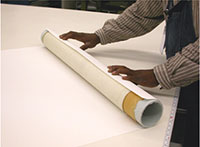
If you have oversized documents such as muster rolls, ledger books, newspapers, etc., I would strongly recommend storing those flat in appropriately sized boxes. If the oversized loose papers are pliable and strong enough to be rolled, they may be stored rolled using an archival tube and rolling the papers around the tube and storing them in a second tube or wrapped in archival tissue and then polyester film. This ensures that the document is not rolled too tightly causing damage.
Here you can see staff at the National Archives rolling a historic document around a tube which will then be wrapped in archival tissue and polyester film to be protected.
No archive is perfect, and when you are working with old and fragile items, unfortunately, some deterioration is unavoidable as the very materials simply age. But, the more steps we can take to better care for our collections, the longer they will last. For other archival tips, check out previous blog posts here: https://researcharsenal.com/category/archival-and-preservation-tips/
Collection Preservation Tips from The National WWII Museum
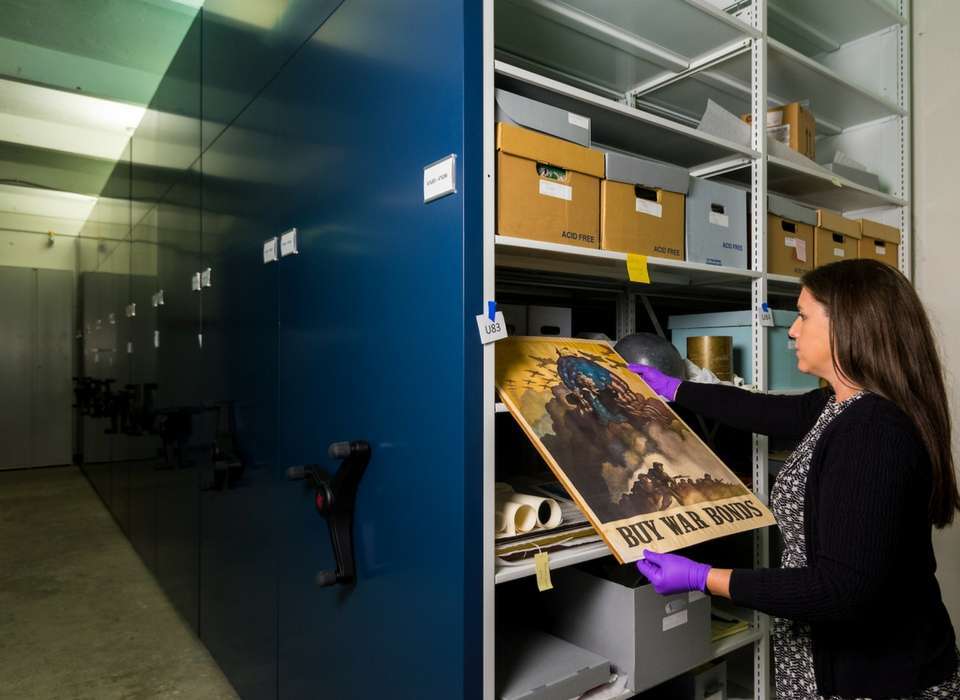
This photograph from the National WWII Museum shows collections boxes stored on Space Saver shelving, in archival boxes, and properly tagged with archival tags. Notice the staff member is also handling the poster with gloves while is fully supported so that it doesn’t bend and tear. Image source: https://www.nationalww2museum.org/war/articles/20-years-collecting-wwii-artifacts
Although the National WWII Museum is a bit further forward in time than Civil War collectors, the concept of preserving uniforms, firearms, photographs, and paper, is much the same. Their website is a fantastic resource for the private collector, so I thought it would be helpful to distill some of their key collection preservation tips down for Civil War collectors.
The National WWII Museum champions the principle “Do No Harm”, offering clear, practical guidance to help preserve such treasures for future generations. You’ll recognize the “Do no harm” motto as something I have repeated in previous posts—do not do anything to your collection that is not reversible! Put down those ballpoint pens! (If you know, you know…)
Seven Factors That Can Affect Your Collection
Before diving into specific techniques, here are seven factors that can affect your collection that you should be aware of:
Light: UV-rich sunlight and fluorescent lighting can severely damage paper, textiles, photographs, and furniture. Keep sensitive items out of direct exposure.
Temperature: Extreme or fluctuating temperatures wreak havoc on materials like rubber, wood, and metal. Avoid attics, basements, and unconditioned spaces.
Humidity: Too much moisture fosters mold and pests; too little causes brittleness. Aim to maintain 45–55% relative humidity in stable environments.
Pests: Insects like silverfish (paper), moths (textiles), and termites (wood) can be destructive. Regular inspections are essential.
Human Handling: Oils, sweat, or makeup from hands—even gentle touching—can harm surfaces. Always use cotton or nylon gloves and avoid unnecessary handling.
Chemical Reactions & Pollutants: Metals and marble can corrode when exposed to indoor airborne chemicals; avoid the use of acid-emitting materials.
Inherent Vice: Some materials naturally degrade due to incompatible components—such as leather glued to wood. Periodic condition checks help catch early signs.
Tailored Preservation Tips by Material
Textiles
Store in climate-controlled spaces, not attics or basements.
Keep out of bright light and UV exposure.
Use acid-free boxes—avoid ordinary cardboard or wooden drawers. Wood will off-gas over time and that can discolor and damage your collection.
Store flat when possible; pad and support folds if necessary.
Use acid-free tissue padding, properly padded hangers, or roll large textiles around acid-free tubes—never sealed plastic bags. If moisture is sealed inside a plastic bag with your textile, it can cause mold.
Paper
Maintain storage below 72°F and around 50–55% humidity. This may seem like a high level of humidity, but very dry air can be as destructive as very humid air, just for different reasons. This level of humidity will keep the paper from becoming brittle and crumbling.
Keep flat, avoid folds, and use acid-free folders/boxes/sleeves.
Frame with archival-quality, acid-free materials and UV protective glass.
Photographs
Store in a cool, dry place, use acid-free or inert framing materials.
Handle by the edges, ideally with gloves—avoid touching surfaces.
No tape, markers, paper clips, or sticky notes; use pencil on copies or backs.
Avoid self-adhesive photo albums at all costs. I know those were very popular in the 1980s and 1990s, but they are bad news for the longevity of your collection! Opt for acid-free sleeves or place them with archival photo corners in archival photo albums.
Be sure to rotate any original images when displayed, or better yet, consider displaying copies, leaving originals safely stored.
Metal Artifacts
Most metals (except gold) are prone to corrosion—store in dry, conditioned spaces.
Don’t polish or clean without professional consultation. Cleaning and polishing old metal ruins the aged patina on the item, which can also be an issue when determining authenticity of a piece.
Always wear gloves when handling. Oil from your fingers will damage the original polish on a sword or other fine steel.
Light oil (e.g., 3-in-One) or wax (e.g., paste wax) may help preserve steel or iron—but consult a specialist for weapons.
Leather
Store in moderate humidity and temperature, away from direct light.
If dirty, gently clean with damp cotton cloths. Please avoid saddle soap or conditioners as they can discolor and damage historic leather.
Never apply petroleum products; they can cause irreversible damage.
Use acid-free stuffing to maintain form—support shoes, boots, cases thoughtfully. If you have an old saddle, for example, make sure that it is fully supported on a saddle stand. If it’s sitting on a shelf, that puts the weight on parts of the saddle that are not designed to carry it, causing damage. That can also cause excessive strain on stirrups and other components. The dryer and more brittle the leather, the more of a concern this is as leather tends to stiffen over time.
Suede and kid leather are different, and should be treated by a specialist.
Wood
Wood objects are fairly stable if kept in consistent, moderate environments.
Avoid direct sunlight, over-cleaning, or using linseed/oil-based products.
Wax like SC Johnson Paste Wax may offer a protective layer; oil sparingly, especially around handles or grips.
When oiling your firearms, make sure not to get that oil onto the grips or stocks.
Expert Resources & Support
If you require a professional opinion, or are just looking for more information, these are some great resources:
American Institute for Conservation — to find recognized conservators.
Library of Congress — guidance on paper and photo care.
Northeast Document Conservation Center — specializes in paper/photo conservation.
Sometimes following museum best practices with your collection can seem overwhelming. Here are 3 simple tips to protect your archival collection that you can do quickly, easily, and affordably.
Use Archival Folders
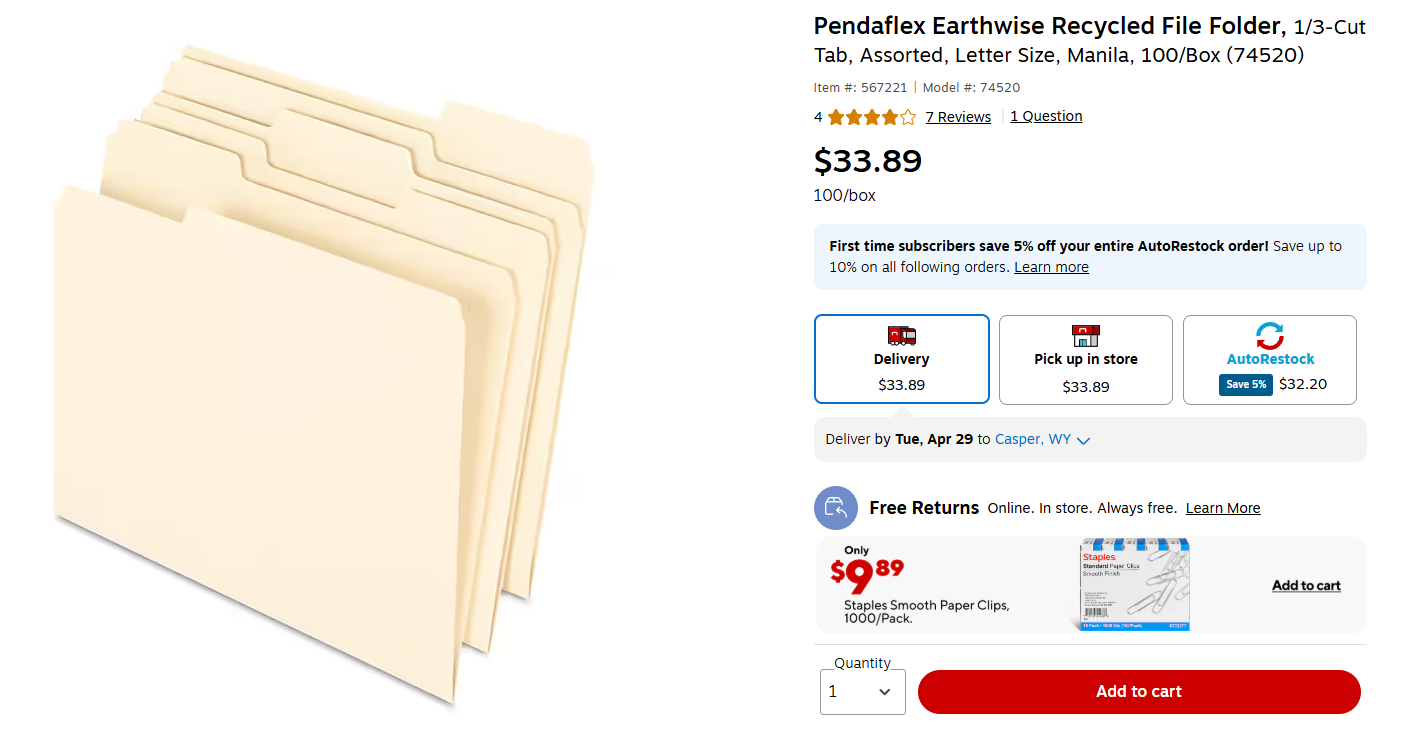
These Pendaflex folders from Staples are acid-free and would be an easy option for archival storage. They can be found here.
If you’ve gotten into collecting Civil War history, you’re likely to start winding up with a lot of paper. This ephemera could be CDVs, military documents, old newspaper articles, etc. Some of these may end up on display somewhere in your home, but if they are not, they need to be stored. It may be tempting to just stick them in a box for safekeeping, but that is not the best idea.
Placing these historic documents in archival folders is a great cost-effective option because it allows you to protect the documents while also keeping them organized. Archival folders are becoming much easier to find nowadays. Instead of ordering them from museum supply companies, you can often find them at your local Walmart or Staples store. They tend to cost a bit more, but in the long run they are worth it. Non-archival materials will damage your documents over time. They tend to be acidic, which means they will turn papers yellow and eventually crumble them away.
We’ve all seen an old, yellow crumbly newspaper, right? The reason that the newspaper is yellow and crumbly is because it was printed on very acidic paper. Dime store paperbacks from the 1950s and 1960s are often yellowed as well for the same reason. Acidic paper is cheaper and is often used by printers when longevity is not a priority. Now, have you seen a paper turn yellow because it was stored next to a newspaper? I’ve seen this happen countless times in shoe boxes of old papers that folks tend to keep. The newspaper clippings are acidic and so any paper they come into contact with is also yellowed and damaged. That is exactly why we want to use archival folders to store our documents. We don’t want them to turn yellow because they were stored inside an acidic folder.
Use Acid Free Paper
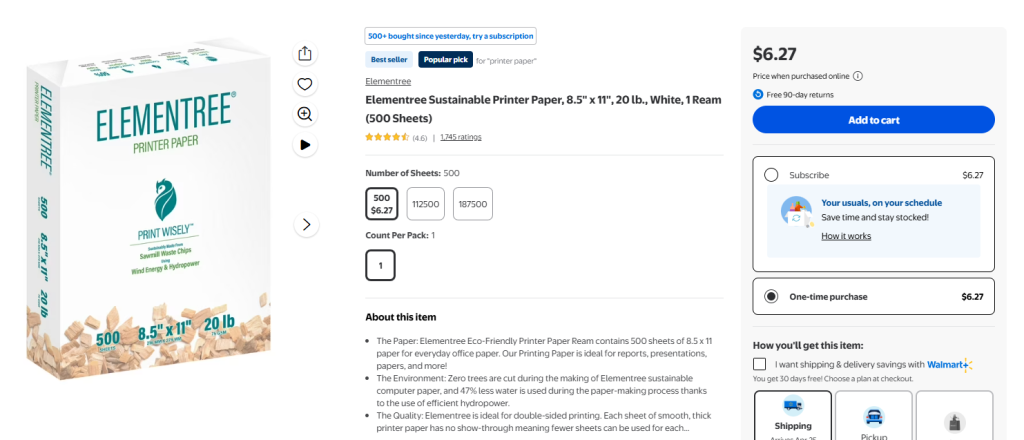
This paper is extremely low cost and available locally in Walmart stores. It is acid free and suitable for archival purposes. This paper is a great low cost option for interleaving. It can be found here.
Now that you’ve got some archival folders, you’ll want to get a ream or two of acid free paper. You can store multiple documents in the same folder, but you’ll want to separate them with acid free paper. Use the paper as interleaving between the documents.
Let’s say you have 5 papers that all relate to the same individual and you would like to store them in a folder together. You can store the first document in the folder, then a sheet of acid free paper, the next document, a sheet of acid free paper, and so on, until you’ve placed them all in the folder. This ensures that the papers are not rubbing against each other and transferring ink or dirt, and they are also protected from any potential acid transfer. Now, this is something that you will need to check on. If you have a folder full of newspaper articles, that acid in those newspapers may leach through the interleaving eventually, so you may need to replace it periodically.
Acid free paper can also often be found locally very easily at any office store or big box store.
Use Archival Photo Sleeves
These are archival products that I really can’t live without. I use these for photos and also for any important documents. These sleeves give paper artifacts and an extra layer of protection. For reference, I prefer the side-locking sleeves that I’ve mentioned in previous posts, which can be purchased here.
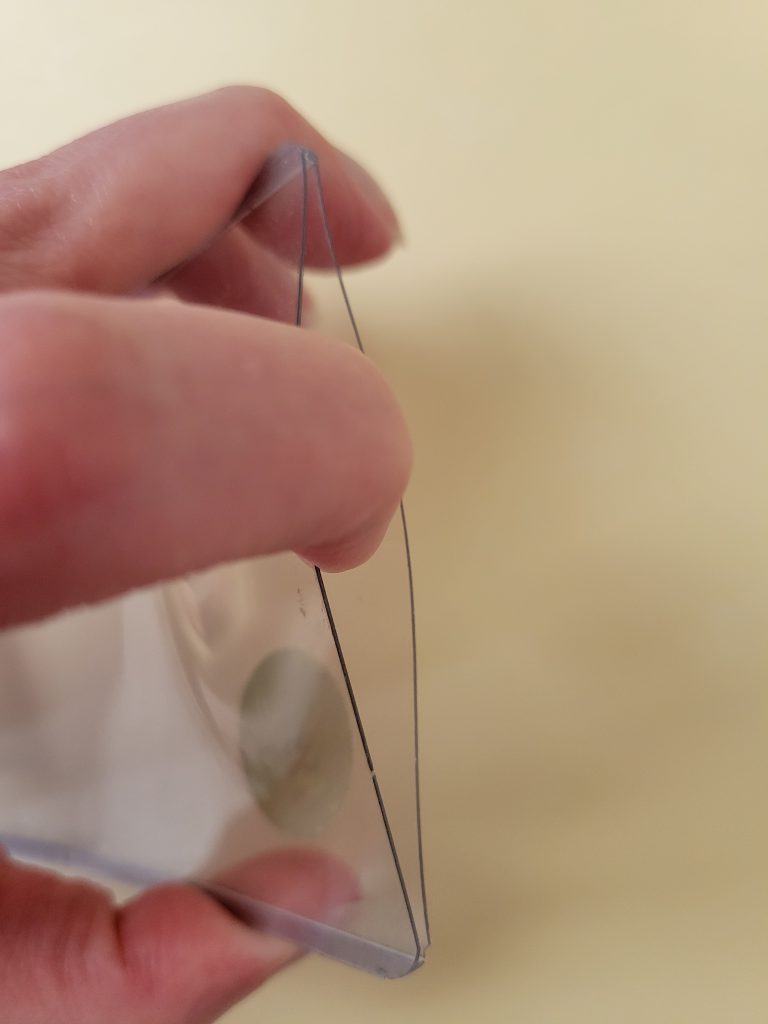
Here is an example of one of those hard plastic sleeves. Notice how this is only a narrow opening available to slide media in and out and how it takes a great deal of pressure to open. Compare that to a sleeve that lays completely flat, opens up for your to place your document inside and then folds back over. These may have value for dealers who have people sifting and sorting through their wares on a regular basis, but these have no place in a private collection for long term storage of fragile documents.
I have had CDVs shipped to me in rigid plastic folders that I CANNOT STAND. I’ve also seen a lot of collectors keep their CDVs in these same hard plastic holders that are only open on the top. I hate these for several reasons:
You have no idea if they are archival or not. Just because an antique dealer shipped you a photo in it, does not imply that it is safe to continue to store your item in it.
They are rigid and the document is held inside by force. This is not a good way to store archives. You don’t want pressure on the document because that harms it over time. Think of any video you have ever seen of an archive or museum collections room—are ANY of the artifacts stored in things that squish them, press down hard on them, or force them in any way? No.
Because they are so rigid and only open on one side, it is much more difficult to remove the document from them and also difficult to place them back inside. Yes, we all have our little tricks to pop them open a certain way, use a thumb to press down and slide them out, etc. Again, where have you ever seen anything like that done in a museum collection? It’s not. Typically, these cards are used to store CDVs, although I have seen them used with tintypes, which is a whole other issue…CDVs are basically REALLY old cardstock with an image printed on it. It should be handled delicately because each time you remove it and put it back, you are damaging it. Period. No matter how good you think you are at getting them in and out. The very fact that you have to grab the image with your thumb to pull it out, damaging it. Period images should be handled by the edges just like how you’d handle an “old fashioned” CD. Remember how sacrilege it was to get fingerprints on a CD? Think of that when you’re handling those CDVs and tintypes. You can’t handle them by the edges and use those rigid plastic holders that are only open on the top. For that reason alone, they are not good for these collections. Not to mention rubbing on the images, damaging the prints, etc.
If some of you would like to keep your images in “pockets” I would recommend looking into archival sleeves that are designed to hold images safely in binders, or even small archival books designed to hold images. I use these notebooks, place the images on the paper using archival photo corners, and they are safe inside the book without any pressure on them, and they can easily be removed if I need to rescan them for any reason.
Bonus Tip
Always, always, always scan and digitize your collection! If you don’t have one, invest in a simple scanner that can scan at least 600 dpi and scan all your photographs at that resolution to start. Documents can be scanned at 300 dpi and be easily read and enlarged clearly. Once you have your collection digitized there is no reason to be pulling old photos in and out of sleeves, documents in and out of folders, etc. You can easily look at them digitally and ensure that their condition is not degrading as you keep handling them. No matter how careful you are, every time a document is handled, its condition degrades. That’s a simple archival fact. So, the more we can minimize that, the better! And as an extra tip, please consider setting up a digital catalog system like I discussed in a blog post a few weeks ago here! All of these tips will go a long way to protect your archival collection!