Charles Walbridge was born in 1841 in Buffalo, New York. He wrote these letters to his brother, George Walbridge, who was named after their father. Before the war, Charles Walbridge worked for Pratt & Co., a hardware dealership. He enlisted in the 100th New York Infantry in September, 1861, and was appointed 2nd lieutenant of company H.
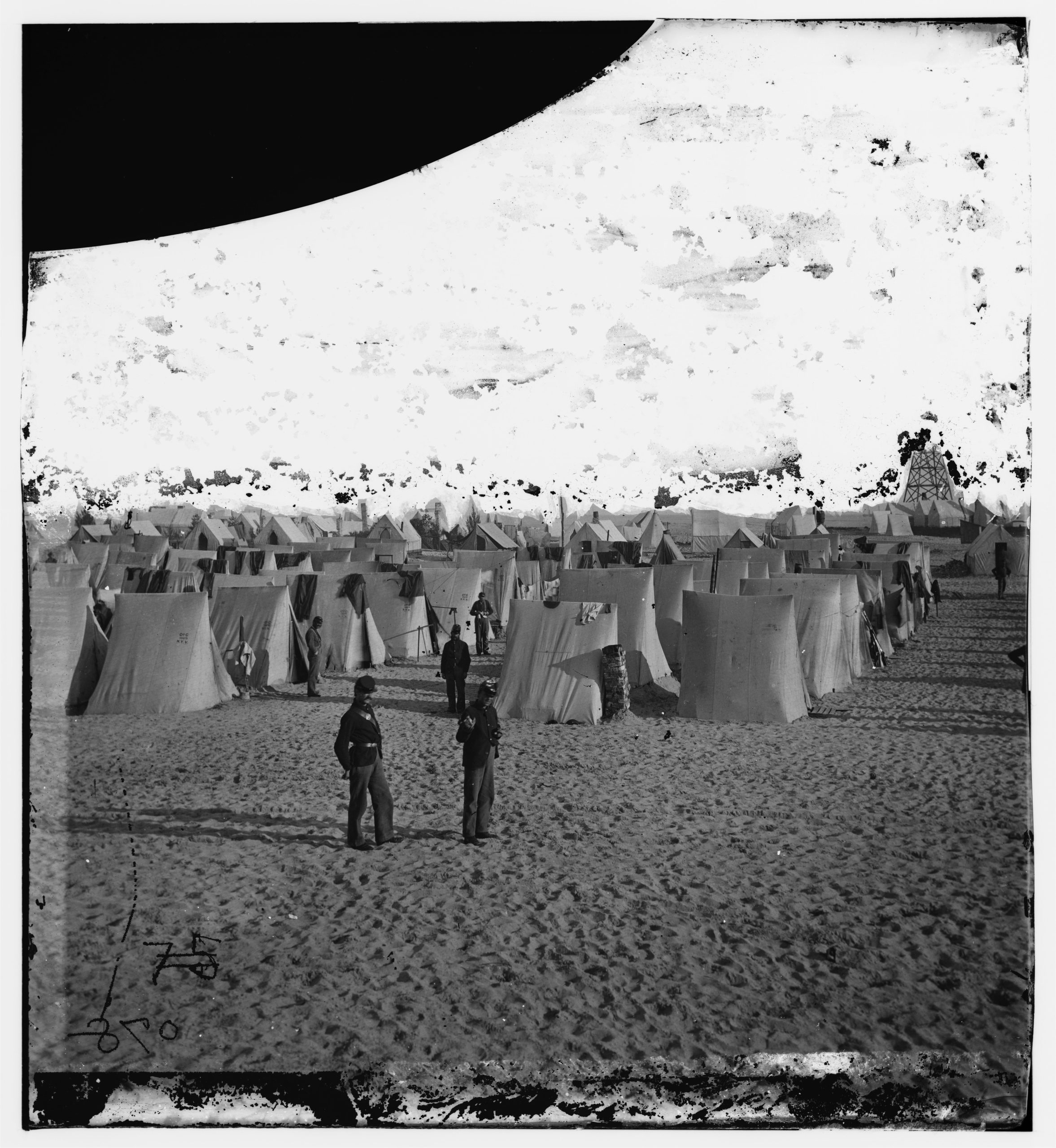
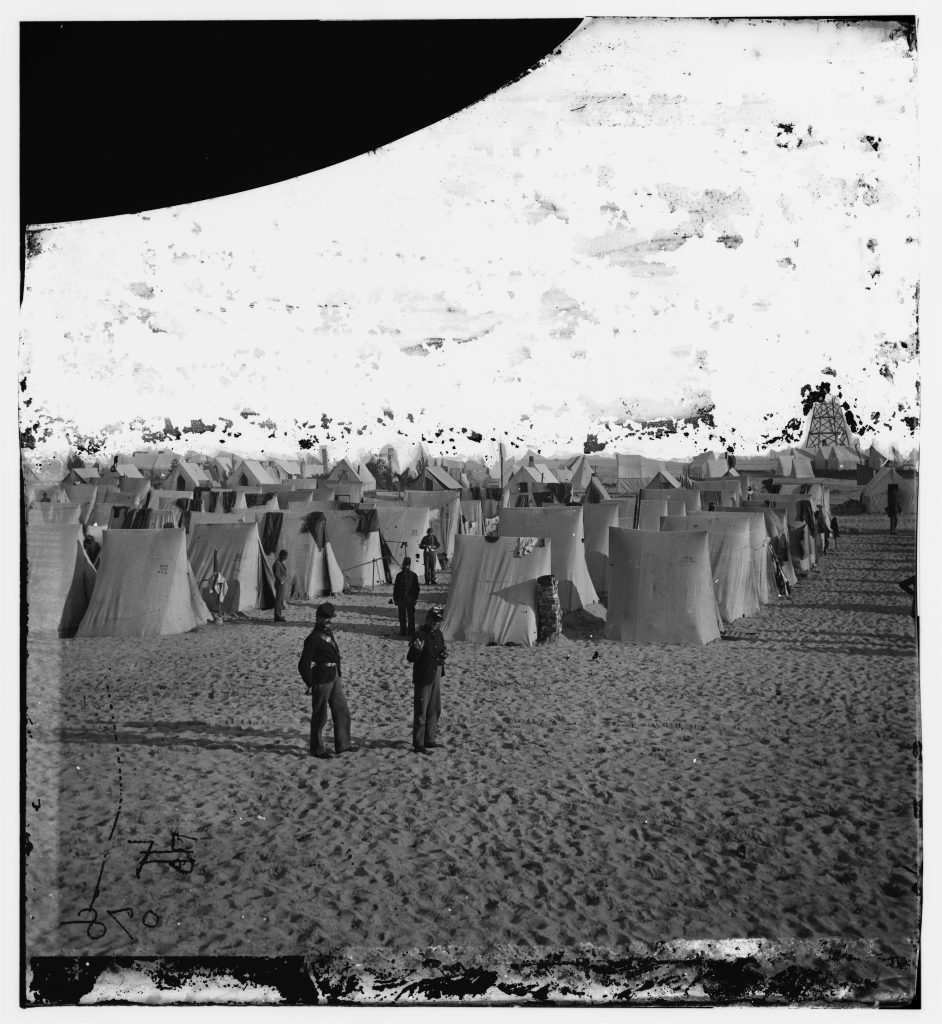
100th New York Infantry at Folly Island
On January 28, 1863, Charles Walbridge wrote from the Steamer Cahawba at Beaufort Harbor, North Carolina. By this time he had become captain of company H. Charles Walbridge knew the regiment would soon be moved somewhere, but their final destination remained a mystery. He hoped that the Union forces would soon seize Charleston and that that would be where they were headed.
“We have been all ready for sea for two days but have been delayed by a very high wind. The latest orders are to go to sea at high water which will be in about two hours (three o’clock). I intend to send this ashore by the pilot [boat] when he goes. I received the copy of your letter but not the original.
My trunk, instead of going home, got in with the baggage of the 8th New York and I received it all safe, thanks to having my name on it.
We are still in the dark as to our destination. My opinion is that it is not Wilmington. I think that it is nothing less than Charleston. Wouldn’t that be a big thing?”
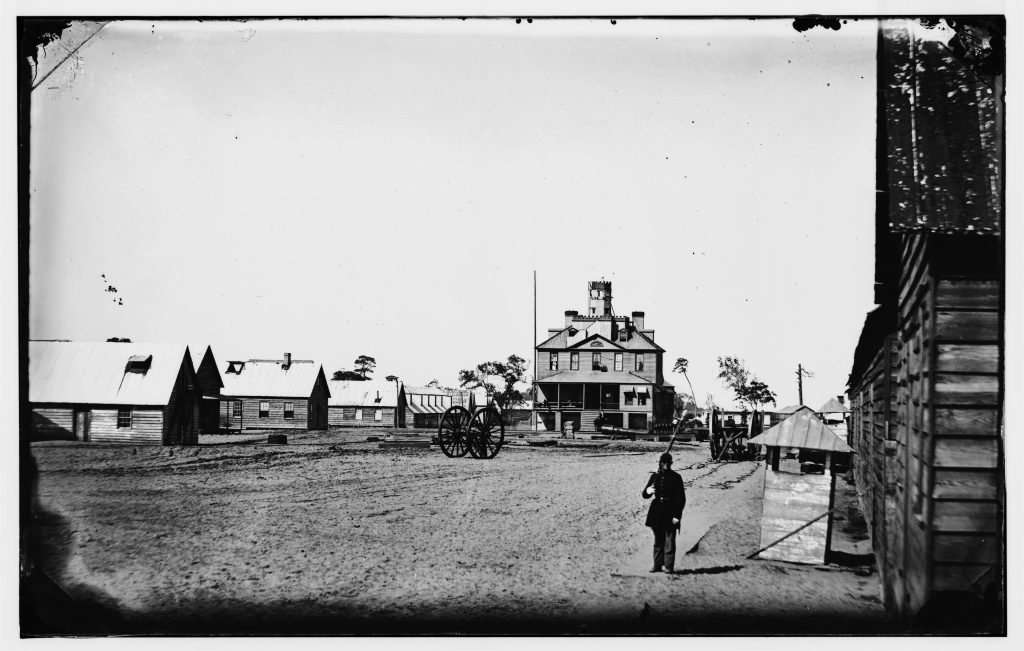
The 100th New York Infantry went first to St. Helena Island before being sent to Folly Island, South Carolina. In a letter written April 18, 1863, Charles Walbridge gave the details of Union forces on the island, with the warning that the information should be kept confidential.
“I wrote a letter to mother the other day giving a detailed account of our doings. I mentioned at the tail of it that we were once more upon the noble isle of Folly. Nothing unusual has happened. We use extraordinary precautions against a surprise. We detail three companies every night to go out and support the pickets. Last night Co. H was on the duty. We had everything nicely fixed, I can tell you, and I was almost in hopes that a few rebs would come over so that I could get pay for the men I had wounded and captured. The enemy are in very strong force on James Island.
When we returned to this island, it was intended to evacuate, but day before yesterday, the authorities concluded to hold it, so I suppose we will be here some time. I believe we are to be reinforced. There are now but four (4) other regiments on the island, all of them smaller than the 100th, and a battery (of course it is needless to remind you that the figures which I give you, especially in the letter to Mother, should not be generally known).”
In the same letter he revealed his hopes at receiving a position as assistant quartermaster for the brigade, but did not think it likely do to the failure of the army to seize Charleston.
“I don’t suppose there is much prospect of my getting the position of A.Q.M. [Assistant Quartermaster]. If the attack on Charleston had been successful, I should have had much more hope, but I hardly think the Dept. at Washington will feel like bestowing any favors on this Department at present and i don’t myself think it deserves any.”
Charles Walbridge had previously spent some months detached from the regiment as a quartermaster.
Charles Walbridge in the Summer of 1863
The 100th New York Infantry remained on Folly Island for the summer and, as predicted, Charles Walbridge did not receive a position as assistant quartermaster. On May 10, 1863 he wrote about the recent order allowing some enlisted men to go home on a furlough and that he had selected four of the men in company H with families to receive them.
“Gen. [David] Hunter has issued an order that in accordance with the recent Act of Congress, furloughs will be granted to five percent of the enlisted men of each company, for a period not to exceed thirty days. I have accordingly recommended four of the “old stock” of Co. H, choosing those who have families as the first squad. As you may imagine, there was quite a commotion among the officers as well as men. I went down to the regiment to see about it yesterday afternoon and learned that Gen. [Israel] Vogdes was not going to grant leaves of absence to commissioned officers for the present. I am not quite certain as to the truth of the report, although I had it from the adjutant who is very good authority. I have had, and still have, strong hopes of getting home this summer. I should prefer to go home in July or August but of course would be only too happy to get a leave at any time. As there will now be three officers in the company, perhaps I will stand some chance if leaves of absence are granted.”
On July 29, 1863 Charles Walbridge described the activity around him and made an oblique reference to the recent attempt to capture Fort Wagner with his worry for two of the men in his company who had gone missing.
“Our troops are working hard on Morris Island, planting guns, erecting batteries &c. The rebels bother us some with their shells. They fire a shell almost every minute. From my tent door, I can see the whole field of operations. Wagner on my right, the Cumming’s Point with Battery Bee, then Sumter stands out plainly in the centre of the circle, then comes Mt. Pleasant — a village on the opposite shore of Charleston Harbor, while clear round to the left rise three spires of churches in Charleston. Besides this, I have a fine view of the sea with the blockading fleet, monitors, &c.
We have not heard a word from [Lt. Charles H.] Runckel [Runckle] or [George N.] Clark, my orderly sergeant. I fear they are both dead. I have sent over to the regiment for Runckel’s trunk. I think I will express it to you and you can find out his relatives and send it to them. I think he had a grandfather living in Buffalo.”
Both Charles Runckle and George Clark were killed in the Battle of Fort Wagner.
Preparations to Seize Fort Sumter
On August 6, 1863, Charles Walbridge related the story of the capture of another captain in his regiment, Lewis S. Payne of company D.
“We are getting along pretty well with the siege but are not quite ready yet. I think we will be in about a week. We have had a real misfortune; this is nothing else than the capture of Captain [Lewis S.] Payne [of Co. D]. He was captured in a small boat in Charleston Harbor night before last. He had some ten men with him. I believe they were all killed but one. He escaped and reports that Capt. Payne was not hurt. The Rebels were undoubtedly laying in wait for him. He has rendered very efficient service ever since we first came into this region. He is a personal friend of mine and one of the finest men I know. His absence will be a great loss. Only a few nights ago, he went into the harbor and waited until a steamer (which was known to be in the habit of coming down nightly with supplies for [Fort] Wagner) came down to that Fort, when he sent up a couple of rockets & skedaddled. Our gunboats which had previously been notified and had the range opened fire and drove away the steamer which has not been down to the fort since. The Rebs opened fire on Capt. Payne but didn’t hurt him; at last, however, his good fortune has deserted him.”
The records of the Adjutant General indicated that Captain Payne was later paroled but give no date as to win. But as Lewis Payne was commissioned lieutenant colonel of the 100th New York Infantry on November 9, 1863 (to date from June 20, 1863) it is likely that the parole was before that time.
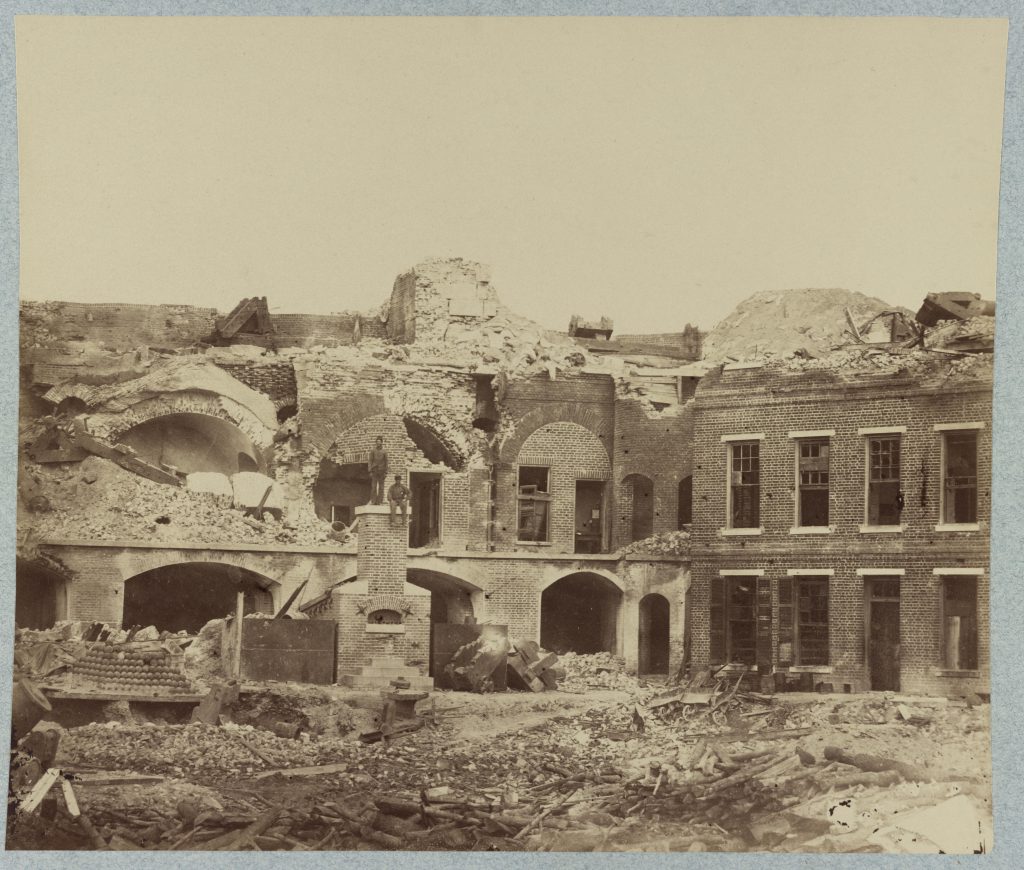
On August 21, 1863, Charles Walbridge wrote about the Union bombardment of Fort Sumter and Fort Wagner.
“The bombardment commenced Monday morning and has continued ever since. The fire has mostly been directed at Sumter. The wall on this side appears to be half down. It is completely shattered. I think it can’t hold out much longer. Sumter does not reply to our fire at all. Night before last, Sumter fired her sunset gun (the first she had fired all day) and hauled down her colors. Did you ever see such impertinence? Her flag has been down half a dozen times but it is always raised again. The firing seems to be as heavy this morning as at any previous time. Everybody is very hopeful. I go whenever I can get time up into the maintop of a brig. which lays in the inlet and which I suppose is as good a point of observation as there is in the vicinity. From it, one can see the whole of Morris Island and Charleston Harbor, the fleet, and in fact the whole battleground, if I may so call it. Every minute or two a shot ploughs up the dirt in [Fort] Wagner, then a shell perhaps explodes over our own batteries. It is quite exciting to look at it.”
Fort Sumter was finally captured by Union forces after the Second Battle of Fort Sumter on September 8, 1863. Fort Wagner was abandoned by Confederate forces on September 7, 1863.
In February, 1864, Charles Walbridge was commissioned by the President as assistant quartermaster of volunteers with the rank of captain. A year later he was brevetted to major and was appointed chief quartermaster of the 10th corps. After the war he married Annie F. Noble and helped establish the Walbridge & Co. hardware firm in Buffalo, New York. He died in 1913.
We’d like to give a special thanks to William Griffing of Spared & Shared for his work in transcribing and sharing these letters.
To read more of Charles Walbridge’s letters and access thousands of other Civil War letters and documents, sign up for a Research Arsenal membership.
If you enjoyed this article, check out some of our other featured collections like Abraham Crumbecker of the 32nd Ohio Infantry and Henry Murray of the 8th New York Light Artillery.